
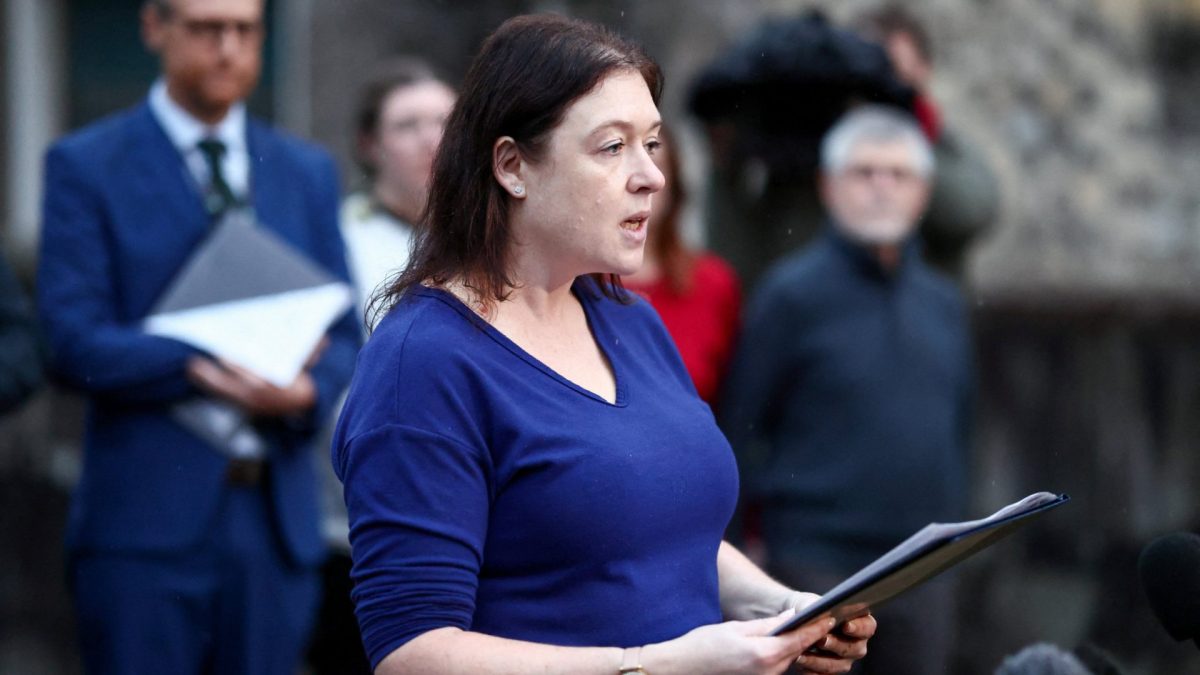
This article contains distressing details.For nearly 15 years, Joanne Young’s husband Philip spiked her vodka nightcaps with sedatives. He created aliases like “londonmonkey” on swinging websites and sex apps to solicit strangers who he’d guide, creeping past the bedrooms where his three children lay sleeping, up to the loft conversion, and film them raping Joanne as he masturbated. He insisted that none of them – we don’t know how many, he will not deign to tell her – wear condoms. The risk that she could become pregnant from a man she might walk past in the street gave him a thrill. Nobody could hear the details of Joanne’s horror and question with whom shame should lie. Nobody could watch her statement last week, outside Winchester Crown Court, after her husband and four more men were convicted, and fail to be astonished by her composure. “Brave” is a tricky word when it comes to the victims of sexual abuse – who have no choice but to bear their trauma in whatever way allows them to survive, which for some means staying anonymous and for others sadly means staying silent altogether. But is there any other word for Joanne, who faced down her abusers in court, and who waived her right to anonymity to give courage to others in future and let herself be living proof that women “will be believed”? Gisèle Pelicot’s ordeal in 2024 left the world the resounding message: “Shame must change sides.” Unfortunately, it is only more trials, and only more women prepared to have their private violations made public, that can put that change to the test. Shame is not as simple as right and wrong. It is a condition, shaped by the standards and opinions and accepted social mores of the groups around us. (Probably, it is one of the conditions that most informs human behaviour – so powerful is our fear of judgement or exclusion). Shame comes from the unthinkable. Dominique Pelicot’s crimes, Philip Young’s crimes, the crimes of the men who jumped at the opportunity to rape an unconscious woman upon seeing the advert: “F**k my tied and blindfolded wife”, and argued that they believed they had her consent, are all unthinkable. They are depraved, shocking; abuses of trust that are so execrable they seem beyond comprehension. It is easier for us to say that shame is changing sides when there can be no ambiguity about the evil committed. What about when people think there is some ambiguity around consent, though? What about when the circumstances of a rape are not so premeditated and grotesquely monstrous they would not even be deemed appropriate for a horror movie? What about when a boyfriend carries on after his girlfriend says “no”, when a man takes the condom off without consent; when a woman finds herself in a position that is vulnerable and unsafe and she can’t get out of it; when a woman changes her mind; when a woman has previously consented to sex of different kinds or actively pursued it; when time has passed before reporting? The crime committed against her is no less wrong. But it’s not “unthinkable”. It’s “complicated”. There is still an ambient suggestion, reinforced by figures such as Russell Brand’s barrister Ian Winter, that she could have avoided it, or that she is somehow less of a victim. There is still a temptation to find excuses for men when it’s “ambiguous”, or to assume that he didn’t realise his transgression. And so the shame does not quite change sides. On the day of Brand’s sentencing this month, women around the world celebrated as Mr Justice Bennathan read his closing remarks. “Whatever women wear, wherever they go, indeed whatever they drink, they retain the right to say no.” I was moved to tears by such public recognition of these misconceptions, in a case during which the defence had reinforced rape myths and attempted to use the women’s backgrounds, decisions and sexual histories as proof of deceit and dishonour. What was not broadcast on the news, though, were the victim impact statements heard in court earlier that morning. In these there was far less to celebrate, as the women repeated the trauma of the assaults and the investigation and the trial, the distress and disruption all had caused to their lives, and described the fear they would live with for the rest of their lives, that their names would be revealed. Most strikingly, they repeated the shame they have carried for decades. The rest of us might assume that Brand’s sentencing would provide vindication for his victims. But even when you know you’re not to blame, shame can be a hard thing to shift. The failure to properly apportion shame has long consequences, and we still rely too much on the bravery of women like Joanne Young to show us where it really belongs. It shouldn’t take a nightmare as extreme and unthinkable as hers for a woman to know she will receive solidarity. Until that changes, shame has changed sides for only some women.
What two rape trials reveal about men and shame
Full Article
Original Source
Read the full article at Inews →KhanList aggregates and links to publicly available news content. We do not host full articles from third-party sources. Always verify important information with original sources.