
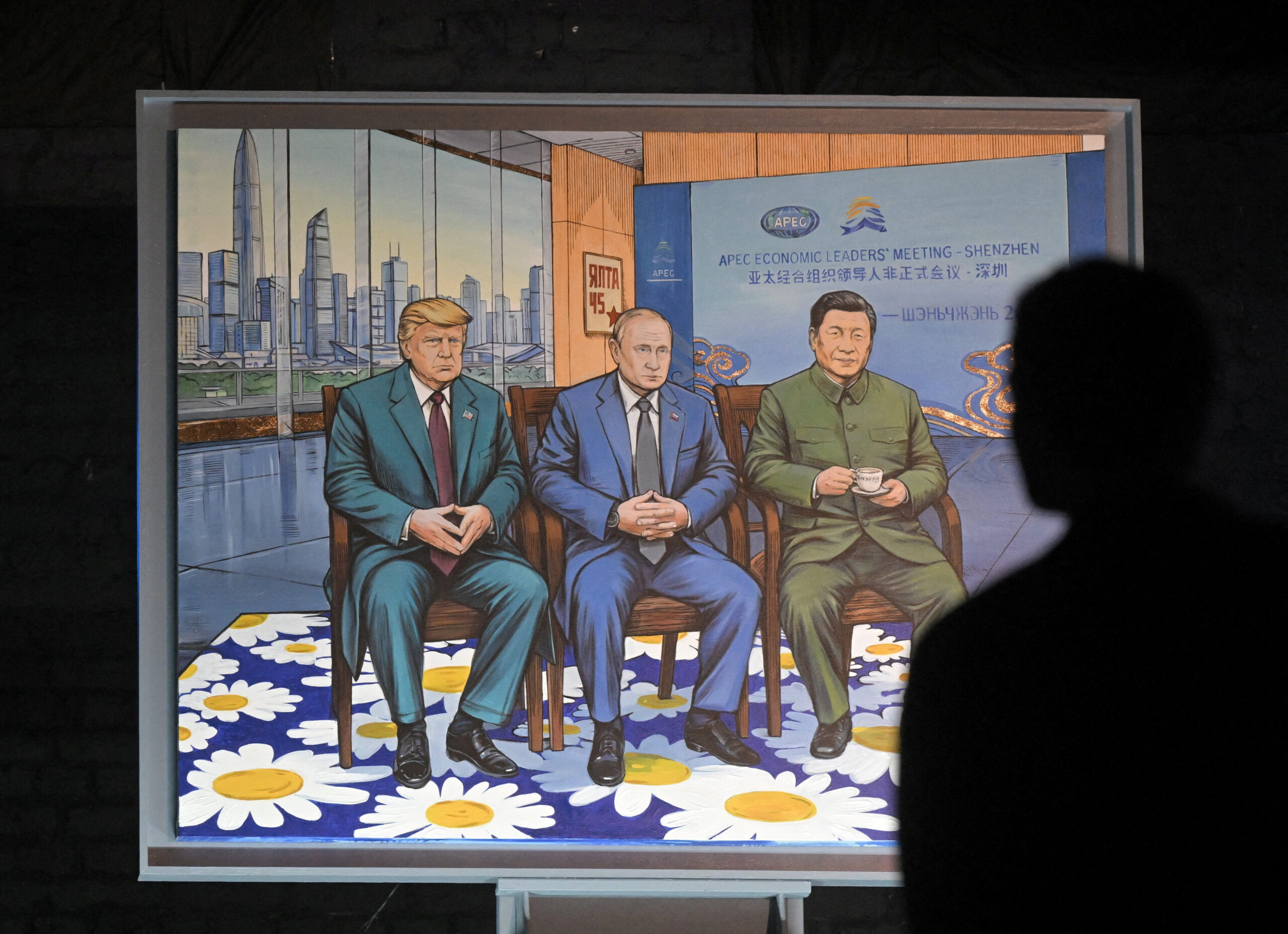
Is it worth a tri? On Thursday, US President Donald Trump, Russian President Vladimir Putin, and Chinese President Xi Jinping will meet in Shenzhen. Host China has said the trilateral will be of “groundbreaking significance,” but the range of reported possible topics for discussion, from denuclearization and trade to Russia’s war in Ukraine, suggest a fluid agenda. Below, Atlantic Council experts break down what each of the participants wants out of the meeting and what US allies and partners on the outside should be looking for. 1. What is Putin hoping to get out of this meeting? Putin has every reason to smile heading to the trilateral meeting. Right now, Putin and numerous Russian pundits believe that he has turned the Trump administration into a de facto enabler of Moscow’s war effort. The proof includes the signing of the deal with Russia to export more diesel fuel, the waiver of the sanctions in the Lindsey Graham bill, the cutting off of Starlink and Starshield satellite capabilities from Kyiv, and agreement to Putin’s proposed trilateral with Xi. Putin’s aim in proposing the trilateral is to create a Yalta-like environment where great powers determine the fate of “lesser” nations. In this case, the nation in question is Ukraine, and Putin would like Xi’s support to encourage Trump to continue putting pressure on Ukraine. When Trump first spoke about Putin’s proposed trilateral, he deftly said that he wanted to discuss nuclear arms control with the Russian and Chinese presidents. But as he departed for Asia on Monday, he told reporters that he would discuss nuclear arms, Iran, and his “favorite subject,” Ukraine. While Xi will be nuanced in supporting Putin on Ukraine, he will likely be helpful. And Xi likely has no intention of discussing nuclear arms control. The Wall Street Journal editorial board, which often supports Trump, urged him, when the trilateral was first raised publicly, to avoid it. In a November 15 editorial, it came to the glum “conclusion that Mr. Trump’s real goal is to appease Mr. Putin.” No wonder Putin is smiling. —John E. Herbst is senior director of the Atlantic Council’s Eurasia Center. He previously served as US ambassador to Ukraine. 2. What is Xi hoping to get out of this meeting? Xi is hoping to get two things out of the trilateral summit this week: demonstrating his convening power and avoiding surprises. From Beijing’s perspective, the fact that Trump was standing on the tarmac at Joint Base Andrews to personally greet Xi upon his arrival was—hands down—China’s biggest win at the September summit in Washington. Trump’s decision to do so broke protocol. To Beijing, it signaled that Washington now views China as a peer power, one deserving the highest diplomatic honor and respect. No US president has ever greeted his Chinese counterpart in that manner. Trump has only hosted one other state dinner during this term—for King Charles—and he was not standing on the tarmac when the British monarch landed at Joint Base Andrews. The trilateral summit offers a similar opportunity. By convening the US and Russian presidents on Chinese territory, Xi hopes to signal to the Chinese people that he is operating at the highest levels of global statecraft. That is particularly significant in the run-up to next year’s Party Congress, where Chinese Communist Party leaders will select the next slate of incoming leaders and likely grant Xi an unprecedented fourth term. Xi is working to bank as much political capital as he can going into 2027, and if the trilateral convening goes well, that will add to the tally. Therein lies the risk: making sure the trilateral meeting goes well. Beijing is incredibly anxious about what Trump and Putin may say when they stand on either side of Xi in Shenzhen. Chinese diplomats are maneuvering to script every element of the meeting to avoid surprises and ensure that nothing happens to embarrass Xi. That is a hard thing to do with Trump and Putin, both of whom will be walking in with their own agendas and neither of whom likes to follow a script. China is looking for show, not substance. And in Beijing’s view, the only good show is a tightly controlled one. —Melanie Hart is the senior director of the Atlantic Council’s Global China Hub. She previously served as senior advisor for China in the Office of the Undersecretary for Economic Growth, Energy, and the Environment in the US Department of State. 3. What is Trump hoping to get out of this meeting? Since this trilateral summit has been scheduled on short notice, the optics and precedent will be more important than any concrete deliverables. The US president will certainly raise Iran. Even without agreement, the optic of Xi and Putin discussing Iran with Trump will likely cause unease in Tehran and suspicion of its friends in Moscow and Beijing. This is especially because Xi has similar interests to the US, including opening the Strait of Hormuz, which would lower energy prices, and preventing Iran from possessing a nuclear weapon. China would be amenable to these discussions because it would like to be the dispenser of security in the Middle East; that is, Beijing would like for states seeking security to look east. Trump may also want to raise trilateral arms control discussions on strategic weapons. China has always resisted joining any kind of expanded New START arrangement, and yet the precedent of discussing these issues in a trilateral format might ease the way for continued discussions in the future and perhaps Russian agreement with the United States on including China. Trump may also want to raise Ukraine, though the benefit will be less immediate. Here China’s interests more closely mirror Russia’s than those of the United States. Though China would like energy prices to go down, it also would support a Russian tactical victory, something that does not raise Russia to the ranks of the superpowers but allows Moscow to retain its prestige and ability to determine security in Eastern and Central Europe. However, it is still useful to create a precedent of including China in Ukraine talks in case it is helpful for the talks to expand further in the future. For example, if Washington needs Beijing’s help to get Moscow to do something on the negotiations—moderate its position on Donbas, moderate its demands of European security, or just general pressure for a settlement—then China will likely ask for something in return. Because settling the war is in Europe’s interest as well as the United States’ interest, the request should thus be made in a group context, with Europeans there as well, so they’ll be more likely to agree to share the price that China asks for in return. —Andrew L. Peek is the director of the Adrienne Arsht National Security Resilience Initiative and the GeoStrategy Initiative of the Scowcroft Center for Strategy and Security. He previously served as the senior director for European and Russian affairs at the National Security Council. 4. What nuclear issues are on the table? According to the White House, when Trump, Putin, and Xi meet in Shenzhen on Thursday, one of the many items on the agenda will be “the reduction of nuclear weapons in the world.” Denuclearization, in his words, is a priority for Trump, although the definition—removing nuclear weapons from a region—is probably not the president’s goal. Instead, he likely hopes to see a trilateral arms-control deal similar to the one he sought in his first term, when China was invited but declined to join the New START agreement, which has since expired. As recently as last month, a spokesperson for China’s Ministry of Foreign Affairs stated: “it is neither fair, reasonable nor realistic to ask China to join the so-called trilateral nuclear disarmament negotiations at this stage.” Beijing frequently cites the disparity between its nuclear stockpile and those of Russia and the United States. While this gap is real, the framing is misleading: China is currently in the midst of the most rapid nuclear expansion in its history and is projected to field more than a thousand warheads by 2030. More broadly, Beijing has long been skeptical of arms control agreements—it was never a party to the Limited Test Ban Treaty of 1963, which Beijing framed as a US-Soviet effort to prevent China from acquiring nuclear weapons—and is unlikely to discuss limits now. Putin, for his part, has little incentive to push Xi to the table, and since last year, Russia has maintained that any multilateral nuclear framework must also include the nuclear arsenals of the United Kingdom and France. Moscow would likely link any participation to the United States’ continued concessions on Ukraine. Absent a binding agreement, the meeting might produce more modest outcomes. Washington and Beijing might, for example, agree on a missile launch notification agreement, and all three governments could jointly reaffirm commitments not to conduct future explosive nuclear testing. Unfortunately, even these steps seem unlikely, and Trump is unlikely to leave Shenzhen with a concrete agreement. —Alyxandra Marine is an associate director and resident fellow in the Forward Defense practice at the Atlantic Council’s Scowcroft Center for Strategy and Security. 5. How should Ukrainians view this meeting? For Ukrainians, this meeting is a troubling reminder that the old system of great-power politics, in which powerful nations decide the fate of smaller ones, is far from dead. Ukrainians know the consequences of such arrangements from their own history. The decisions made at Yalta in 1945 shaped their fate for generations, without their consent. Today, the concern is that Ukraine could once again become a bargaining chip in negotiations over a new global balance of power. Trump’s intention to discuss Ukraine with Putin and Xi only reinforces that fear. Putin seeks recognition for Russia as a great power and acceptance of its sphere of influence. Trump is focused on striking deals between major powers no matter the price. However, prolonged war serves China’s strategic interests by weakening Russia, exhausting Europe, and diverting US attention from the Indo-Pacific. An increasingly dependent Russia and a divided West strengthen Beijing’s global position. Beijing has avoided openly endorsing Russia’s territorial aggression while providing Moscow with critical economic and political support. However, Ukrainians are not simply watching history repeat itself. They have spent years resisting precisely this logic of great-power domination, paying an enormous human price to defend their right to determine their own future. Ukraine’s resistance has demonstrated that even the greatest powers cannot simply dictate the future of a nation determined to defend itself. —Myroslava Gongadze is a nonresident senior fellow at the Atlantic Council’s Eurasia Center and a former Eastern Europe Bureau chief for Voice of America. 6. How should European allies view this meeting? European governments (and publics in countries most exposed to Russian aggression) will be watching to see whether this Big Three Summit attempts to work “deals” over their heads, especially about Ukraine. We can expect references to a twenty-first century “Yalta,” which has come to mean great powers disposing of other nations with scant regard for the consequences. They will watch with skepticism should Putin be treated, as is likely, as an equal by the US and Chinese leaders, even as Russia intensifies its shadow warfare against Europe and threats against eastern flank countries, most recently Estonia. They may nevertheless give a careful welcome to any accomplishments (e.g., arms control) given that there is no serious precedent for a trilateral nuclear arms control regime, and they may approach a summit void of any major announcements with a sense of relief. US presidents have often sought to work with leaders of great powers. In the early 1970s, Richard Nixon did it with skill. Trump takes it, as with many things, to an extreme. Trump seems attracted to various dictators and especially impressed with the power of Xi and Putin. He seems to hold that great powers stand apart, that power is the measure that counts. Stephen Miller, Trump’s new chief of staff, puts it plainly: the world since the beginning of time has been “governed by strength, governed by force, governed by power.” Or as US Secretary of State Marco Rubio put it in a recent speech, “stop quoting laws to men with swords.” Europeans with an understanding of where such thinking led in the twentieth century look at Trump’s version of great power “realism” with dismay and alarm. —Daniel Fried is the Weiser family distinguished fellow at the Atlantic Council and a former US assistant secretary of state for European and Eurasian affairs. 7. How should East Asian allies and partners view this meeting? The first-ever trilateral meeting between the leaders of the United States, China, and Russia will likely create some uncertainty and nervousness for the United States’ Indo-Pacific partners. However, it is unlikely that any dramatic agreements or substance will result from the talks. The Chinese Foreign Ministry has framed this meeting as “safeguarding world peace and promoting strategic stability in major power relations.” Despite the lofty goal for the agenda, there are simply too many competing worldviews and strategic interests that divide the three powers. US allies will certainly be apprehensive about the summit; the classic framework of abandonment or entrapment in alliance politics will accompany any summit where they are not a party to the discussions. Taiwan is concerned over suspended arms sales, Japan over Russia-China alignment, South Korea by North Korea’s nuclear buildup and strengthened ties with Russia, and the Philippines in the number of disputes that lie in the South China Sea. All desire stability in the US-China relationship, but not at the price of deterrence. Perhaps even more important than the summit are the follow-on conversations with Indo-Pacific allies to ensure strategic coherence and reassure them of US commitments to collective defense. —Rick Hoehne is a nonresident senior fellow with the Indo-Pacific Security Initiative of the Atlantic Council’s Scowcroft Center for Strategy and Security and a former Pentagon and Defense Intelligence Agency official.
What Trump, Putin, and Xi want from their meeting in Shenzhen
Full Article
Original Source
Read the full article at Atlanticcouncil →KhanList aggregates and links to publicly available news content. We do not host full articles from third-party sources. Always verify important information with original sources.