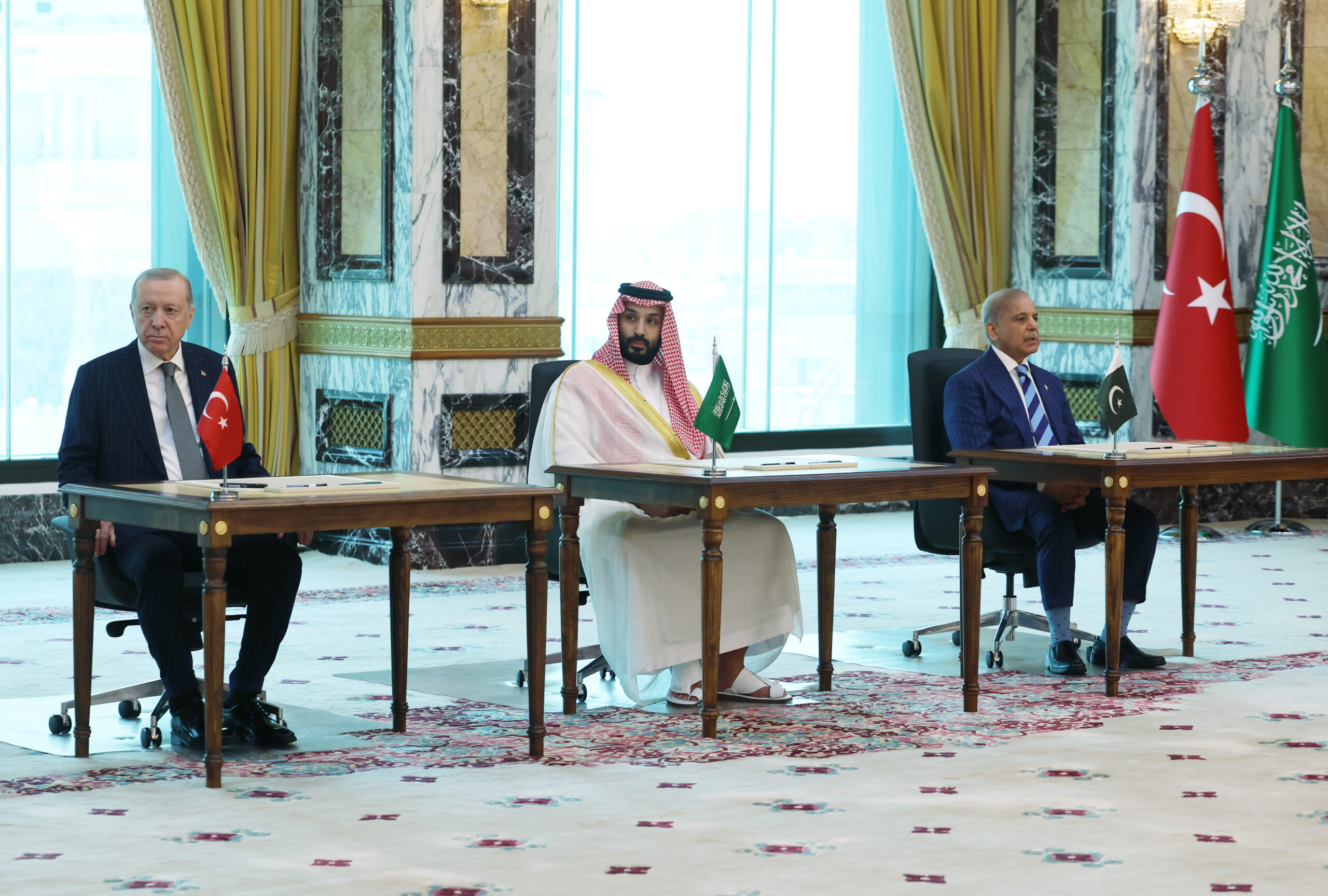
Foreign Affairs The agreement between Saudi Arabia, Turkey, and Pakistan may herald a new Middle East. On August 7, Saudi Crown Prince Mohammed bin Salman, Pakistani Prime Minister Shehbaz Sharif, and Turkish President Recep Tayyip Erdogan met in the holy city of Mecca to sign a new trilateral defense pact. The birth of the Mecca Joint Defence Agreement is a significant geopolitical event. It brings together into a security alliance three of the largest and most influential countries in the Middle East. Turkey has the second-largest army in NATO. Pakistan is the only Muslim nation to possess a nuclear arsenal. And Saudi Arabia is a leading oil producer with near-limitless wealth. Though the full text of the agreement has not yet been published, it appears to be a full-blown military alliance. Pakistan’s foreign ministry says that, under the new agreement, an attack on any of the three countries "shall be regarded as an attack against them all.” What is so far known about the agreement leaves two unanswered questions. First, although the pact seems clear that an attack on one will be considered an attack on all (the same sort of language as NATO’s famous Article 5), what, exactly, will the other parties do in such an event? The agreement, we are told, is “intended to strengthen collective deterrence” and is “purely defensive.” It looks similar to the previous Strategic Mutual Defense Agreement between Saudi Arabia and Pakistan. That agreement, too, contains a clause stating that “that any aggression against either country shall be considered an aggression against both.” And when Iran struck Saudi Arabia with missiles, Pakistan sent its ally 8,000 troops, a squadron of fighter jets, and an air defense system. But it did not fully enter the war. Nor has Islamabad entered its ally’s fracas with the Houthis. What, if anything, would change with this new pact? We know only that the Turkish Foreign Ministry has said that the allies would hold consultations on the nature of the form and degree of support if one of them was attacked. The second question concerns the intersection of this alliance with already existing alliances. Turkey is a member of NATO, and is covered by that alliance’s mutual defense provision. Let’s say Turkey is pulled into a conflict between India and Pakistan as a result of its Mecca commitments, and the Indians launch a strike of some sort against the Turks. Could that trigger Article 5? But although the Mecca Joint Defence Agreement raises important questions, it does provide clarity on one important issue: the degree to which the region’s powerhouses are content to depend upon American protection. As the guarantees offered by Washington look less and less appealing, Middle Eastern countries are diversifying and intensifying their security relationships. The Gulf countries have been heavily hit by a war with Iran that they emphatically warned Washington against. They are angry with the U.S. for first ignoring those warnings and then failing to deliver the promised protection. The sense of abandonment and vulnerability has intensified calls for a new regional security architecture with an umbrella strong enough and wide enough to cover the Muslim world. Several Muslim-majority nations have expressed an interest. Turkish Foreign Minister Hakan Fidan has said that “we need a regional stability pact” whose “main goal is to establish absolute trust among the countries in the region.” Egyptian President Abdel Fattah el-Sisi has called for “an Arab-Islamic mechanism for coordination and cooperation” that ensures that “the geography of any Arab country extends from the Ocean to the Gulf and its umbrella is wide enough for all Islamic and peace-loving countries.” Pakistan has called for the adoption of “effective deterrent and offensive measures” that are “synchronized.” Pakistan’s Defense Minister, Khawaja Asif, says that it is time to “form an Islamic NATO.” Badr Al Busaidi, Oman’s minister of foreign affairs, has recently gone so far as to acknowledge that “Tehran [does] not constitute an existential threat” and has called for “a future regional security architecture” that excludes none of the Gulf coastline states, including the nations of the Gulf Cooperation Council, Iraq, and Iran. The Mecca Joint Defence Agreement has formed the backbone of a regional security architecture. And as the roll call of interested countries suggests, it could grow larger still. Erdogan has already stated that the alliance is open to other countries “that aim to achieve stability in the region.” His foreign minister says it is Turkey’s vision that other countries should be brought “under this umbrella.” Egypt has been a leader in the call for such a security architecture and is the only country to be named so far by the signatories as a likely partner. It’s unclear why Cairo was not a founding member. There have been media reports that Saudi Arabia opposed Egypt’s inclusion in the pact, allegedly because of “a growing frustration with President Abdel Fattah el-Sisi's government and a belief in Riyadh that Egypt no longer offered the strategic or military value it once did.” But Egypt could also have reasons of its own to stay out, at least for now. Khaled Elgindy, senior research fellow at the Quincy Institute, told The American Conservative that there may be two calculations at play in Cairo. The first is that Egypt is the least capable of the four of acting independently. It is more dependent on foreign support from countries like the U.S. and the United Arab Emirates. Subscribe Today Get daily emails in your inbox The second is that el-Sisi is very cautious. Elgindy says that he does not like to do things that run afoul of the U.S. or that do not have Washington fully on board. Egypt also has close ties with some of the allies’ rivals and may not want to aggravate the UAE or India by aligning too formally with Pakistan and Saudi Arabia. Turkey’s foreign minister says he believes that “at the next stage, Egypt will also be among us in the alliance,” once the “technical issues” have been ironed out. There are still many unanswered questions about the new regional alliance. But one thing is clear: though the region is not abandoning the American security umbrella, it has begun the process of diversification by setting up a regional Muslim umbrella that already contains three powerful states. If this shift facilitates a U.S. military disentanglement from the Middle East, then that could well be a case of something good coming from something bad.
What the Mecca Defense Pact Means
Full Article
Original Source
Read the full article at Theamericanconservative →KhanList aggregates and links to publicly available news content. We do not host full articles from third-party sources. Always verify important information with original sources.