
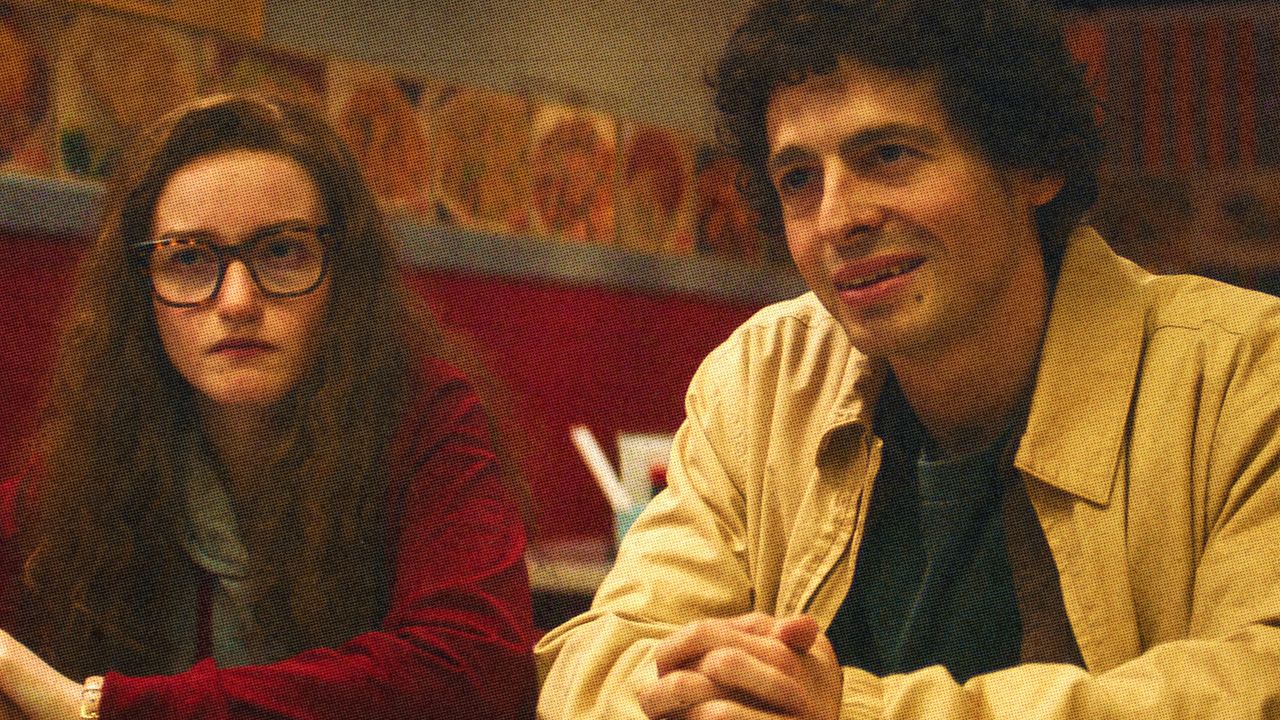
A new Netflix series about the now-imprisoned cryptocurrency king features rich performances by Anthony Boyle and Julia Garner. If you didn’t know better, you’d be rooting for these off-putting lovebirds.Courtesy of NetflixThe math holding up Netflix’s The Altruists is simple. Anthony Boyle plays currently imprisoned one-time cryptocurrency king Sam Bankman-Fried, and Julia Garner plays Caroline Ellison, fellow momentary crypto royal and Bankman-Fried’s one-time romantic partner. Both actors cook so fearlessly that the show’s shortcomings recede into the background. What you’re left with is a tidy sum: two excellent performances that offer rich, vatic examinations of real-life figures. From these visions of Bankman-Fried and Ellison we get a glimpse into a crime and into a psychology.Famously, no bankers were sent to prison in the aftermath of the 2008 financial crisis. No suit from Countrywide Financial walked the yard in Lompoc. But Samuel Bankman-Fried did go to prison after being found guilty of wire fraud and conspiracy. For the Bloomberg set, his trial was covered as intensely as O.J. Simpson’s, and each day of it hit trip wires: polycules, blockchain, non-fiat currency, etc.One of the threads in the journalism about the crimes, and on The Altruists, is that our power couple did not feel good in fancy spaces. But unlike the protagonists of so many other shows and movies from the tech-disruptor-story boom of the past 15 years, neither Boyle’s SBF nor Garner’s Ellison lean into rage.On The Altruists, SBF and his inner circle frequent a Margaritaville in the Bahamas. They seem happy there, or at least at home. To be wildly rich, extremely young, and crushing vegan nachos at Jimmy Buffett’s theme restaurant is a choice made out of avoidance.The show’s first episodes make clear the overlaps between Ellison and Bankman-Fried. They were true math minds surrounded by the glib Wharton crowd, goofs with board games. They were not-conventionally-attractive people in an industry where many people are quite hot, and where the primarily hot at least know which regression tool best fits what task.The Altruists’s versions of SBF and Ellison found love in a hopeless place. Boyle interviews Garner for a position at Jane Street and they realize they have the exact same investment strategy—all in, all the time. If you didn’t know better, you’d be rooting for these two off-putting lovebirds to make a go of it.Boyle’s performance mesmerizes. He seems to have control over his lashes, so completely articulated is his eye acting. His whole posture changes as he takes up different roles in the story: a curious loser, a gifted rhetorician, an anxious boss, an ignored former lover. The show shifts from alienation in New York to crypto adventures in Hong Kong to the office-dorm hybrid of “The Orchid” in the Bahamas. Boyle owns the physical transformations, letting the glee of the Hong Kong era fester into the eyebags and stress-weight accrued (probably one of the more ethical uses of a bodysuit I can recall) in the scheme’s last days.Garner, meanwhile, has entered rarified air as a TV actor. Over the course of her career she has given us a moody, adrift Gen X student (Kimmy on The Americans), a Millennial lady of rage trapped in her dumpy hometown (Ozark), and now two glimpses of the self-satisfied Zillenial scammer (Anna Delvey in Inventing Anna and The Altruists). Garner’s signature move as a performer is to fail to sublimate anger or distress. Her characters have their own idiosyncratic patterns of twitches and attempts at steely gazes. The brittle darkness inside each of them sings. Her TV career belongs next to those of Elisabeth Moss and America Ferrera and Walton Goggins. It is time that this was generally acknowledged.The supporting cast is solid, with one particular highlight. In the middle of The Altruist’s eight-episode run, we get an entire episode focused on Sam Trabucco, a college bestie of SBF, a former Alameda Research co-CEO, and an early cooperator with federal prosecutors once the wheels started falling off.Alex Lawther plays Trabucco and almost walks off with the show. Lawther’s slight frame and self-searching candor give each line of dialogue intimacy. I first saw Lawther on Andor, playing Nemik, idealistic proto-Rebel and truest of true believers, a character based on Lei Feng, the Chinese communist folk hero and soldier, who, like Nemik on Andor, died in a freak accident but left behind a diary of such pure faith that it became a recruitment tool for the revolution. (A recording of Lawther reading that manifesto from his diary—his voice reedy and prophetic—literally haunts Imperial high command at the end of Andor.)In maybe my favorite scene of The Altruists, Trabucco and Ellison get dinner together. They talk and realize their childhood paths intersected and diverged across metro Boston—the same math competitions, the same tests. But their hometowns were quite different. She was from Newton. He was from Natick. If you’re from New England, that’s the only detail you need. (If you aren’t, I recommend Love Story and/or the novels of Dennis Lehane for background.) At that dinner, Lawther shares a deep, specific childhood memory of his father and Garner’s Caroline flinches without breaking eye contact, like she’s watching a recording of a natural disaster.Sadly, the Netflix sins are here in full effect. The lighting is smeary and wildly off in many scenes. The music and sound mix could hardly be blunter. Even Oscar-nominated showrunner Graham Moore and talented directors like James Ponsoldt can’t lift dialogue that not-infrequently feels tailored to second-screen viewers: “They’re both off-the-charts math geniuses!”The braided narrative can turn single episodes into distracting puzzle boxes. The form is designed to function the way a big juicy 10,000-word legacy-media reported feature does: You know the ending, so it takes a memorable reshuffling of moments and incidents to create something new.But watching this gang of true believers and opportunists and criminally naïve teenage dream brains go from geographic zone to zone does carry emotional import. To them, and to The Altruists, the Bay Area has become a dated country club, a mirror image of The Social Network’s version of Harvard from the 2000s, back when the Bay Area promised something fresh. Post-Recession New York is greyscale normie central. Hong Kong and Macau blur together. The show ends in the Bahamas, a place that rich outsiders have always treated as both Eden and the afterlife.I think the era of the tech-bro-scammer-titan show and movie is reaching its end. If its dawn was The Social Network, the unrepeatable, mesmerizing You Can See Everything might be the sunset. Gen X icons Aaron Sorkin and David Fincher once tried to get their heads around millennial narcissism and now millennial genius Nathan Fielder has transformed his time with a real-deal apex-predator narcissist into a Möbius strip of content.The drama of The Altruists depends on the psychology of the people who believe in crypto as a kind of syncretic faith. The show avoids a technical delineation of crypto itself, which makes sense. (I’ve yet to encounter a crypto evangelist who can provide a transparent explanation of the asset class that is superior to this.) ExxonMobil sells you a product and it works. Glock sells you a product and it works. Crypto works in so much as its existence justifies its existence. There are no earnings reports. Value is vibes.NetflixWhenever something is being marketed as the future, it’s usually just the past, accelerated. People made crypto into an alternative financial system because they were “outsiders” who wanted to “disrupt.” Now the crypto system wants to be held close to the bosom of the enduring US financial markets and bulge bracket banks. A bill that would have brought them closer, setting up a regulatory framework, nose-dived in the senate.It sounds almost cowardly, like running home to mom and dad: We made a brave new thing better and cooler and freer than your corrupt old monetary system. A few years later: Let us back in and give us all the benefits of the old system! Get us in your PNC digital wallet, normie!Bankman-Fried and Ellison are both the children of elite academics. To its credit, The Altruists pokes these Freudian pains. Bankman-Fried was raised by Stanford Law professors and chose MIT. Ellison was the child of MIT academics and chose Stanford. There’s self-belief in those exact choices. The children of faculty get a significant leg up in gaining admission at their parents’ institution. SBF and Ellison wanted to do something honest on their own, at least once.My parents are retired professors. You learn early on that you cannot possibly replicate your parents’ careers. A child of a lawyer can have their parent’s career 2.0. Same if you have doctors for parents. But truly successful academics—and given the market today, you either are truly successful or you don’t exist—create niches built only for one.Successful academics eschew any number of linear career paths and lucrative fields to burrow into zones of learning where they have to be singular, own every network and endure any marginal post (Oregon State, thou hast thy music, too). To make it to a top institution, you need luck and power and timing to dovetail your own research record and professional charisma. Many people make it to powerful banks and hospitals and law firms. But if you manage to get tenure at Berkeley, you might really be that special.The track record of the children of academics I know is messy: deluded guys floating around Portland or Boston trying to jam their unreadable YA series into the world, an acquaintance who self-sabotaged a promising, morally-clear career as a social worker because they did not get a doctorate and let that arbitrary marker of value smother their self-worth for decades.SBF and Ellison were expected to perform precocity at all times, but the minute that they stumbled, Dr. Mom or Professor Dad stepped in with the better therapists and better lawyers to set everything right. The last two episodes of The Altruists bubble over with dread. Paul Reiser and Robin Weigert play SBF’s parents, and Jennifer Grey plays Caroline Ellison’s mom. Each performance puts its own spin on enmeshment and infantilization. The parents are not the big bads here. But they are the judgmental elitists who analyzed when they should have listened, and who raised these world-class scammers.There was a guy a little like me in high school. Like me, he was the child of academics and teachers. Like me, he was clever and capable, which might have been enough in another high school. But such minor skills were door prizes in our grand, old, dizzyingly competitive boarding school. We both loved De La Soul. We were both cut from the same teams. We were both contrarians who trafficked in equal measures of insight and anserine bullshit. I won’t pretend to have been good friends with the guy—it was the classic situation where young men who play similar roles in their respective circles repel each other like the same sides of different magnets. But I sympathized. It’s painful to know exactly why you are not near the top of an elite ecosystem and then having to go on living in it.I imagined he might have a career adjacent to mine. I imagined that we might see each other in the late 2000s at a Babygrande Records release party or in the bathroom at Santos Party House. It did not play out that way. A few years ago, during the inevitable age-related transition from Facebook to LinkedIn, the guy’s face and name swum across my screen. He’s become a big deal in the crypto space. At one point, he rapped about crypto on crypto podcasts. On a class-wide group chat, as former classmates who had chosen to work in community health settings or on federally-funded research projects shared their pain after losing their jobs in the DOGE cuts, and as they voiced their concerns about what other digits of the American experiment would be severed next, this crypto dude commandeered the chat to brag about taking his company public. No child of an academic has ever missed a chance to make it about them.One of the side effects of the world-gobbling narratives around A.I. (which gets its own Social Network moment in Luca Guadagnino’s imminent Artificial, with Andrew Garfield as Sam Altman) is that crypto already feels cringe—at best, a chrome decoration on the world-shaking machinery of LLMs and Deep Learning. The brave new world of private money that needed no society and no army behind it has become just another widget. The most vulgar people in the world trade meme coins with Turkish billionaire failsons. That Uber driver for whom you had great sympathy waits forever for a crypto ship that will never come into port. (Bankman-Fried, as it happens, was an early investor in Anthropic; it was reported last week that his shares, liquidated during FTX's bankruptcy, would be worth $35 to $37 billion in the wake of the AI lab's splashy IPO.)If 2026 is the close of the tech-movie and tech-show era, then how do we square The Altruists? It has arrived at the end of something. It’s not perfect, maybe not even excellent, but it is effective and memorable, and provides a showcase for superb young actors. I wonder how many of these shows about tech founders, disruptors, optimists, hustlers and misanthropes will last. The paranoia of 70s American film evaporated in the desert of 80s escapism and the wry smirk of Ronnie Reagan. The thorny, violent prestige TV era begat the soft-clothes forever-childhood of Stranger Things and of Ted Lasso. Legacy cannot be legislated in advance. I hope viewers check out The Altruists, and appreciate its gumption in allowing love—the least efficient of emotions—to animate the story.But maybe I’m wrong. Maybe I’ve been hustled by Boyle and Garner’s wonderful acting. Maybe my almost-instinct about the past 15 years of watching damaged young ladder-climbers and their digital dreams on screen is almost true: what will survive of us is coins.Sign up for Manual to receive useful advice on style, health, and more, six days a week.
What The Altruists Gets Right About Tech Scammers Like Sam Bankman-Fried
Full Article
Original Source
Read the full article at Gq →KhanList aggregates and links to publicly available news content. We do not host full articles from third-party sources. Always verify important information with original sources.