
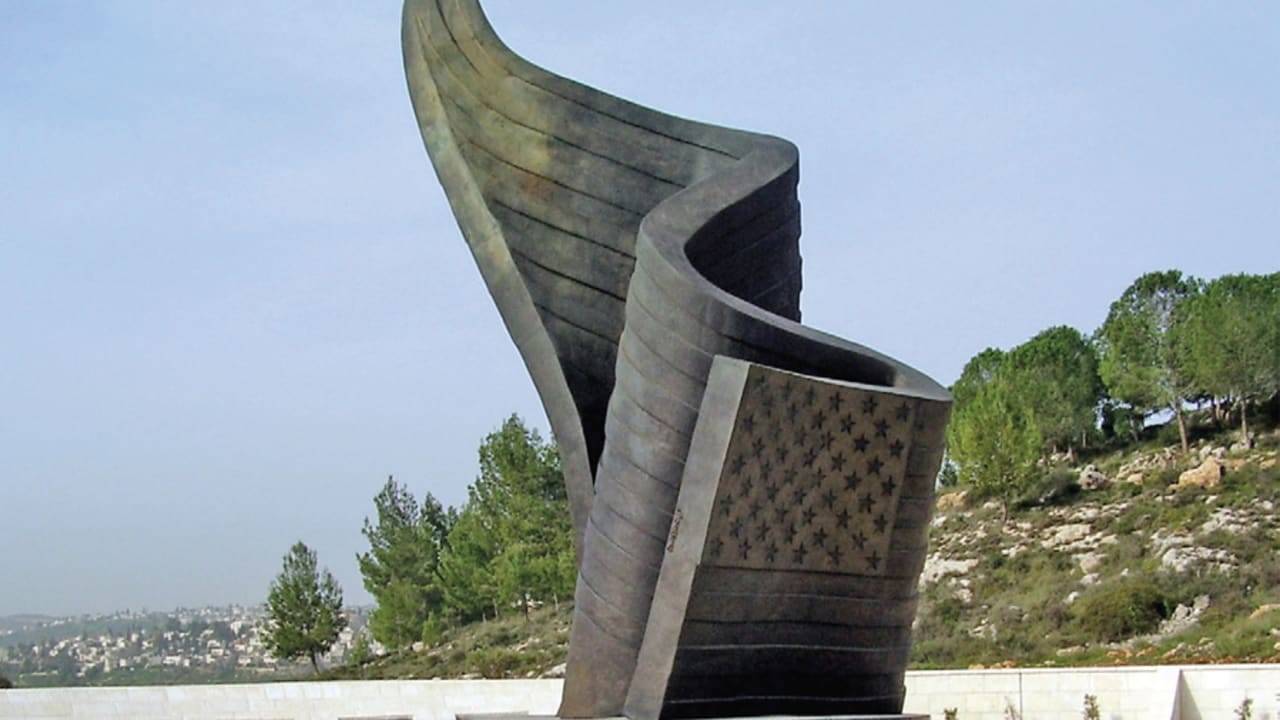
SEPTEMBER 19, 2026 04:01On the way to the Western Wall for our community’s annual slihot tour, we stopped at Jerusalem’s 9/11 Living Memorial Plaza.It is an extraordinary site. At its center rises a monumental American flag that gradually transforms into a flame. A piece of metal recovered from the ruins of the Twin Towers is embedded in its base. Around the plaza are inscribed the names of the nearly 3,000 people murdered on September 11, 2001.One inscription particularly caught my attention: “This metal piece, like the entire monument, is a manifestation of the special relationship between New York and Jerusalem.”Those words were presumably intended to be timeless. Yet standing before them today, they read almost like a message from another age.A verse from Exodus came irresistibly to mind: “A new king arose over Egypt who did not know Joseph.”New York City Mayor Zohran Mamdani pictured during his first day in office, January 1, 2026. (credit: Dave Sanders/Pool via REUTERS)Our Sages debated whether this was literally a new king or the same ruler who adopted new policies. Either way, the message is unsettlingly familiar.Joseph saved Egypt from famine, yet his contribution was forgotten when it became politically convenient to forget it. History had not changed; the leadership’s willingness to acknowledge that history had changed. Gratitude gave way to amnesia, and friendship to estrangement.Largest Diaspora Jewish communityFor decades, New York and Jerusalem seemed joined by far more than direct flights, diplomatic courtesies, or municipal declarations. New York was home to the largest Jewish community outside Israel. Its Jews helped shape the city’s culture, commerce, philanthropy, and public life. Support for Israel was woven into New York’s civic identity, shared by successive mayors across political and religious divides.Following October 7, however, much of that certainty began to dissolve.Israelis watched demonstrations in New York at which the massacre was rationalized, celebrated, or rapidly pushed aside. Jewish students faced hostility on campuses. Zionism became a term of abuse in supposedly enlightened circles. Too often, sympathy for the victims of October 7 appeared to have an extraordinarily short shelf life.The election of Zohran Mamdani as mayor marked a dramatic political culmination of that change. Mamdani has accused Israel of genocide, declined to affirm its right to exist specifically as a Jewish state, stayed away from the city’s Israel parade, and declared that Israel’s prime minister was unwelcome in New York.Whatever one thinks of Israel’s government or its policies, this represents a profound departure. The mayor of the city with the largest Jewish population outside Israel now speaks about the Jewish state in terms once confined to its most committed adversaries.A new king has arisen in New York: not one unaware of the profound historical relationship between New York, its Jewish community, and Jerusalem, but one whose politics appear unwilling to accord that relationship its former significance.The inscription at the memorial therefore carries a new poignancy. The metal sent by the City of New York remains fixed in Jerusalem stone, but the political relationship it was meant to symbolize no longer appears nearly as solid.The monument’s flame acquires another meaning. Something precious has, at least politically, gone up in smoke.But our journey did not end at the memorial.From there, we continued to the Old City for slihot. Last year, after making the same pilgrimage, I wrote about the extraordinary sight that greeted us: Jerusalem’s streets filled with young Jews singing, dancing, praying, and simply enjoying one another’s company.I came away convinced that, despite the darkness surrounding us, the future of our people was safe in their hands.This year, the scene was even more powerful.Hurva Square and the streets leading towards the Western Wall were heaving with people. There were young men and women, families, yeshiva students, visitors from abroad, and groups of soldiers. Some were religiously observant; others evidently were not. They wore black hats, knitted kippot, jeans, flowing skirts, and IDF uniforms. Some hurried towards the prayers, while others stood talking, laughing, singing, or eating.Nobody was checking credentials. Nobody was asking precisely how each person defined his or her Judaism. They came because it was slihot, because this was Jerusalem, and because, in ways that are sometimes difficult to articulate, they knew that they belonged.At the Western Wall Plaza, their voices rose together.These were not the bowed heads of a defeated people. They were proud, confident, and unafraid. Many of the soldiers among them had spent the past three years defending the country in conditions that young people should never have to experience. They have buried friends, left studies and careers, and carried responsibilities far beyond their years.Yet there they stood, singing with an energy that seemed capable of lifting the stones themselves.The contrast with the memorial could hardly have been greater.Political alliances are precious, and we must work hard to preserve them. We should not casually dismiss the pain of seeing New York’s leadership turn so sharply against Israel. Nor should we confuse a mayor with an entire city.New York still contains a vast, diverse, and deeply committed Jewish community, together with many non-Jewish friends of Israel. They deserve our support and solidarity, particularly when they feel increasingly isolated.Nevertheless, history teaches us not to entrust Jewish survival to the goodwill of others, however sincere that goodwill may appear at a particular moment. Governments change. Public opinion shifts. Yesterday’s unbreakable consensus becomes today’s contested proposition. New rulers arise who do not know Joseph, or who choose not to remember him.Jerusalem has witnessed empires far greater than any modern political movement. They made grand declarations, minted coins, and erected monuments. One after another, they disappeared. The Jewish people remained – sometimes scattered and persecuted, but still praying towards Jerusalem and still teaching their children that they would return.Now those children and grandchildren crowd Jerusalem’s streets.That is why the young people at the Western Wall mattered so much. They were not merely attending a religious service. Their presence was an answer to those who believe that Jews can be intimidated into abandoning their identity, shamed into surrendering their national home, or exhausted into relinquishing their future.The relationship between New York and Jerusalem may have become strained. Political fashions may grow uglier. The flame sculpted from the American flag may now evoke not only remembrance but the burning away of old assumptions.Yet a flame also gives light.And the light I saw that night came from thousands of young Jewish faces in Jerusalem: singing, praying, dancing, and standing together. They were proud Jews in their own land – neither bowed nor broken, neither apologetic nor afraid.Hopefully, one day, the friendship between New York and Jerusalem will be repaired. But whatever politicians decide, our future will not be determined in City Hall.It is being written in the streets of Jerusalem.Gmar Hatima Tova.The writer is a rabbi and physician. He writes and teaches on Jewish ethics, leadership, and resilience. His work appears on rabbidrjonathanlieberman.substack.com and youtube.com. @rabbidrjonathanliebermanFollow us on Google
What survives the smoke: From New York’s memorial to Jerusalem’s living future - opinion
Full Article
Original Source
Read the full article at Jpost →KhanList aggregates and links to publicly available news content. We do not host full articles from third-party sources. Always verify important information with original sources.