
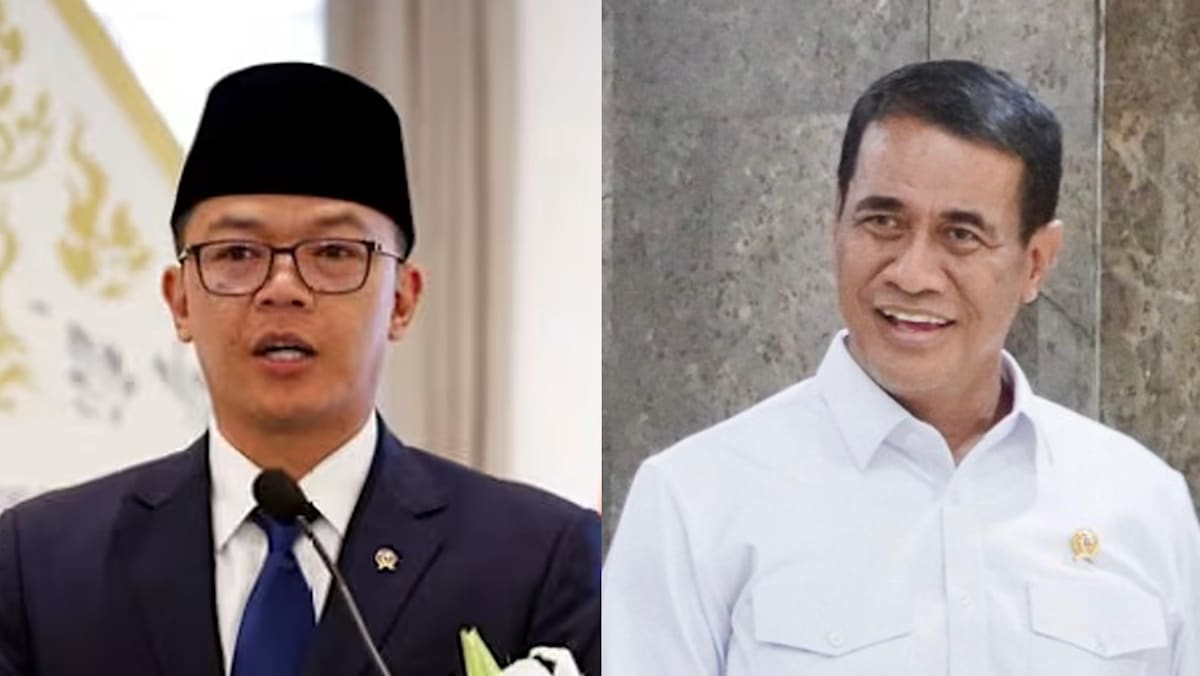
JAKARTA: Indonesian President Prabowo Subianto has narrowed the race to become his next vice-president to two men, setting up a contest between a political loyalist and a seasoned minister and businessman. Prabowo's nomination of Agriculture Minister Andi Amran Sulaiman and Coordinating Minister for Human Development and Culture Sugiono, who goes by one name, to replace former vice-president Gibran Rakabuming Raka puts forward two very different political personalities. Sugiono is a retired lieutenant who has spent years building his career alongside Prabowo since the latter founded his Gerindra party, while Amran is a wealthy entrepreneur-turned-minister with influential business connections.Sugiono is a senior member of Gerindra, holding the position of secretary-general. Amran is not known to be a member of any political party, although he has been linked with United Development Party (PPP), one of Indonesia’s long-standing Islamic political parties. Indonesian President Prabowo Subianto (left) submits two vice-presidential nominees to People’s Consultative Assembly (MPR) Speaker Ahmad Muzani at the Parliament Complex in Jakarta, Indonesia, on Nov 23, 2026. (Photo: Press, Media and Information Bureau of the Presidential Secretariat/Kris) “Sugiono … is unlikely to become a political competitor to Prabowo. After all, he has been Prabowo's loyalist from the beginning, and his entire political career was built by Prabowo,” said Wawan Mas'udi, a political lecturer at Gadjah Mada University.“Amran, meanwhile, has a more technocratic background,” he added.After submitting the names to the People’s Consultative Assembly (MPR) on Monday (Nov 23), Prabowo himself stressed that his considerations were based “solely on achievement, dedication, loyalty to the state, and my conviction that they will perform to the best of their ability”.Members of the MPR will convene on Dec 11 to choose one of the two as Indonesia’s next vice-president. Analysts say the two candidates offer different advantages and potentially different risks, reflecting Prabowo’s wider considerations of government stability, political control and preparations for the 2029 presidential election.The next vice-president could become Prabowo’s running mate if he seeks re-election in 2029, or potentially emerge as a successor within his political organisation.Wawan said the nominations should be viewed as part of Prabowo's efforts to consolidate both his administration and political power.He said Prabowo needs a deputy who can help deliver his flagship programmes such as the free meal programme to combat malnutrition, while ensuring political stability ahead of a possible second-term bid.“In terms of consolidating the administration, the goal is to ensure that the president’s priority programmes - the key initiatives - can be implemented,” said Wawan.“The choice of these two individuals is, in fact, a combination of factors aimed at achieving that.” PRABOWO’S PICKSAmran, 58, is an entrepreneur from Bone, South Sulawesi, who has served as agriculture minister under both Prabowo and his predecessor Joko Widodo, popularly known as Jokowi.He first held the portfolio from 2014 to 2019. He returned to the role in October 2023 and kept it when Prabowo assumed office in October 2024.Amran founded the Tiran Group, which has business interests spanning agriculture, plantations, mining and other sectors.He is also the cousin of prominent South Kalimantan businessman Andi Syamsuddin Arsyad, better known as Haji Isam, whose business spans coal mining, palm oil plantations, biodiesel, logistics, marine transport, aviation and sugar production. Amran's ministerial experience could help him implement Prabowo's food security agenda, particularly the administration's push for rice self-sufficiency and agricultural expansion, said Wasisto Raharjo Jati, a political researcher at Indonesia's National Research and Innovation Agency (BRIN).“Amran is an agriculture minister who, I think, understands the problems at the rural level, particularly those directly related to the implementation of Prabowo's priority programmes on the ground,” he told CNA. His South Sulawesi origins could also strengthen regional representation by bringing an eastern Indonesian figure into the country's leadership, he added. In mid-2025, Amran emerged as a candidate for the PPP chairmanship but he declined the offer, Wawan of the University of Gadjah Mada said. Indonesia's Minister of Agriculture Andi Amran Sulaiman interacts with farmers during agricultural field visits in Maros, Indonesia on Nov 20, 2026. (Photo: Ministry of Agriculture) Meanwhile, Sugiono, 47, represents a markedly different political trajectory and is often labelled as Prabowo’s ideological son, according to media reports. Born in Takengon, Aceh, he attended school there before entering the military-oriented Taruna Nusantara senior high school in Central Java.A former military officer, Sugiono subsequently became one of Prabowo's closest political associates and rose through the ranks of his Gerindra Party, where he now serves as its secretary-general.He previously served as foreign minister before taking up his current coordinating ministerial portfolio in October.While being appointed as a coordinating minister is considered a promotion, Nicky Fahrizal, a political expert at Indonesia's Centre for Strategic and International Studies (CSIS), said Sugiono's achievements during his tenure as foreign minister were largely considered unremarkable. “The foreign policies he crafted frequently confused the public, leaving Indonesia without a firm stance and projecting a largely ambiguous position,” said Nicky.Like most Indonesians, Sugiono is Javanese, but Wawan noted that he has maintained ties to Aceh in western Indonesia, where he was born and raised.“Sugiono has always identified himself as part of the Acehnese community because he was born there and attended school there until junior high school,” said Wawan.“When he was appointed foreign minister, he even made a special stop in Aceh to express his gratitude and visit the province before continuing his first overseas trip,” he added.However, observers said his long-standing relationship with Prabowo most clearly distinguishes him from Amran. Sugiono (right) greets the ministry of foreign affairs staff during a ministerial handover ceremony in Jakarta, Indonesia, on Oct 12, 2026. (Photo: CNA/Ridhwan Siregar) Both candidates would have to relinquish their ministerial portfolios if elected vice-president. Wawan noted that the move would not necessarily give them greater direct policymaking authority.For Amran, leaving the agriculture ministry would mean surrendering considerable control over a sector in which he has built his reputation.The vice-presidency, however, would offer something potentially more valuable, such as national political stature and the chance to build networks across sectors.Wawan said that Amran would retain his considerable financial resources and business connections even after leaving the ministry, because of his private sector experience as a businessman. “Don't forget, Amran is a wealthy man. Even if he were to become vice-president, he wouldn't lose any of his resources. He's very rich, indeed,” said Wawan. Based on the 2025 state official wealth report, Amran’s wealth was about 1.72 trillion rupiah (US$94.4 million), making him one of the richest ministers in Prabowo’s Cabinet. Sugiono’s wealth was calculated at 13.15 billion rupiah. Yet both would gain the prestige and political leverage associated with Indonesia's second-highest office, said Wawan. “The vice-presidency is a symbolic position, but we must not forget that it is a very high-level symbolic position,” he told CNA.“Ultimately, for politicians, what are they looking for? The highest level of a political career is in the executive branch, as president or vice-president.” Indonesian President Prabowo Subianto (left) speaks to the media after handing over the names of candidates for his new vice-president to Speaker of the People's Consultative Assembly Ahmad Muzani at the parliament building in Jakarta, Indonesia, on Nov 23, 2026. (Photo: EPA/Mast Irham) WHY PRABOWO PICKED THEMThe two nominations appear to reflect administrative competence and access to influential networks on one hand, and absolute political loyalty on the other, said experts. Wawan said Sugiono would be particularly useful in consolidating Prabowo's political authority because he is unlikely to challenge the president.His political career has centred on Prabowo, making him a relatively safe choice for a leader seeking to avoid competing centres of power, he added.On the other hand, Amran could become a more independent political figure, said Wawan.“Amran will be much more high-profile, much more active and much more proactive. It is very possible that he could become a very popular vice-president,” he told CNA.“I don't know whether, in the longer term, he could become a competitor. Not for now, but in the future, Amran could become a very strong alternative leader,” he added.Nicky of CSIS offered a similar view. He said Amran represents a technocratic choice who could help execute government programmes and maintain the networks needed to support them, while Sugiono would offer Prabowo a loyal deputy with little incentive to develop an independent political agenda.According to Nicky, loyalty may ultimately matter more to the president than the candidates' individual achievements.“The key is loyalty. Whether their achievements are good or not comes second or third, in my opinion,” he told CNA.Ray Rangkuti, executive director of the civil society organisation Lingkar Madani, said Prabowo's primary consideration is likely political comfort rather than administrative competence. President Prabowo Subianto (front centre) and Vice-President Gibran Rakabuming Raka (front row fourth from right) pose for a group photo with newly-appointed cabinet ministers after their swearing-in ceremony at Merdeka Palace in Jakarta, Indonesia on Oct 21, 2024. (File photo: AP/Achmad Ibrahim) “I don't think he is considering whether the person will improve (the government’s) performance,” Ray told CNA.Analysts CNA spoke to noted that Amran’s nomination could accommodate influential business interests, including networks associated with influential Indonesian tycoon Haji Isam.“It is possible that Amran was chosen because of business or political interests,” said Wasisto. “This could be a political deal, given his connections to Haji Isam, who has also played a significant role in programmes under both Jokowi and Prabowo.” GOOD POLITICAL MOVE?Neither candidate leads a major coalition party with an independent electoral base capable of challenging the president, said analysts.Selecting either man could also avoid tensions among coalition partners such as Golkar and the National Mandate Party (PAN) and the National Awakening Party (PKB), whose leaders might otherwise compete for the vice-presidency, said Nicky from CSIS.“If PAN were to nominate someone, would that be acceptable to Golkar? Would it be acceptable to PKB? That would become a fairly serious debate,” Nicky told CNA.A Prabowo-Sugiono partnership could concentrate more power within Gerindra, while an Amran vice-presidency could raise questions about the relationship between political authority and business interests and offer greater geographical representation, he added.“A Prabowo-Sugiono pairing would test whether Gerindra, with two of its own figures on the ticket, has sufficient electoral strength in 2029. A Prabowo-Amran pairing, meanwhile, would test the idea that a president's running mate should come from outside Java,” Nicky told CNA. “We have seen this with the pairings of Susilo Bambang Yudhoyono and Jusuf Kalla, and Jokowi and Jusuf Kalla. Kalla's political base was in South Sulawesi, representing eastern Indonesia,” he added.Jusuf Kalla served as vice-president from 2004 to 2009 under former President Susilo Bambang Yudhoyono, and from 2014 to 2019 under Jokowi. Singapore Foreign Minister Vivian Balakrishnan (second from left) and Indonesia Foreign Minister Sugiono (third from left) at Gedung Pancasila in Jakarta on May 12, 2026. (File Photo: CNA/Ridhwan Siregar) Moreover, Wawan considered the nominations broadly consistent with Prabowo's need to consolidate his administration.He argued that the president's top priority should be ensuring flagship programmes deliver tangible results before the next election in 2029 such as Prabowo’s free meal programme for children and pregnant women to fight malnutrition and the Red-White village cooperative, which aims to improve the people's economy in rural areas while also creating jobs.“The most important thing for Prabowo over the next two or three years is to ensure that all his flagship programmes are delivered,” Wawan told CNA.“If they are implemented successfully, it will strengthen the government's legitimacy in the eyes of the public ahead of the election,” he said. ASSESSING THEIR CHANCESAnalysts noted Sugiono’s well-known close relationship with Prabowo but they cautioned against treating the contest as a foregone conclusion.Nicky said that Sugiono’s loyalty has been demonstrated over many years and his position as Gerindra secretary-general could also make him attractive if Prabowo is considering the party's future beyond his own presidency.“In my opinion, it would be Sugiono because of his loyalty. Sugiono has been following Prabowo for a very long time, whereas Amran was a minister inherited from Jokowi's administration,” Nicky said. Ray from Lingkar Madani declined to identify a clear favourite, suggesting that the contest remained relatively evenly balanced.“I would say the two are still quite evenly matched. From now until the election, there will be continuous lobbying among political parties and individual members of the MPR,” said Ray. Indonesia's Minister of Agriculture, Andi Amran Sulaiman, who has been named as one of the country's vice-presidential candidates, in Maros, Indonesia, on Nov 21, 2026. (Photo: Ministry of Agriculture) Wawan noted that the MPR, rather than Prabowo, will make the final decision. The assembly comprises 580 members of the House of Representatives (DPR) and 152 members of the Regional Representative Council (DPD).While party discipline could influence how DPR members vote, Wawan said DPD members are more politically fluid because they do not operate under the same party structures.Their votes could therefore introduce an element of unpredictability.“People may generally see Sugiono as the favourite because he is Prabowo's ‘ideological son’. But we must remember that this is an election, not an endorsement,” Wawan told CNA.Therefore, he anticipated informal campaigning, political negotiations, and social media efforts to shape perceptions of the candidates before the Dec 11 vote.Looking further ahead, both candidates could potentially become Prabowo's running mate in 2029.But Wawan said that Indonesia's political landscape could change substantially before the next presidential election.“The president would only put forward two names if he was convinced that there would be no problem regardless of who was elected. That is for sure,” said Wawan.
What Prabowo’s two vice-presidential picks bring to the table
Full Article
Original Source
Read the full article at Channelnewsasia →KhanList aggregates and links to publicly available news content. We do not host full articles from third-party sources. Always verify important information with original sources.