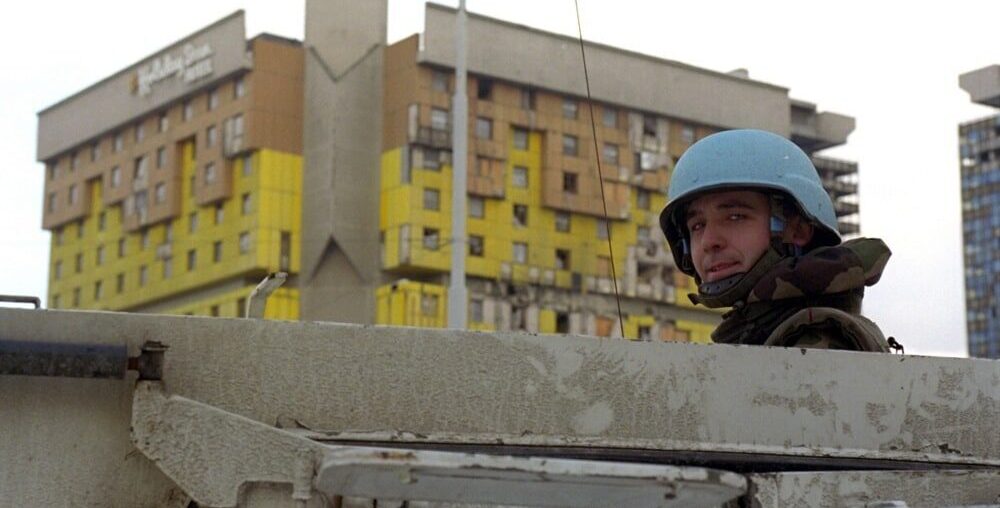
The former Holiday Inn hotel in Bosnia's capital, Sarajevo, nowadays only known as Holiday, is remembered abroad mostly for who it sheltered – the foreign journalists who used its bright yellow tower as a base during the 1992-95 siege, filing dispatches from a hotel that sat in the crosshairs of the notorious Sniper Alley. A new documentary turns the camera the other way, toward the Bosnian staff who kept the hotel running through the war, and toward their sons who are now close to the age their fathers were when the shelling started. The film, Inn a State of Siege, which had its premiere at the International Film Festival Rotterdam, will now get its first Bosnian screening at the Sarajevo Film Festival on August 18. Its director, Qali Nur, is a Dutch-Somali journalist and filmmaker based just outside Amsterdam. Its producer, Dzenita Camo, was born in Sarajevo but left the city as a small child in the early days of the siege, eventually settling in Rotterdam. What began as a curious visit to a hotel lobby in 2019 grew, over six years, into a film built almost entirely on conversations that had never happened before, between fathers who worked at the Holiday Inn and survived the war and sons who had never found a way to ask about what they went through. Nur’s connection to the story started with proximity, not planning. She was residing in Sarajevo’s Marijin Dvor neighbourhood in 2019, working on an entirely different documentary about the city’s Jewish community, and would pass the Holiday Inn on foot most days. She already knew its reputation from journalism school, the correspondents, the sniper fire, the stories that had circulated for decades – and one day she simply went inside. There was no funding, no plan, only curiosity. For a long stretch, that was all there was room for. “I kept that idea in my mind and I thought: Okay, I’ll come back to it,” Nur told BIRN. She did so, repeatedly, over the years, having conversations with former staff whenever she was back in the city, “and it just never left”. Camo’s connection was deeper. She was in Sarajevo at the start of the siege, a sick child sent abroad by parents who thought they’d be gone in a few weeks. She ended up in Rotterdam with an uncle, and never really went back. She spent 17 years building a career as an independent producer, always assuming the right Sarajevo story would eventually find her. It arrived by email one April morning in 2023, the day after she’d wrapped a theatre piece with the Bosnian community in Rotterdam. She met Nur for coffee and recognised something immediately. “I saw how connected she was, how serious. She really did it from the heart,” Camo told BIRN. There was also a more literal connection: Camo had grown up a couple of streets from the hotel; her school was just behind it: “Holiday [Inn] was a place I loved to play, to walk around, because of the colours. It was like a big Lego thing for me.” A film meant to be short quickly outgrew its length; the funding came fast, but the shape of the project took much longer to settle. One conversation changed the film The structure that gives the documentary its force – three fathers who worked at the hotel during the war, paired on camera with three sons roughly the age their fathers had been in 1992 – wasn’t the original idea. It emerged from a single stalled conversation. Nur was interviewing one of the fathers, Mustafa Osmanovic, without funding or a crew, often relying on friends to translate, when her Bosnian gave out. Neither Google Translate nor goodwill was quite enough, so Mustafa called his son, Amar, who worked nearby and spoke fluent English, to come over on his lunch break and help. What Nur noticed once Amar arrived wasn’t just his translation. It was that he didn’t know everything that his father was telling her, and that he started asking his own questions alongside hers. “That got me super interested,” she said. She was already turning over how to visualise these stories, and another father, Faruk Titoric, had separately mentioned his own son, Ervin. The idea solidified once she asked Mustafa and Amar directly whether they had talked about the war at home, and did the same with Faruk and a third father, Ismet Mrsevic and his son, Adnan. Nur is careful not to overstate the silence. “I don’t want to pretend that they never talked about the war together,” she said. “Certain stories have not been told, certain stories have been told.” She recognises the pattern from her own family – her parents fled Somalia – and the instinct to weigh every question against what it might cost the person answering it. “As a child of your parents, you sometimes think, this is a bit sensitive, or you don’t want to bring bad memories to your parents,” she said. “I’m a pretty curious person, so I would ask a lot, but still I would find it sometimes difficult.” For Camo, that recognition was personal in a different way. She didn’t fully register how little her own family talked about the war until she was in her late twenties. “I realised not only do I not ask. I didn’t know what to ask,” she said. She has spent recent years working with Bosnian youngsters in the Netherlands, children of parents who lived through the war, and has watched how directly that unspoken history gets passed down anyway. “I was pretty shocked how much that trauma transferred, because their parents didn’t talk,” she said. At screenings, including at IFFR Rotterdam, young audience members have told her the film sent them home to ask questions of their own parents for the first time. “If it starts a few conversations,” Camo said, “I think we’ve done something good.” ‘I never push people to say something’ Mustafa Osmanovic (L) and his son Amar at one of Sarajevo’s cemeteries. Photo: Inn a State of Siege.Some of the film’s most charged moments happen in the space between a father finishing a memory and a son deciding what to do with it. In one scene, Faruk describes risking his own safety to put out fires caused by shelling. His son’s response, a simple, unrehearsed statement of pride, visibly catches his father off-guard. In another, Ismet, who worked as a hotel driver during the siege, describes coming home one day to find his own father, and his son, Adnan, has to work through memories of his own in real time. Nur said she was conscious of never pushing anyone past what they wanted to say. “I never want to push people to say something that they really don’t want,” she said. There was real tension in some of these exchanges, a son signalling he wanted to keep certain memories to himself, sometimes, she suspected, to protect a father from seeing how much a story had affected him. Handing the questions to family members rather than asking them herself was, she said, “very experimental”. A trained interviewer knows how to sit inside a silence and let it do the work; a son doing it for the first time is more likely to wonder if he’s doing it right, whether he should move on to the next question. But what came out of that unfamiliarity, in Nur’s view, was something more honest than a polished interview would have produced. Feelings that clearly hadn’t been spoken aloud before, including the moment she calls one of her favourites in the whole film: a son telling his father, plainly, that he’s proud of him. “In a lot of families,” she said, “it’s not so much that you tell your parents you’re proud of them. You show it through actions, but maybe not through words.” Asked how the film manages to hold the brutality of the siege, the deaths, the deprivation, alongside its lighter, almost tender moments, like an improvised birthday cake, Nur pushed back gently on the idea that these are two separate things requiring balance. The people she interviewed brought up the lighter memories themselves, unprompted – playing football with the journalists, for one – and she came to see those moments as a form of resistance in their own right, inseparable from the horror around them. A story that didn’t make the final cut, but stayed with her, involves Ismet smoking a cigarette in Baščaršija with a friend while hearing grenades in the distance nearby, and later describing it as the best cigarette of his life. “It wouldn’t be the best cigarette of his life if the other things weren’t going on,” Nur said. “It’s so intertwined that, for me, it only felt natural to bring both in.” Still, she said she stayed conscious of the balance throughout editing, wary of leaning too heavily on the good stories, in case the film ended up suggesting the siege “wasn’t that bad”. The film’s end credits list crowdfunding donors ahead of institutional backers, a reflection, Camo said, of how the project actually got made. The original funding covered a short film. Once it became clear in the edit that the material demanded something longer, that funding no longer covered the film that existed. Additional Dutch funds proved hard to secure mid-production, and some of the feedback the team received was pointed: a strong story, but “European history”, with funders preferring projects more directly tied to the Netherlands, despite what Camo sees as an obvious, substantial connection between the Netherlands and the Bosnian war. Crowdfunding became the last resort, and it worked. Donors included people from Bosnia, members of the Bosnian community in the Netherlands, and friends and colleagues of the filmmakers. That money went largely toward archive footage, by far the production’s biggest cost. “Without their help, it was really crucial,” Camo said. The Balkan Investigative Reporting Network (BIRN) supported the archive research for the film. ‘We don’t know this history’ Ervin Titoric in a scene reconstructing his father’s wartime story. Photo: Inn a State of Siege.The Rotterdam premiere carried particular weight for Camo, not least because of what she says Dutch audiences generally don’t know. Srebrenica is familiar; the siege of Sarajevo, and the cultural resistance that ran through it, largely isn’t, even among people of her own generation. “The jury told us, we saw the film and we thought, my God, we do not know this history. We need to programme this,” she said. With festival submissions still ongoing and an international premiere now set for Sarajevo, the team is also building out a life for the film beyond the circuit: closed screenings for schools and youth groups in the Netherlands, a push for arthouse and cinema screenings for the general public, and, they hope, a television broadcast by the end of the year. Camo frames the school outreach as part of something larger than the film itself; a way to open conversations about war and peace in a country where, she notes, more than half the population has some history of migration, and where questions about conflict and polarisation are far from abstract. That outreach has taken concrete form in a free lesson package built for Dutch secondary vocational schools, developed with a lesson designer personally invested in the story. Deliberately modular, two core lessons plus two optional ones that can be paired with a screening, in a classroom or a library, with or without a guest speaker, it was designed around a simple constraint: teachers have almost no room in a fixed curriculum to add anything new. “It’s free to download,” Camo said. “We really want people to use it. We want to spread it.” Asked to sum up the six years between her first visit to the hotel and the finished film, Nur reached for rhythm rather than plot. “It was like a moment where something goes very slow and then super intense, very slow and then super intense,” she said. It took years simply to arrive at the idea and feel ready to approach people. This is, in a sense, her first real film with a crew, rather than something she shot and recorded herself. Once production began, everything moved quickly, and at times it was overwhelming. But the slowness at the start, she said, was what allowed her to actually know the people at the centre of the film. Years of messages sent back and forth through Google Translate meant that, by the time cameras rolled, “we’d known each other for a long time”. For Camo, the film has settled into something more personal than a professional credit. “I will always remember this as the first film I made about Sarajevo,” she said. “It came so unexpectedly, but it has, and it will always have, a special place in my heart.” ‘Inn a State of Siege’ will be screened in Sarajevo on August 18 at 2pm at the Cineplexx cinema during the 32nd Sarajevo Film Festival, which takes place from August 14-21.
What Our Sons Never Asked: Sarajevo Film Breaks Generational Silence About Siege
Full Article
Original Source
Read the full article at Balkaninsight →KhanList aggregates and links to publicly available news content. We do not host full articles from third-party sources. Always verify important information with original sources.