
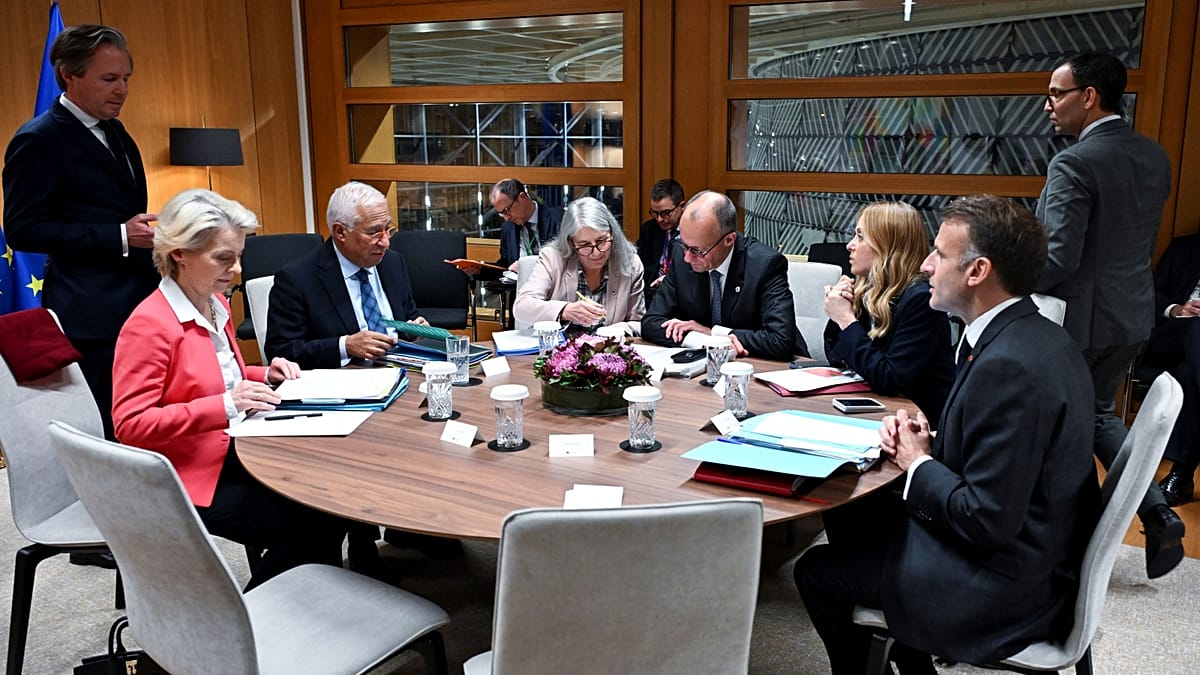
This week's special summit in Brussels was never meant to produce a final deal on the European Union's next seven-year budget. ADVERTISEMENT ADVERTISEMENT Instead, its aim was to encourage leaders to move beyond their entrenched positions and much-repeated red lines in search of a possible compromise. None of that happened. Leaders holed themselves up in the trenches, pointed the finger at each other and refused to budge one single inch. It did not take long for the meeting to descend into disarray, with simmering tensions bursting into the open for all to see. Plans to continue the talks on Friday were scrapped as it became clear that the hoped-for breakthrough remained out of reach. The chaotic, inconclusive summit offers an ominous preview of what will (or not) happen when leaders meet again on 17-18 December to attempt the final deal. Diplomats and officials in Brussels presage a "blood-on-the-walls" marathon that will likely stretch into the weekend – and perhaps into the following week. Here's where things are now and what to expect next. What's on the table? The bitter fight over the next EU budget (2028-2034) began last year when the European Commission presented a nearly €2 trillion proposal with record spending on defence, border controls, green energy, innovation and foreign policy. The Commission revamped the budget's traditional structure, which allocates cash for specific programmes over a seven-year horizon, to make it more flexible and reactive to unforeseen crises. The lessons from the pandemic, Russia's war on Ukraine and natural disasters weighed heavily on the thinking. Although the new structure was preserved, the €2 trillion volume was successively cut by the Cypriot and Irish presidencies to make it more politically palatable. The last cut was inflicted by European Council President António Costa, who tabled a €1.78 trillion budget in current prices – a 10% reduction of roughly €204 billion. Costa heavily cut Heading 2 (Competitiveness) and Heading 3 (Global Europe) and largely spared Heading 1, which includes agriculture and cohesion policies. Who's who in the fight? The budget has split member states into two irreconcilable camps. On the one side, the seven "frugals": Austria, Belgium, Denmark, Finland, Germany, the Netherlands and Sweden. All of these are net payers in the budget and are determined to slash the overall size. They also want to focus common spending on modern-day priorities, hence their euphemistic nickname: "modernisers". For them, Costa's proposed €204 billion reduction is unacceptable. The group has now demanded an additional €50 billion decrease. "This won't stop at €204 billion. It will be even less. How much less it will be is still open," German Chancellor Friedrich Merz said at the summit. On the other side, the 17 "Friends of Cohesion": Bulgaria, Croatia, Cyprus, Czechia, Estonia, Greece, Hungary, Italy, Latvia, Lithuania, Malta, Poland, Portugal, Romania, Slovakia, Slovenia and Spain. Most of these countries are net recipients of EU funds and want to preserve ambitious expenditure for both traditional and modern policies. For them, Costa has cut too much, and nothing less can be tolerated. "We are fighting for a good budget for our region. We are taking action, and we are not backing down," Polish Prime Minister Donald Tusk said, striking a combative tone. France, a net payer that receives hefty farming subsidies, has not picked a side but is adamantly opposed to any drastic devaluation. French President Emmanuel Macron slammed Costa's €204 billion cuts as a "strategic mistake" that would make Europe more dependent on the United States and China. A similar warning was issued by Commission President Ursula von der Leyen, who does not have a vote but plays a crucial technical role. "We need to stay true to the priorities we have collectively agreed on for the past years," she said. Ireland and Luxembourg are non-committal, though they are seen as more frugal-friendly. So what now? The focus now turns back to Costa, whose authority and credibility as European Council president will be defined by the outcome of these negotiations. "We need to continue to work and to try to bring all the member states closer. In any case, as you know, we need unanimity to approve the new budget," he said. "That means that all member states need to agree with each other." Costa and his team have drawn two conclusions: the "frugals" will request further cuts and the "cohesion friends" will oppose any reductions of H1 (agriculture and cohesion). This puts H2 (competitiveness) and H3 (global Europe), the two envelopes that the "frugals" want to boost, on the chopping block. However, some "cohesion friends", like Poland and the Baltics, are ready to fight for H2 because it includes funding for defence and security. Another point of contention that remains glaringly unresolved is the EU-wide taxes, also known as "new own resources", to bring additional revenue into the budget. Costa has proposed a package of five taxes – digital services, carbon-intensive imports, electronic waste, tobacco products and the Emissions Trading System (ETS) – to collect around €60 billion per year. So far, no tax has garnered the necessary unanimity. Ireland and Malta, for instance, are firmly opposed to the digital tax, while Poland is dead-set against the ETS. The fact that these own resources have a distinctly uneven impact on member states also raises eyebrows. If the taxes are pared down and fail to raise €60 billion per year, Costa will have no choice but to cut the budget even deeper to offset the loss. How hard is the deadline? Costa has repeatedly urged leaders to agree on the new budget by the end of the year at the very latest. This, he says, is necessary to have enough time to negotiate with the European Parliament, finalise the multiple pieces of legislation and prepare national administrations for the new structure before the budget kicks in in January 2028. But there is an additional factor: next year will see high-stakes elections in France, Italy, Greece and Poland, among others, that could make it impossible to take key decisions. Macron threatened to pull out of the talks altogether if leaders fail to reach a deal this year, arguing he would lack the democratic legitimacy to continue the process in early 2027. The first round of the French presidential election is slated for 18 April. Far-right firebrand Marine Le Pen, who leads opinion polls, has vowed to slash the EU budget. "We are not prepared to reach a deal at any cost. We can conclude by 31st December, but that is the absolute limit," Macron said at the summit. Not everyone is convinced. Some see the December deadline as artificial and politically motivated, rather than a hardcore legal constraint. Italian Prime Minister Giorgia Meloni, from the "cohesion friends", and Dutch Prime Minister Rob Jetten, from the "frugals", say what truly matters is the quality, not the timing, of the deal. What about Ukraine? The budget fight has overlapped with efforts to provide Ukraine with a new €45 billion support loan to plug its 2027 wartime deficit. Russia's relenteless attacks have wreaked havoc on the economy and raised costs for Kyiv's budget and army. This week's summit was expected to address both issues, but the budget sucked the energy in the room and relegated Ukraine to the backseat. There was one important development, though: Bulgaria confirmed it will join the new loan on condition that it is exempted from footing the military bill. This leaves three countries – Slovakia, Hungary and the Czech Republic – as the main holdouts. The three already have an opt-out from the previous €90 billion loan. "I expect that when we meet in December, we will sit down to discuss this," Slovak Prime Minister Robert Fico said at the end of the summit. "The €45 billion ceiling for the loan will be established, and whoever wants to will sign up to it. Slovakia, however, will not participate." In yet another layer of complication, the next budget will determine the collective payment of the accrued interest from the two loans, estimated at €6 billion per year. Several leaders also want to open a debate on how to strengthen long-term financing for Ukraine in the next budget, be it for a longer war or a post-war recovery. Merz insists the budget cannot be closed without settling the Ukraine question at the same time.
What now for the EU budget after a chaotic, inconclusive summit?
Full Article
Original Source
Read the full article at Euronews →KhanList aggregates and links to publicly available news content. We do not host full articles from third-party sources. Always verify important information with original sources.