
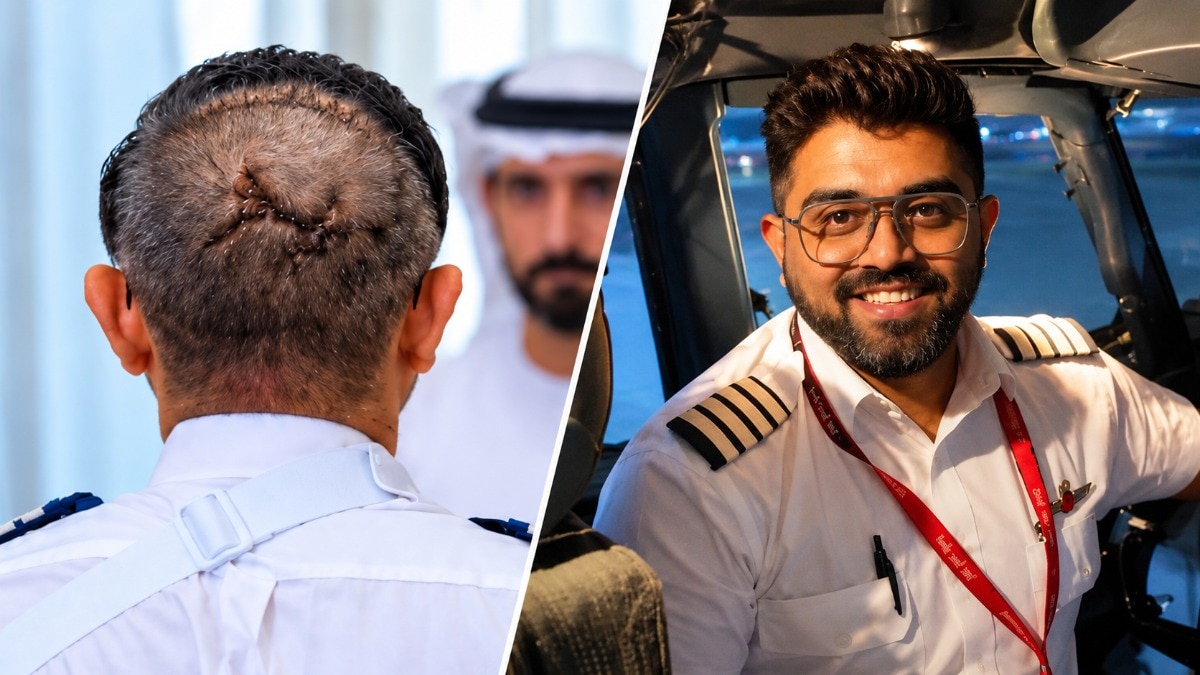
Photographs of Captain Smit Machchhar, the Indian pilot who survived a midair terror attack, have revealed the extent of his head injuries and how close he might have come to death after being repeatedly struck with an axe by his Omani co-pilot. Neurosurgeons examining the deep scars and surgical staples on his head have pointed to a dangerous skull fracture, which could have caused catastrophic bleeding during surgery. A doctor warned that injuries involving a major vein in that part of the brain can carry a risk of death or disability exceeding 40%. Another doctor explained how lifting the broken skull fragments while treating Captain Smit Machchhar could have resulted in the loss of two litres of blood in a minute.Tennessee-based neurosurgeon Dr Sanat Dixit described the injury as "an occipital compound depressed skull fracture treated with a WIDE craniotomy (outer staple line)." Sydney-based Dr Sonu Bhaskar, said, "It is a massive cross-shaped mark. It tells the story of a severe brain injury and at least two major operations." Their assessments came after photographs of Machchhar's injuries emerged during a ceremony in Abu Dhabi on Tuesday (October 27), when UAE President Sheikh Mohamed bin Zayed Al Nahyan honoured the pilot and his crew with the First Class Order of Zayed II.Machchhar was attacked on September 30 aboard FlyDubai flight FZ1073, travelling from Dubai to Tel Aviv. His co-pilot, Hamam al-Hammami, who was reportedly radicalised by al-Qaida's jihadist ideology, repeatedly struck Machchhar on the head with an emergency axe kept inside the cockpit. Despite severe bleeding, blurred vision and losing consciousness, Machchhar managed to open the cockpit door, allowing passengers and crew to overpower the terrorist co-pilot and prevent a catastrophe.WHY SMIT MACHCHHAR'S SKULL FRACTURE WAS SO DANGEROUSThe extensive surgical staples running across the back of Machchhar's head, as seen during the facilitation ceremony in the UAE, have drawn attention and reactions from medical experts. Dr Rahul Chawla, consultant neurologist at New Delhi's ISIC Multispecialty Hospital, explained that head injuries can sometimes cause internal bleeding, skull fractures or damage to the brain. "A head injury may be limited to an external wound, but in some cases, it can also cause internal bleeding, a skull fracture or brain injury. Therefore, the severity of an injury cannot be determined simply by looking at the size of the wound," Dr Chawla told The Lallantop, India Today Digital's sister portal. Dr Dixit, a US-based neurosurgeon, explained in a post on X that the greatest danger was not necessarily the fractured skull, but a major blood vessel running beneath the injured area. "What's scary isn't the fracture; it's what's adjacent to the damaged skull," he wrote on X.According to Dr Dixit, the crash axe blows landed over the posterior superior sagittal sinus, which is a large venous channel running between the two halves of the brain. This channel carries blood away from the brain. An injury to it can cause severe bleeding and interfere with normal blood drainage.On October 7, The Times of India, citing sources, reported that Captain Machchhar had suffered a "depressed fracture fragment of skull" after being struck with an axe by his co-pilot. The report said he underwent emergency surgery in Saudi Arabia before being flown to the UAE for further treatment. Neurosurgeon Dr Krishan Kumar Yadav explained that such fractures occur when a piece of the skull is pushed inward towards the brain, making surgery particularly delicate.In his X post, Dr Dixit warned that penetrating injuries involving the sinus can carry "upwards of a 40% morbidity or mortality".Morbidity refers to serious complications or lasting disability, while mortality means death. And, it must be noted that the figure by Dr Dixit described risks associated with certain severe sinus injuries in general, not Machchhar's individual risk. Dr Dixit explained that a torn sinus can be difficult to repair. Such injuries can cause massive blood loss, air entering the bloodstream or dangerous blood clots.- Ends
What neurosurgeons see in Machchhar's injury marks: 40% mortality chance, brain injury
Full Article
Original Source
Read the full article at Indiatoday →KhanList aggregates and links to publicly available news content. We do not host full articles from third-party sources. Always verify important information with original sources.