
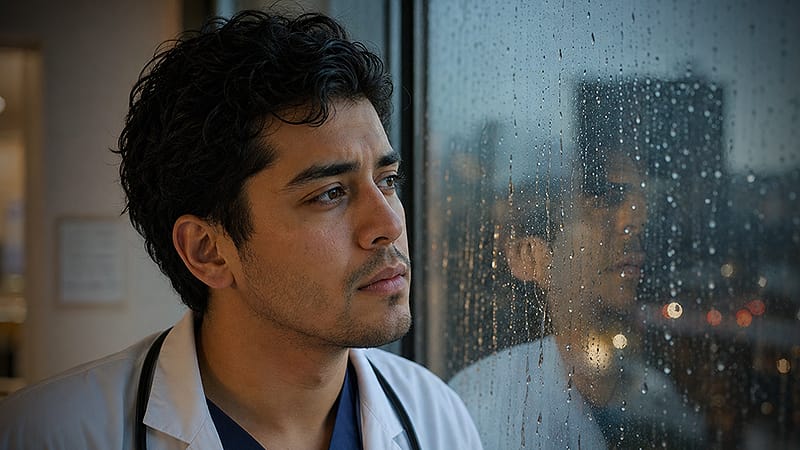
Not long ago, a flash flood on the highway interrupted the rhythm of my training. My tires lost the road. The car spun off the highway. I remember everything spinning, a blasting pain in my hands, and then stillness. Smoke filled the car. Through it, I could see shattered glass and rain. The driver's door wouldn't open, and for a moment I thought this could be the end. I walked away with a concussion, a bruised rib, a strained neck, and airbag burns across my wrists. An absolute miracle, given what could have been.What I didn't expect was how long the crash would follow me.Tyler Beauchamp, MDWeeks later, I was sitting at home, perfectly content, when it started to rain. I was ripped back inside the smoking car, not just reliving the crash but living out every worse version of it: the tree I narrowly missed, the fracture I didn't have, the door that never opened.As a resident physician, I have cared for so many crash survivors over the past few years. While I’ve worked hard to empathize with their experiences in the hospital, I never considered what they may carry when they leave. I've come to believe that the skill medicine teaches us best, setting our own lives aside to care for others, can also keep us from fully understanding our patients.The Compartmentalization of TrainingWe spend so much of our lives being an active part of the worst days of someone else's life. We learn to compartmentalize: to extract the medicine, compose ourselves, and be mentally and emotionally available for the next patient. In pediatrics, where the moments that stay with us tend to be the highest of highs and the lowest of lows, that skill is survival.But life doesn't stop when training starts.When Residents and Nurses Need Support TooAfter my injuries, I was incredibly blessed to be surrounded by supportive residents who took my shifts and encouraged me to rest when I was too stubborn not to. My co-residents made real sacrifices so I could transition back to full strength. I know for others that isn't always the case.The hospital is never closed. Patients will always need someone there. So, if a resident steps aside, it’s only because another resident filled their place. We get sick. We lose loved ones. We go through divorces, surgeries, financial strain, and mental health struggles. We get into car accidents. And when that happens, it isn't just one resident's concern. The tragedies that affect one of us affect all of us. How many trainees out there are less fortunate, having a single human moment erase a lifetime of sacrifices made to care for others?Hospitals depend on their residents and nurses to keep patient care moving. They are often the first to recognize changes in a patient's condition, coordinate care, and respond when something goes wrong. They are the body of the hospital in every sense of the word, and if they break, the hospital breaks with them.We've come a long way in supporting them over the past decade, but we still have far to go, and that support varies wildly from program to program. Residents, who can't easily choose or change where they train, are often at the mercy of the program they match to. The more a system can offer real, tangible support when its people are struggling, the more present they can be for their patients. Caring for the caregivers isn't just kindness. It's how the whole system stays well.The Trauma We CarrySo many of us get through heart-wrenching shifts by going home, decompressing for a few hours, and going back in. But what happens when home is no longer your safe haven?The crash forced me to slow down for the first time in training. For better or worse, I was forced to breathe. Even as someone who prides himself on staying human, I hadn't realized how truly tired I was, or how far I had come from day one.I came back to work with a new appreciation for little wins: an incremental step forward in physical therapy, a baby weaning from intubation to CPAP, a teenager opening up just a little more about their trauma. Our patients struggle daily in ways we'll never fully understand. Their little victories are nothing short of remarkable.I also found myself more aware of trauma persisting. My trigger was rain. For one child, it was an ocean coloring page after a near-drowning. For another, a cartoon dog on the waiting-room TV after a dog bite. For someone else, a certain sticker, a phrase, a word said a certain way. One child is terrified of a needle; another sits calmly with an arm laid open. As physicians, we don't need to have been bitten by a dog to learn how the most innocuous things can bring us back to darkness.When the Patient Has No Visible InjuriesSince returning to work, I recently cared for a family of four after a car crash. Thankfully, no one was seriously hurt. My patient was a teenage boy with a few abrasions and mild concussive symptoms. His little sister walked away without a scratch. Once their parents were cleared in the adult ED and the family was reunited, I began reviewing return precautions for her brother. That's when I noticed her in the corner, staring off, silently starting to cry. As her mother pulled her close, I thought of my own moment after the crash, when the shock wore off, I realized I was safe, and everything I'd been holding back came flooding in.Before the crash, I might have thought, What a scary day. Thank goodness she's okay. A little rest and she'll be fine. After all, her brother was the only one with an "actual injury." This time, I counseled the parents on the signs of trauma in both children and how what they'd experienced might stay with them longer than they'd expect. I gave them resources for child and adolescent counseling and encouraged them to follow up with their pediatrician. Not to push either child to talk before they were ready, but so the tools would be there when that time came. Some injuries never show up on a scan. Left alone, they can quietly grow worse.Sometimes it's simply the hospital itself, terrifying for anyone who isn't used to it. But the speed and onslaught of training can blunt us until we no longer notice.None of this means a physician has to suffer to be a good one. But there is something to be said for the endocrinologist who manages her own diabetes, the hematologist who grew up with a sister with sickle cell disease, the primary care physician counseling patients on community resources he once depended on himself. The beautiful thing about medicine is that there is a place for every unique background to fill an incredible need. The experiences that make us different aren't weaknesses to hide. They are strengths other clinicians may not have.Seeing Through Our Patients’ EyesCompartmentalization forces our bodies to keep moving when our hearts beg us to slow down. It becomes dangerous when it's the only thing we practice, because it walls off the very experiences that could help us understand the person in front of us.Drawing on your experience doesn't mean walking into the room and making the moment about yourself. It's using what you've lived to see through your patients' eyes. What would you want said to you? What would you want done for you? How would you want someone to present themselves when they walked into your room?Listen for the answers patients can’t say out loud. Are they making eye contact? Has their pattern of speech changed? Who in the room do they gravitate toward, and who do they avoid? When you're taking a history, which questions are met with hesitation? Which paths do they seem not to want to go down? So much of what shapes an encounter happens before the patient ever enters the room. The more we keep this eye open, the more our patients can hope to be understood.No one can do this every second of every day. Sometimes you have to compartmentalize and get the job done. But everyone needs to find time to unpack what's in the box, whether that's between patients, after a shift, or on a day off. The change won't come all at once. Over time, though, you may find that some difficult encounters become easier to navigate and that patients and families respond to you a little differently. No one is too far into a career to start, whether you're an intern or 30 years in.It’s time to start building habits of healing, because life won’t pull punches just because you're in training. I would never have gotten through residency without writing and journaling, caring co-residents, and a family whose love and support never wavered. But those are my habits. If you haven’t already, please find yours. Remember, talking to a professional isn't weakness. Keeping alive the things that keep you alive isn't a distraction from work. It's what makes the work possible.The Human Behind the White CoatSome days when it rains, the dread still comes. And who knows if it’ll ever really go away for good. But when the fear comes, I find myself picturing patients experiencing their own rain, and I remind myself that we’re all afraid of something, just rarely the same thing. That is what lets us be steady for someone else when their fear isn’t ours.Look around you. The resident covering your patients tonight could be grieving a parent. The attending running rounds could be ending a marriage, or watching their home be destroyed. The nurse beside you could be weeks out from a car accident of their own. We are not separate from the suffering we treat. We live inside the same fragile humanity as our patients.That isn't a reason to lean away. It's the reason to lean in.The box helps us do the work. What we've lived through helps us do it well.Tyler Beauchamp, MD, is a pediatric resident physician from UNC Children’s Hospital and a best-selling children’s/young adult author.
What My Car Crash Taught Me About Patient Trauma
Full Article
Original Source
Read the full article at Medscape →KhanList aggregates and links to publicly available news content. We do not host full articles from third-party sources. Always verify important information with original sources.