
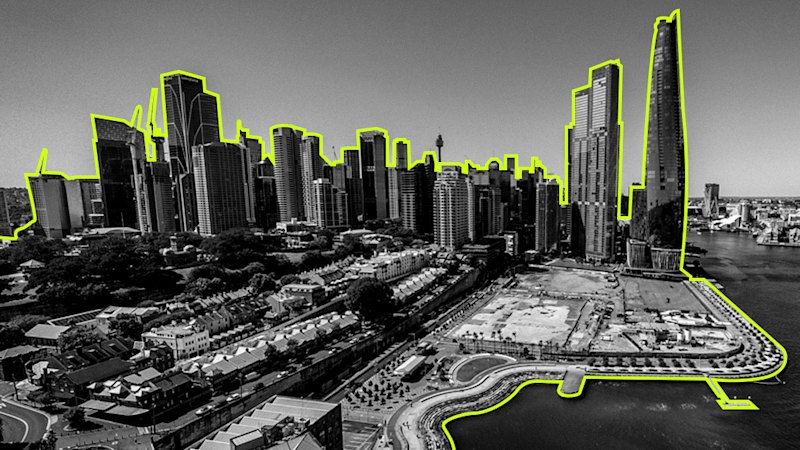
By the colossal sandstone pillars of Sydney Town Hall, Jess Miller is a long way from the place she used to call home.The light rail whirs past the deputy lord mayor of Sydney on George Street, its bell chiming beneath the gargantuan clocktower looming overhead. In a few weeks, jacarandas will explode with violet and lavender trumpets on either side of the town hall’s steps.In Miller’s sleepy hometown of Somerville on Victoria’s Mornington Peninsula, meanwhile, the water in Western Port Bay will rise a couple of degrees, and farmers will start shearing their sheep on hectares of green land. Sydney Deputy Lord Mayor Jess Miller says Sydney has lessons in planning for her home city of Melbourne.James Brickwood“It was funny, in your questions, you said, ‘What’s it like to come home?’” Miller says, on the phone from Sydney.“I reckon it took about 15 years of not living in Melbourne before I was like, ‘Oh, that’s not home any more’.” These sprawling cities have lessons to offer each other, Miller says. But there are some things Sydney just does better.Beyond the concrete wastelandAt a neat park on the Port Melbourne foreshore, a great yellow buoy serves as a repurposed climbing wall for young children.Traverse a rope ladder or bridge, and they’ll find themselves in a wooden crow’s nest tower, looking out over Port Phillip Bay.The other side of the tower looks over a behemoth rusted steel wall, running along the perimeter of the neighbouring shipping dock.“Secure area – entry prohibited,” signs proclaim.A few hundred metres up the road, at Fishermans Bend, the Yarra River glitters through gaping holes in a chain-link fence. Looking down from the Bolte Bridge in Docklands, there’s little to see beyond the industrial, Miller says.“You’ve really built over it all, and kind of forgotten that that’s water,” she says.Sydneysiders are seldom short of a view, Miller says – but they treat water like gold. “Where in the city you’ve got any glimpse at water, it’s about really amplifying that beauty and that access so that everyone can enjoy it.”Take, for instance, Barangaroo. When Miller first moved to Sydney more than two decades ago, the precinct was an immense concrete wasteland, disused after the then NSW government moved port operations to Port Botany (beside Sydney Airport) in 2003.Barangaroo is now a six-hectare headland park, sprawling underground cultural venue, waterfront promenade, netted swimming area, and extensive dining and entertainment precinct, which includes Crown Sydney.The project’s total estimated cost is upwards of $8 billion.“It’s spectacular,” Miller says. “You’ve got no shortage of places with grass and trees and a view on any given day in Sydney, whereas, in Melbourne, I’d be hard-pressed [to find the same].“I’d go to the Botanic Gardens, or I’d go to Birrarung Marr, or I’d probably just go inside.”Miller will share her ideas for the future of the city at The Age’s Melbourne Assembly conference in October, presented in partnership with the University of Melbourne.By the year 2050, Miller would love to see a reimagined and “re-naturalised” dock in Melbourne. The organisation Regen Melbourne is on the right track in championing a revived (and swimmable) Yarra River, she says.“You could extend that idea to go, what would it be like if we reintroduced mangroves and seagrass into the city?” Miller says. “I don’t know that we’ll need all that docking.“Technology could offer some opportunity for land to be given back to nature.”The Port of Melbourne says it has no plans to reduce its footprint as the city’s population grows. The port handles more than one-third of Australia’s container trade, about 20 per cent more than Sydney’s Port Botany.“The current port footprint, even with technology and innovation, is needed to keep goods moving to and from Victorian consumers and businesses as demand grows,” Port of Melbourne chief executive Saul Cannon says.But City of Melbourne Lord Mayor Nicholas Reece shares Miller’s vision for wilder waterways. His council – a supporting event partner of the Melbourne Assembly forum, where Reece will be a speaker – pieced together grass pontoons in the shallows of the Yarra, before floating them onto the river for perching birds and other animals.Reece imagines swimming pools dotted along the river; the first of which could be in Victoria Harbour, Docklands, in a couple of years, akin to the floating “drop-in” pool that just opened in east London’s Canary Wharf.“In the case of developing our ports and making them areas that are suited for living and nature, Melbourne has really led the way,” Reece says.“Think about the Docklands development around Victoria Harbour and up the Yarra River – that was an initiative in Melbourne that began almost 30 years ago.”Miller’s former fellow councillor at the City of Sydney, architect Philip Thalis, takes a dimmer view than Miller of Melbourne’s southern end, describing Southbank as “the most dismal place in urban Australia”. (Reece describes it as a lively suburb, albeit difficult and expensive to retrofit.)Thalis’ firm, Hill Thalis Architecture + Urban Projects, co-designed the original winning plan for the Barangaroo foreshore – a project he later said evolved into the antithesis of the firm’s vision, and a squandered opportunity to make a better Sydney (including by virtue of the “shiny 75-storey casino hotel plonked on the foreshore”).“Southbank unsuccessfully combines the highest of densities, overlaid on the most miserable mishmash of public spaces,” Thalis says. “It’s so hostile to walk around, it’s roads dominated and deformed to cater to too much traffic.”He says Melbourne is a national outlier with its generous street pattern, boulevards, and far wider streets than in Sydney, but they’ve since been overlaid with a “very large motorway system”, showing a misguided preference for cars.City of Port Phillip Mayor Alex Makin suggests few places in Melbourne epitomise this more than Fishermans Bend, where the Victorian government in 2018 promised new tram routes by 2025.Since then, not a “single metre of tram track” has been laid – and school students are routinely left behind by overcrowded buses running hourly, Makin says.The precinct is Australia’s largest urban renewal area, meant to be home to 80,000 people and an equivalent number of jobs by 2050.“If the state government can’t commit to something as basic as a reliable and frequent transport service, how can we strive for any ambition?” Makin says.He has asked for a meeting on the subject with Premier Ben Carroll, whose government says it has timetabled another 1500 weekly bus services to Fishermans Bend.The state government has invested almost $198 million into the first stage of the Fishermans Bend innovation precinct project.The project includes tram extensions and two new heavy rail stations, which don’t yet have a construction date.Reece says Sydney has borrowed many a thing from Melbourne, from its trams, to inner-city living (with the Hoddle Grid), to emulating its laneway and restaurant culture.Tourists flock to Hosier Lane, one of Melbourne CBD’s favourite laneways.Eddie JimMelbourne is aiming to grow its tree canopy cover to 40 per cent by 2040 – “one of the most ambitious targets of any big city in the world”, Reece says – and will rip up the bitumen on its “little” streets to prioritise pedestrians in the coming decades.The Victorian government points to the Metro Tunnel as the biggest change to Melbourne’s rail network since the City Loop opened four decades ago, and notes some 360,000 new homes are planned by 2051 across designated activity centres, which are connected to trains and trams.But Thalis says the architectural tenets of wide, green spaces and walkability were forgotten in places such as Southbank, Fishermans Bend and Docklands.When neglected, he says, an unliveable city is created.Apartment living close to natureOff Walker Street in Melbourne’s north, a wide footpath between apartments beckons neighbours to the creek.Follow the footpath beside blooming red bells and creeping bamboo, and they’ll pass two glass-fronted lobbies. One is for social housing tenants, the other for private. Both are indiscernible to passersby.Australian Institute of Architects Victorian housing committee co-chairs Sarah Buckeridge and James Legge.Simon SchluterDown a short staircase, the footpath hugs the banks of the Merri Creek, before wrapping back around to Walker Street in Northcote.This complex comprises 250 apartments, but the facade here “steps down” to the height of a townhouse, and is set back enough to allow room for tall trees and plants. The nearest tram stop is a minute’s walk; the Westgarth shopping village is five minutes away.It’s what Australian Institute of Architects Victorian housing committee co-chairs James Legge and Sarah Buckeridge consider “best practice” – but projects like it aren’t as commonplace in Melbourne as they are in Sydney.“It’s a bit more hit-and-miss here,” says Legge, founding director of Six Degrees Architects, which designed this place.Buckeridge, co-managing director of architectural firm Hayball, points to Green Square in Sydney’s inner south as an example. It’s slated for more than 30,000 new homes by 2030.What’s more interesting, though, is the ethos behind it, she says.“They thought about the urban block structure, the quality of the streets,” Buckeridge says. “It’s not by accident that the quality of the public space is at a very high level, and that, really, is just as important as the individual building design itself.”This kind of “generational” (albeit, controversial) project is the culmination of a legacy of good apartment design policy in NSW, Legge and Buckeridge say, that was heralded by then-premier Bob Carr in the early 2000s.Carr was an advocate for the sector, incensed by a rise in poorly designed apartment buildings. He convened a forum about it in 2000 and, two years later, legislated what people in the industry still refer to as “SEPP 65” (the State Environmental Planning Policy No.65, since subsumed by the Housing SEPP).The Australian-first policy mandated the role of registered architects in designing all apartment buildings higher than three storeys.The Merri Northcote project at 20 Walker Street, Northcote, in Melbourne’s north.Simon Schluter“In Victoria, you can be a draftsperson and do it,” Legge says. “It’s less training, basically – and particularly less design training.”Victoria went some way to catching up with NSW in 2017, introducing the BADS (Better Apartment Design Standards) to do away with unfurnishable homes, tiny bedrooms, and borrowed lighting and ventilation (whereby windowless rooms can “borrow” light and air from another).The Carroll government says Victoria has led apartment design reform nationally for almost a decade. Labor is updating the state’s design standards.“We’ve passed the biggest overhaul of Victoria’s planning laws in decades to give more people the opportunity to live close to what matters to them – while continuing to invest in major projects that will keep people moving,” a government spokesman said.But the co-chairs of the architects’ housing committee say architectural oversight should be similarly entrenched in Victoria’s system through an existing mechanism – a panel of experts reviewing projects’ design.The Victorian government’s architectural office reviews most significant projects and developments through the panel process. Invariably, this leads to better design – particularly at ground level, which is crucial to how buildings contribute to the quality of the streetscape, Legge and Buckeridge say.The architects suggest the process should be applied to all significant projects in Melbourne’s new activity centres, while Thalis argues NSW’s design rules should be the minimum national standard.“It’s much better than Victoria’s equivalent BADS, as it prescribes better practice in passive environmental design – that is, cross-ventilation, sunshine, light to lobbies and landscape area,” Thalis says. Some architects argue both the Victorian and NSW standards are overprescriptive, as elements forbidden in new projects – such as windowless bedrooms – are inherent to warehouse conversions, for instance.Toby Dean, head of community at not-for-profit developer Nightingale Housing, says projects will need more scope for flexibility in the coming decade.He’s glad the BADS put a stop to “shocking” builds of the ’90s and 2000s – with shoddy construction, limited access to daylight, and rooms too deep in the plan – but says the guidelines are aimed at protecting the “lowest common denominator” rather than rewarding good design and innovation.The rules allow people to build standalone homes of any size, but deter new builds of well-designed studios of 30 square metres, he says.“Over the next 10 years, we’ll probably see really interesting examples of office building conversions, or live-work situations, or adaptive reuse projects,” Dean says.“You have to have some leniency around your apartment design standards because you’re working with the existing footprint.”The north-south divideBack on the Mornington Peninsula, Miller looks out over Port Phillip Bay and fears Melburnians have turned their backs to parts of it.This city lacks connection between neighbourhoods marooned in the north-south divide, she says. People may drive down the peninsula, or up north to Daylesford on a weekend – but they seldom travel from the likes of Northcote to Brighton. “[In Sydney], you can take the ferry over to Manly for the day, and feel like you’re on holiday in your own town,” Miller says.Sydney’s deputy mayor argues Melbourne lacks connection to nature. But on the banks of the rivers, her Victorian counterparts disagree.Reece looks to the Merri Creek, which he cared for as a member of a volunteer group before he became mayor.The creek was once an abused urban waterway, and had since become the pride of a community, Reece says. He wants the same for the Moonee Ponds Creek – “the Kakadu of Melbourne” before European arrival.“It’s incumbent on this generation of Melburnians, to the extent that it’s possible, to rewild some of these areas,” Reece says.Melbourne Lord Mayor Nick Reece describes Merri Creek as the pride of a community.Justin McManusThe mayor envisions the creek as clean and restored, trailing a “beautiful green corridor” from Royal Park in Melbourne’s north to the Yarra River. Melbourne will never have a Sydney Harbour – but it has some of Australia’s pre-eminent parkland. And, where distance sometimes separates Melburnians, there’s a sense of collective like no other when they come together.It’s the thing Miller misses most about her home city: the energy that charges the throng of people on their pilgrimage to the MCG as they trail the Yarra, making them feel part of something bigger.It compels them to seek out community beyond their doorsteps and apartment balconies – and makes the case that they need more to stumble upon, which doesn’t cost them money.“The new and shiny and beautiful in Melbourne is very vertical,” Miller says.When the new and beautiful is on the ground, it feels like it’s for everyone.Melbourne Assembly will be held from October 19 to October 21. More information is available on the Melbourne Assembly website.
What Melbourne could learn from this Sydney landmark
Full Article
Original Source
Read the full article at Smh →KhanList aggregates and links to publicly available news content. We do not host full articles from third-party sources. Always verify important information with original sources.