
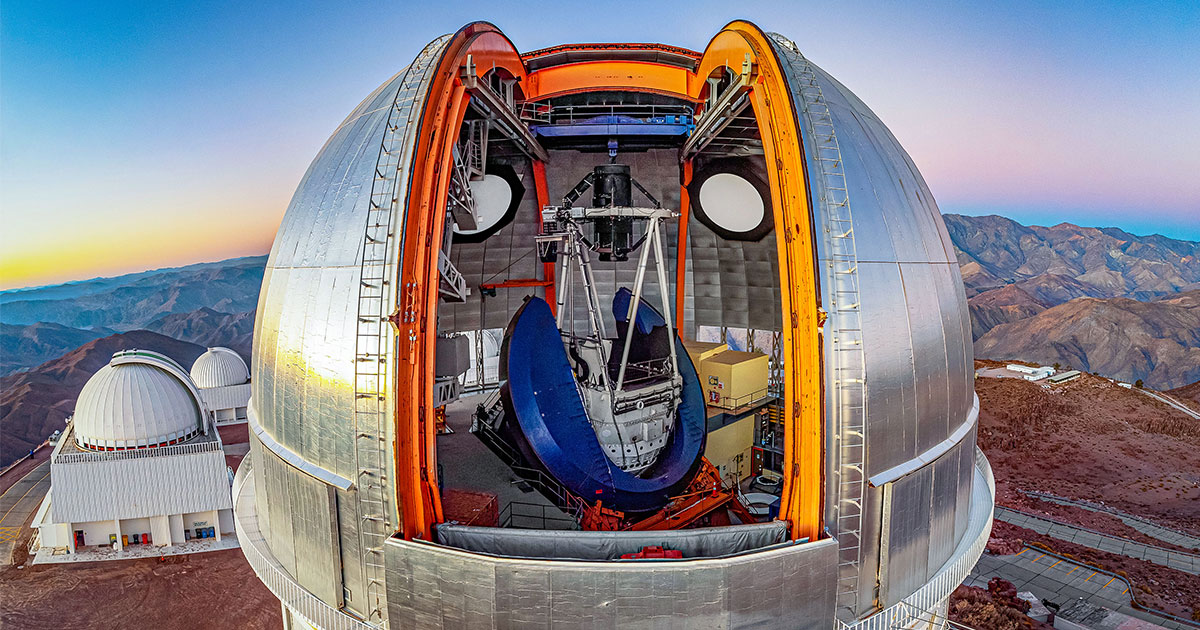
An era-defining galaxy survey has released its final results. They don’t quite fit the leading theory of cosmology. The 570-megapixel Dark Energy Camera is mounted on the Victor M. Blanco 4-Meter Telescope on Cerro Tololo near La Serena, Chile. Dark Energy Survey/DOE/FNAL/ DECam/CTIO/NOIRLab/NSF/AURA Joshua Frieman remembers when the world found out that the universe was made of much more than just matter. For a few years, the scientist had been studying the possibility that the cosmos needed something else — a “missing energy” — to make sense. But it was a niche idea. When he and a colleague started to plan a workshop on the topic in 1997, at first only a few dozen people signed up. Then, in early 1998, two teams of researchers announced that exploding stars called supernovas seemed to be racing away from Earth under the influence of an unidentified, omnipresent repellent force. The observations implied the existence of exactly the sort of missing energy that Frieman and his colleagues planned to talk about. “Suddenly, everyone wanted to come to our workshop,” including reporters with TV cameras, said Frieman, now at the University of Chicago. It was “kind of a circus.” Within a few years, cosmologists had arrived at a whole new view of reality. The missing energy, given the name “dark energy” for its invisible nature, was pushing galaxies apart. The energy seemed embedded in space itself. It made up roughly two-thirds of creation (with matter — visible and dark — making up the remainder). Frieman embarked on what would become a two-decade mission to learn about dark energy by watching how it influences all that we can see: the Dark Energy Survey (DES). Now that project has come to a close. In May 2026, DES shared findings based on its full dataset of thousands of supernovas and hundreds of millions of galaxies spanning billions of years of cosmic history. Those findings, in combination with data gathered by a different project, the Dark Energy Spectroscopic Instrument (DESI), suggest that our understanding of what the universe is made of — the venerable “standard model” of cosmology — is not complete. “There appear to be cracks in that model,” said Simone Ferraro, a cosmologist at Lawrence Berkeley National Laboratory. “There’s something that doesn’t fit.” Joshua Frieman, a physicist at the University of Chicago, co-founded the Dark Energy Survey to examine the accelerating expansion of the universe. Brian Nord Cosmologists can’t yet say what that something is. What they can say is that after 20 years of stability, their field is returning to a state of confusion. “It’s certainly enough to make you either uncomfortable or excited,” Ferraro said. Bigger and Faster Forever Experimental cosmology is a piecemeal endeavor. It’s a bit like trying to reconstruct a person’s life from a dossier of data about them: report cards, utility bills, cholesterol tests, and so on. You come up with a story that weaves all the data together, go find new data, and use it to refine the story. Frieman and other cosmologists started to speculate about a missing form of energy in the mid-1990s because the story they were telling didn’t seem quite right. In previous decades, they had peered at the sky and inferred roughly how much stuff was out there. They saw a smattering of galaxies lighting up the void — visible matter. Based on how fast the galaxies were spinning, astronomers deduced that a preponderance of invisible matter must surround each bright speck, holding it together — dark matter. The rate at which these galaxies were receding from view implied that the universe had been expanding for some 8 billion to 13 billion years. It looked as if there was just enough matter (dark and visible combined) to tug gravitationally on the universe and continuously slow this expansion without ever bringing it to a full halt. But new observations started to clash with this accounting. Astronomers spotted stars, for instance, that seemed to be older than the universe. While trying to understand these and other anomalies, cosmologists noticed that it helped to add a new type of energy to their models. Then came the bombshell 1998 findings that the expansion of the universe was not actually slowing down; it was ever so slightly speeding up. By the end of the year, the unknown stuff driving that acceleration had a name: dark energy. Frieman charged off to measure it. In 1998, cosmologists were like detectives with a thin dossier. They had a blurry image of light from the early universe known as the cosmic microwave background (CMB). And they had observed several million galaxies, along with dozens of supernovas. Because light takes time to travel, these observations gave cosmologists snapshots of what the universe looked like at different moments over the past few billion years. The Dark Energy Camera holds an array of charge-coupled devices, or CCDs, similar to the sensors in normal digital cameras but designed specifically for astronomy. DOE/FNAL/DECam/R. Hahn/CTIO/NOIRLab/NSF/AURA That was just enough data to show that the universe was experiencing an unexpected growth spurt. But to figure out exactly when it had started and how fast it was happening, Frieman and his colleagues would need to fatten their file. Their solution was DES. DES began in 2003, with a handful of physicists at Fermi National Accelerator Laboratory brainstorming what it would take to get a more comprehensive view of the cosmos. They went on to design and build the 570-megapixel Dark Energy Camera, the most powerful digital camera of its era, and install it on the 4-meter-wide Blanco telescope in the Chilean Andes. They then used it to conduct the Dark Energy Survey, which ran for 758 nights between 2013 and 2019. During this time, DES increased the number of recorded galaxies to hundreds of millions. DES was supposed to end in 2018, but the researchers extended it to make up for lousy observations due to clouds from a strong El Niño season. Every couple of years the DES collaboration, which grew to include more than 400 scientists across seven countries, would analyze the data they had collected so far to see what it suggested about the history of our universe. Again and again, what they found was consistent with the theory that had coalesced after the 1998 supernova papers: The universe was about 30% matter (mostly an invisible and lethargically drifting “cold dark matter,” or CDM), and the remaining 70% of the universe was dark energy. Physicists noted that this energy acted like an unchanging property of the vacuum of space, referred to as “lambda.” The bigger space gets, the more of this vacuum energy there is, and the faster the cosmos expands. This theory of the universe became known as Lambda-CDM. Then, in 2024, researchers from a next-generation experiment, DESI, combined the DES observations with a sharper image of the CMB and new observations of their own. They found that the Lambda-CDM theory no longer quite fit. Broken Record Whereas DES uses one big camera in Chile, DESI at Kitt Peak in Arizona uses thousands of tiny eyes. Each can swivel to focus on a single galaxy. The individualized attention more precisely captures each galaxy’s motion. This technology lets DESI see hidden cosmic structures. Due to the way that sound waves rippled through matter in the early universe, spherical shells of slightly dense matter formed. Over time, matter in these shells gathered into galaxies. Each shell is the same size, so by looking at how big or small it appears from Earth, scientists can tell how far away its galaxies are. Combining the distances to the galaxies with other observations, the researchers can calculate how fast the universe has grown over the past 10 billion years or so (out of the 13.8 billion years since the Big Bang). Young stars emitting stellar winds shaped the dust and gas of the Dragon nebula, captured here by the Dark Energy Camera, into a form that resembles a pair of fighting dragons. Dark Energy Survey/DOE/FNAL/ DECam/CTIO/NOIRLab/NSF/AURA In 2024, the DESI collaboration dropped a bombshell report. When researchers added their shells to the existing dossier, they couldn’t get the Lambda-CDM model to fit all the data. What fit better was an exotic theory that replaced lambda, the constant vacuum energy, with a different form of energy that weakened over time. A year later, an analysis of more data found the same thing. In the meantime, the DES collaboration continued to analyze the galaxies they had photographed. Those researchers focused on building a different contribution to the dossier: a detailed record of a cosmic tug-of-war. While gravity pulls matter — mostly dark matter — together, dark energy fights back, pushing matter apart. By measuring how much matter has clumped together in different eras, cosmologists can infer the strength of dark energy over time. DES assesses this clumping using three methods, explained Sujeong Lee, a physicist at Ohio University. First, DES measures how tightly galaxies of visible matter cluster together, which reveals how much dark matter floats around them. Second, it maps out visible matter in the foreground by looking for the ways it distorts light coming from galaxies in the background. And third, it maps out foreground dark matter in a similar way. Each of these measurements involves comparing pair after pair of DES’s hundreds of millions of galaxies, looking for tiny distortions in their positions and shapes. After seven years of rigorous analysis, the collaboration published their final results in early 2026. “It’s been a real tour de force,” said Ferraro, who isn’t part of DES. “It pushed the analysis to a new level.” Alongside these measurements, DES also reprocessed a catalog they had compiled of 1,600 recently observed supernovas, establishing the sharpest view yet of the modern universe. “I trust the DES-reanalyzed supernova data much more than I trust any other supernova dataset,” said Seshadri Nadathur, a DESI cosmologist. Cosmologists have now assembled their thickest file on the universe to date. DES merged its map of matter clumping, its supernova catalog, DESI’s galaxy shells, and a CMB image, then checked to see how well Lambda-CDM could still account for the whole cosmic history. The answer: not very well. In their final report, DES scientists found that their data fit somewhat better with the theory that dark energy is not stable and has slackened in recent eons. In the statistical language of physicists, DES reports a “three-sigma” preference for the new theory. That’s significant enough to make people pay attention, especially since it combines data collected in different ways, but it falls far short of the “five-sigma” confidence physicists need to claim a new discovery. The Dark Energy Camera was mounted on the Victor M. Blanco 4-Meter Telescope, famous for its role in the 1998 discovery that the expansion of the universe is accelerating, a process thought to be driven by dark energy. CTIO/NOIRLab/DOE/NSF/AURA/R. Hahn (Fermi National Accelerator Laboratory) Adding to the intrigue, DES found that the mismatch can’t be explained away if, for instance, one of the datasets holds some hidden error. If you assume Lambda-CDM is right, the CMB picture doesn’t quite match the matter maps; the matter maps don’t quite match the supernovas; and the supernovas don’t quite match the CMB picture. There is no single item that you can toss from the file to make everything fit, so no single observation looks fishier than the others. This suggests that the tension is less likely to be a random artifact — the kind that could easily arise from the merger of millions of observations using different instruments — and is more likely to reflect a clash between the real universe and our understanding of it. “There’s something that doesn’t fit,” Ferraro said. And “we’re trying to figure out what that something is.” Mystery Upon Mystery Some theorists are deeply skeptical of the idea that dark energy can change. They already face a major challenge in explaining why the vacuum of space has the specific energy that it seems to have — an almost imperceptible amount of oomph filling every cubic kilometer of space. Confirmation that dark energy is also changing would layer on a second major challenge: explaining why that mysteriously tiny amount of energy is evaporating at a mysteriously slow rate. Some cosmologists wonder if they should tweak other assumptions of Lambda-CDM instead, such as the time at which early stars (and possibly other bright objects) burnt off a hydrogen fog that filled the early universe. Lambda-CDM puts this event at roughly 700 million years after the Big Bang. But if this happened roughly 200 million years earlier, Ferraro and collaborators found in a 2025 analysis, then Lambda-CDM would fit the cosmological data better. “This number is crucial,” Ferraro said. “However, it’s extremely hard to measure.” The Vera C. Rubin Observatory, seen here, sits on Cerro Pachón, about six miles from Cerro Tololo, the home of the Dark Energy Survey. RubinObs/NOIRLab/SLAC/NSF/DOE/AURA/A. Pizarro D Other theorists are looking into the implications of a changing dark energy, such as the possibility that it could shift in tandem with the mass of dark matter. For observational cosmologists, the next steps are clear: Keep fattening the dossier on the universe. While DES has ended, DESI will continue collecting data until at least 2028. And on the summit of Cerro Pachón in Chile, the Vera C. Rubin Observatory started its survey operations in 2026. Rubin is a spiritual successor to DES. It now holds the honor of hosting the world’s largest digital camera, and astronomers expect its powerful eye to spot roughly 10 billion — with a “b” — galaxies. DES veterans are already flocking to the Rubin collaboration to help analyze those galaxies, pair by pair, just as they did for DES. Back in the 1990s, the quickening expansion of the universe became clear from the motions of just a few dozen supernovas. Rubin should find millions more. In a dossier comprised of millions of supernovas and billions of galaxies, an exquisitely detailed cosmic history — and an accounting of the forces that shaped it — will be laid bare for all to see. Next article Can Network Science Transform Health and Nutrition?
What Makes Up the Cosmos? A 20-Year Survey Hints That Something Is Missing.
Full Article
Original Source
Read the full article at Quantamagazine →KhanList aggregates and links to publicly available news content. We do not host full articles from third-party sources. Always verify important information with original sources.