
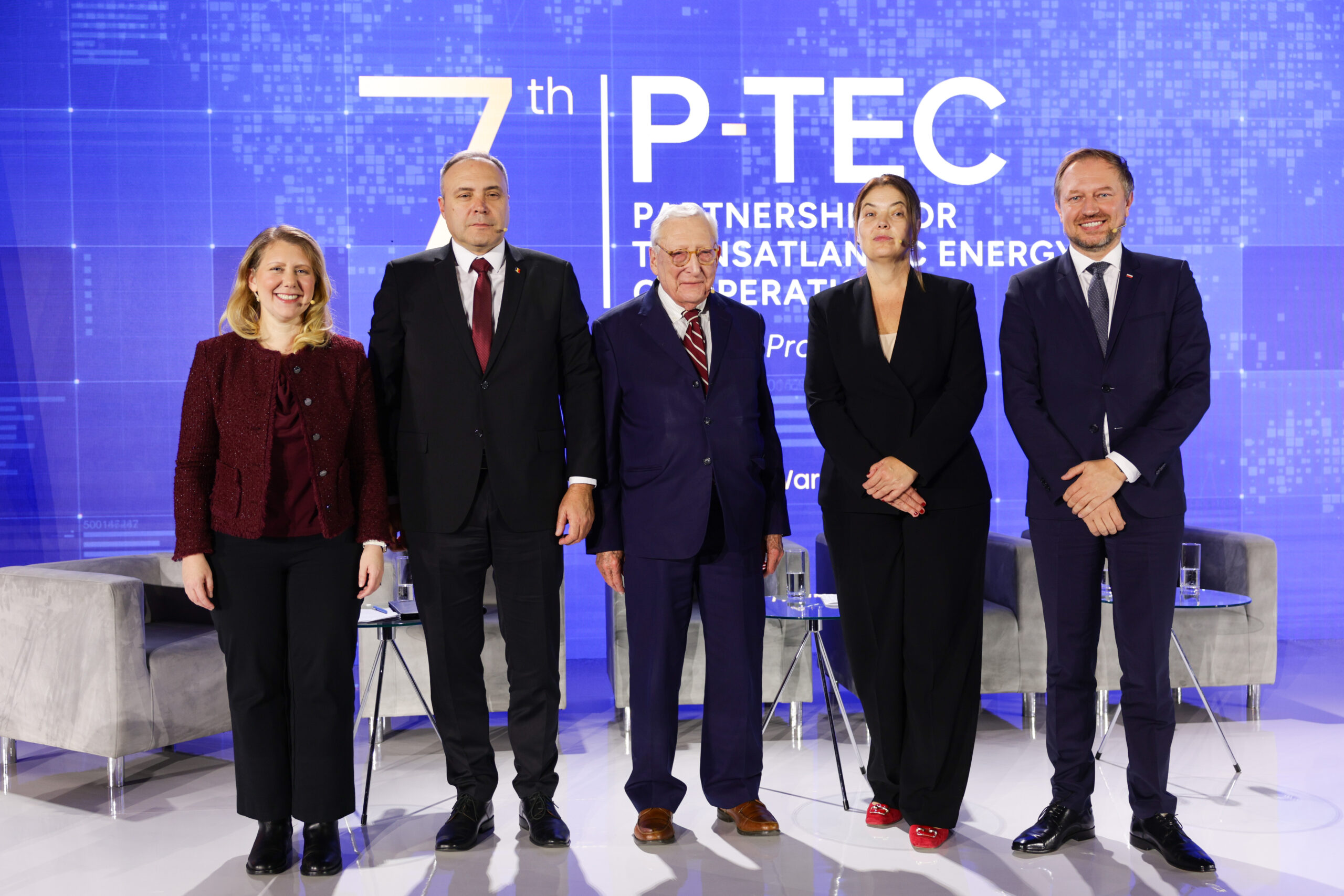
Watch the event “There is no way to build a nuclear power plant, even a small-scale nuclear power plant, purely based on commercial terms,” Polish Secretary of State Wojciech Wrochna argued. That raises a question for policymakers urgently working to diversify their countries’ energy mixes: What is the role of government in nuclear project deployment? Wrochna spoke at the seventh Partnership for Transatlantic Energy Cooperation (P-TEC), a ministerial gathering in Warsaw hosted by the US Department of Energy, the Polish Ministry of Energy, and the Atlantic Council’s Global Energy Center. There, he joined energy leaders from Romania, Bulgaria, and the United States to discuss cooperation between the private sector and government needed to propel nuclear energy development. Below are more highlights from the conversation—moderated by Jennifer Gordon, director of the Nuclear Energy Policy Initiative at the Atlantic Council—in which the energy leaders spoke about the financing support and derisking needed to grow the nuclear sector. Financing the buildout Wrochna outlined Poland’s plans to build two nuclear power projects, including three AP1000 reactors. He explained how the first project will be financed, with 30 percent coming from state-provided equity and 70 percent from external debt and borrowing. Government support to new nuclear builds provides “a certain credibility,” Wrochna argued, which could signal confidence to the private sector and drive private investment. Romanian Energy Minister Dumitru Chisǎlița similarly emphasized the role of governments in providing “predictable long-term contracts” to make projects bankable, pointing to a Romanian project to refurbish and develop the Cernavodă plant in cooperation with US, Canadian, and European companies. Chisǎlița urged more EU financial support for nuclear projects, including reactor lifetime extensions, under the next multiannual financial framework. Wrochna likewise suggested the EU should clarify nuclear energy’s place in the energy market. US Assistant Secretary of Energy Ted Garrish highlighted financing available through US institutions, including the Export-Import Bank and the International Development Finance Corporation. Such financing could help cover project costs, he said, with repayments beginning once plants generate electricity. De-risking supply chains and infrastructure Chisălița argued that predictable government investment programs help suppliers plan capacity expansion and reduce bottlenecks. He called for stronger European supply chains developed with transatlantic partners, including workforce training and supplier qualification—though that capacity is “not possible overnight,” he cautioned. Bulgarian Energy Minister Iva Petrova noted that fuel diversification is essential to energy security and strategic autonomy but added that there is a difference between “diversification of fuel supplies [and] achieving a long-term resilience,” which requires licensing, financing, and technological cooperation. Petrova recalled a heat wave this past summer that lowered water levels in the Danube River, forcing several nuclear units in the region to curtail output. The crisis, she said, showed the need to “assess the risks that climate change is posing on energy infrastructure and its resilience.” The need for international cooperation The energy officials also made the case for regional collaboration on nuclear projects, with Petrova saying that only “international cooperation” in the energy sector can foster the technology exchanges and financing needed to make nuclear a “successful story.” Wrochna likewise emphasized regional regulatory cooperation, arguing that closer coordination with European regulators could reduce costs and delays by sharing analyses and expertise. “The learning can go two ways,” he added, noting Poland can benefit from its neighbors’ experience as it goes through its nuclear reactor licensing process. Garrish noted that intergovernmental agreements can also help advance the nuclear buildout, mentioning the US-Poland agreement that was negotiated under the first Trump administration. “There’s a potential for Poland, in this particular case, to help us regionalize the approach throughout Europe,” he explained. Such agreements signal a government’s commitment and thus unlock supplier confidence—and the benefits of such collaboration can extend beyond energy: “Having a nuclear relationship with the country is a hundred-year relationship.” Jessica Moss is an assistant editor on the editorial team at the Atlantic Council. Watch the event
What it will take for nuclear energy to take off across Europe
Full Article
Original Source
Read the full article at Atlanticcouncil →KhanList aggregates and links to publicly available news content. We do not host full articles from third-party sources. Always verify important information with original sources.