
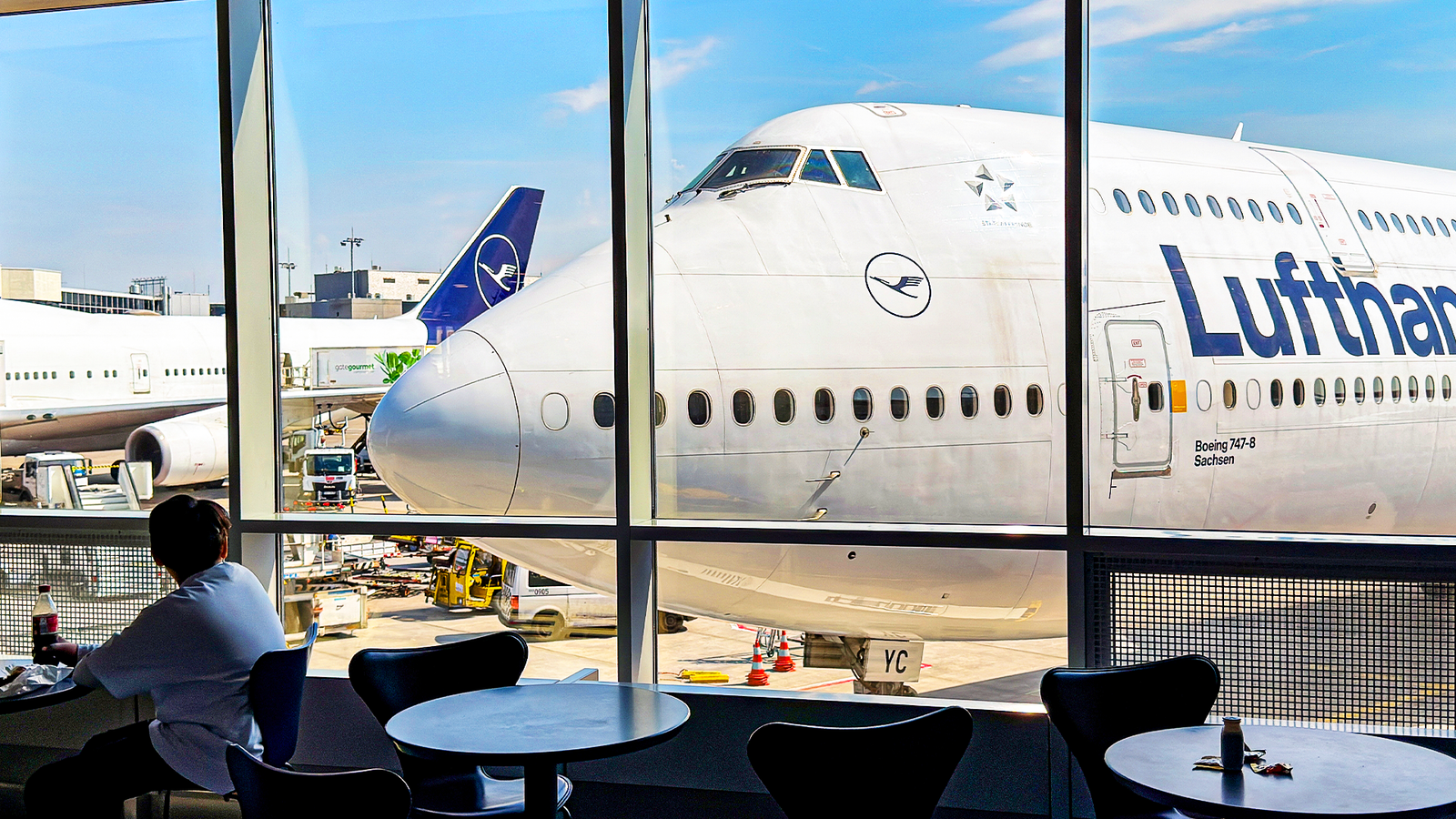
Credit: Ceri Breeze | Shutterstock, Simple Flying Published Oct 5, 2026, 7:00 PM EDT Based in the UK, Josh is a keen writer with a degree in Military History. Having worked previously as a financial journalist, he has covered the aviation industry extensively, reporting on airlines' results and monthly passenger statistics in the aftermath of the pandemic, alongside the likes of regulation around sustainable fuels, and the prospects for hydrogen-powered commercial flight. He joins Simple Flying with a lifelong love of all things aviation. Sign in to your Simple Flying account The Boeing 747 is no doubt an icon of the jet age. With its routes dating back to the 1960s, when it opened the door to intercontinental travel for the masses, the world’s first widebody jetliner remains widely in use across the globe all these years later. It is only a matter of time before its distinct hump and four-engine design are confined to the history books, though. That is in no small part down to more efficient alternatives increasingly emerging, which are as capable of transporting so many people over such distances as the 747 has for so long. Namely, the Boeing 777 has played a major part in proving the viability of twin-engine jets for long-haul operations. The Airbus A350 is another to bring about a major leap in efficiency, representing a new class of next-generation models that are progressively coming to dominate the space. As to why this is, the cost of running each is a massive factor. What Does It Cost To Run An Aircraft? Airlines have to consider several distinct sets of costs when considering how much it takes to run their aircraft. Direct operating costs, for example, encompass those incurred directly when flying a plane, such as fuel, maintenance, crew pay, as well as navigation and airport fees. On the other side, fixed costs cover the likes of depreciation, liability insurance, hangar leases, and management fees, which are less directly tied to how much a jet flies. The distinction is important because direct operating costs can vary significantly depending on timing and how an aircraft is used. Fuel, for instance, tends to be among the largest expenses for operators, so swings in oil prices can see costs shift massively. Similarly, maintenance fees really depend on the specific airline, aircraft type, its age, and utilization, so the amount spent on repairs and routine work, again, fluctuates from aircraft to aircraft and carrier to carrier. In the interest of providing an overview of the economics involved in flying different aircraft, direct operating costs can be used as a basis for comparison. Namely, fuel is key, since — in the case of the 747, 777, and A350 at least — the amount spent shifts considerably between models. The Boeing 777 And Longer-Haul Twin-Engine Travel Boeing’s 777 did not pioneer the use of two engines on widebodies itself. Entering service in 1995, it was preceded by the likes of the Airbus A300 and Boeing 767. What the 777 did do, though, was show that a twin-engine aircraft could sit closer in size and capacity to huge four-engine planes like the 747. Importantly, this helped to demonstrate there could be a far more economical option for airlines to use in serving the longest and highest density routes than bulky four-engine aircraft. The Boeing 777-300ER, itself the latest passenger variant from the family to be built and delivered to airlines, can offer an insight. First flown commercially in 2004, production of the variant ended in 2024 as Boeing readied itself to introduce the larger and more efficient 777X. That said, hundreds remain in service today, with the 777-300ER typically carrying 350 to 425 passengers in a two-class configuration for up to 7,500 nautical miles (13,890 km), according to the US manufacturer. Select Boeing 777-300ER specifications and indicative fuel costs: Model Capacity (two-class) Range Hourly fuel cost during cruise Boeing 777-300ER 350-425 7,500 nautical miles (13,890 km) ~$12,500* *Based on late September 2026 jet fuel price of $4.415 per US gallon In terms of fuel, the 777-300ER burns approximately 2,833 gallons (10,722 liters) of fuel per hour at economic cruise speed, according to the aviation data website Aircraft Investigation Info. Based on the International Air Transport Association (IATA) tracked jet fuel price as of the time of writing in late September ($4.415 per US gallon), that would equate to approximately $12,500 hourly in fuel alone as it stands. While better than its predecessors, such efficiency has come to be well beaten by the latest generation models flying today. The Airbus A350 And Next-Generation Economics Through the A350 family, Airbus offered its take on the next generation of commercial jets. Alongside the Boeing 787 that launched commercially four years prior, the A350’s introduction to passenger services in 2015 brought about a leap in technology. In particular, the A350 was designed with a greater proportion of composite materials than previous aluminum-heavy planes, making it lighter and more economical to run in turn. Of the two A350 variants, the Airbus A350-1000 is most comparable to the 777-300ER in terms of capacity, with a standard two-class configuration leaving room for 369 passengers onboard. The A350-1000 wins out on range, however, being capable of making trips of up to 9,100 nautical miles (16,850 km), per Airbus. It also comes out significantly stronger on fuel burn. Select Airbus A350-1000 specifications and indicative fuel costs: Model Capacity (two-class) Range Hourly fuel cost during cruise Airbus A350-1000 369 9,100 nautical miles (16,850 km) ~$10,000* *Based on late September 2026 jet fuel price of $4.415 per US gallon Based once again on data from Aircraft Investigation Info, the A350-1000 consumes around 2,268 gallons (8,585 liters) of fuel per hour during cruise. That means a fuel cost of just over $10,000 an hour based on the current price from IATA. In other words, fuel costs for the A350-1000 are 20% lower during each hour spent cruising than for the 777-300ER. Factor in older four-engine examples like the 747, and that number becomes even more stark. The Boeing 747 And Quad-Jet Consumption The 747 was revolutionary at the time of its introduction in the late 1960s, and its accolades speak for themselves. Some 1,574 were built over 56 years of production right up until 2023, racking up over 118 million flight hours and nearly 23 million flight cycles, per Boeing. Nonetheless, technology has moved on since its debut, leaving an ever-dwindling number of 747s in service today, particularly among passenger carriers. Against the 777-300ER and A350-1000, the latest 747 variant — the 747-8, which entered commercial passenger service in 2012 — does retain one strength: Its size. In excess of 500 passengers could be packed into the plane in theory, though the three airlines with 747-8s on their books run three- or four-class configurations. Lufthansa, the largest operator of the type, fits 364 passengers onboard throughout four classes, for context. When it comes to range, the 747-8’s ability to make 7,730 nautical miles (14,310 km) is trumped by the A350-1000 but betters the 777-300ER. However, each of the 777-300ER and A350-1000 is far more efficient in comparison. Select Boeing 747-8 specifications and indicative fuel costs: Model Capacity (two-class) Range Hourly fuel cost during cruise Boeing 747-8 500+ 7,100 nautical miles (13,100 km) ~$17,280* *Based on late September 2026 jet fuel price of $4.415 per US gallon At approximately 3,914 gallons (14,818 liters) an hour during cruise, based on Aircraft Investigation Info numbers, the 747-8 consumes far more fuel than either. At the current fuel price, that translates to $17,280 an hour, with the 777-300ER’s figure marking a near 28% reduction and the A350-1000’s a little more than 42%. That is before maintenance and the string of other direct and fixed operating costs, too. Maintenance And Other Direct Costs Where fuel prices can be highly volatile and realistically be the difference between an airline making and losing money on each flight, expenditure on maintenance and a host of other factors can have a similar, varying impact. Needless to say, when it comes to maintenance, the number of engines plays a part. The four engines of the 747 each require their own overhaul program and offer greater scope for costly and unexpected repairs than the two apiece on a 777 or A350, for instance. Age and airline are also just as vital, with older aircraft requiring more work and some operators boasting in-house servicing departments or flying common fleets to keep costs down. Add in the other direct operating costs — pay, the use of airport infrastructure, air traffic control, navigation, and communication services — and the cost of running each of the trio discussed above can balloon way past the price of fuel alone. Tens Upon Tens Of Thousands Of Dollars An Hour In the case of a 747, that all means running costs come in well above $20,000 and sometimes reach towards $30,000 per block hour, so the time between leaving the gate at the departure airport and parking at the next. That might sit at sub $20,000 for a 777 in the meantime, with an A350 then demanding noticeably less. An important note to make is that jet fuel, as of the time of writing in late September, had skyrocketed 106% compared to a year earlier. As such, the likes of hedging on the part of airlines will today be another key determinant of how much they actually pay per flight, with the power of locking in prices when they are low being as important as ever.
What It Costs To Run A Boeing 747 In 2026 Vs. A 777 Or An Airbus A350
Full Article
Original Source
Read the full article at Simpleflying →KhanList aggregates and links to publicly available news content. We do not host full articles from third-party sources. Always verify important information with original sources.