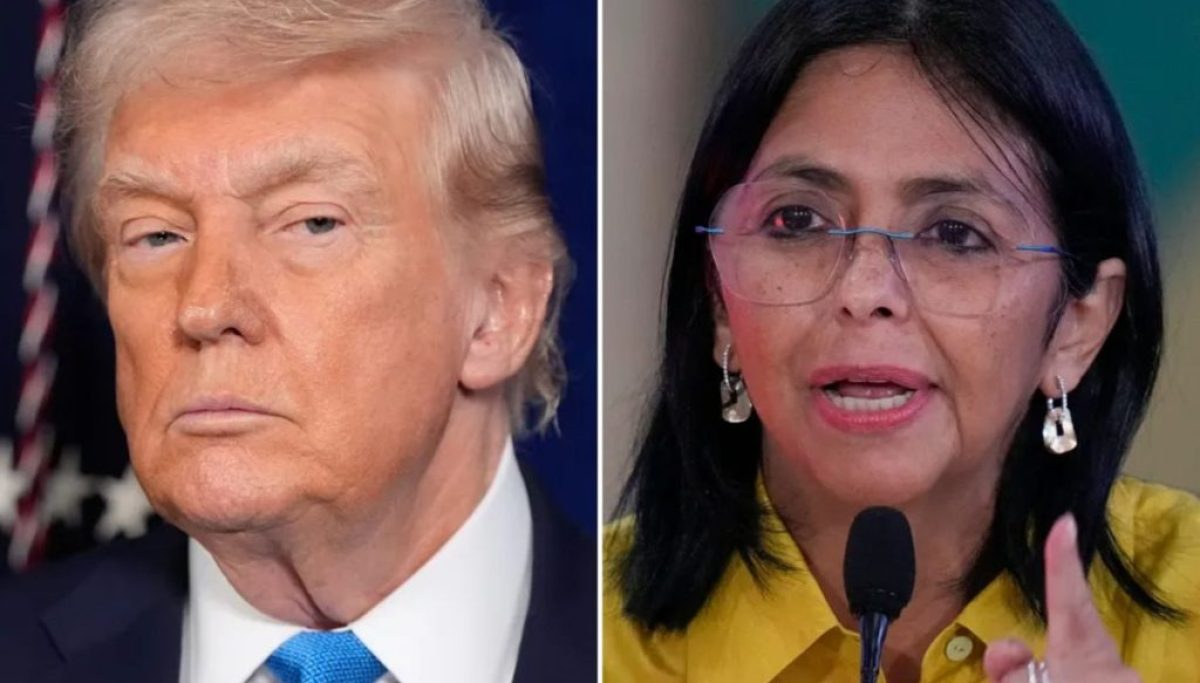
On Aug. 11, Israel and Venezuela announced that they would restore consular relations and establish an official coordination channel, 17 years after Hugo Chavez expelled Israel’s ambassador during the Gaza war. Foreign Minister Felix Plasencia and his Israeli counterpart, Gideon Sa’ar, presented the agreement as an outgrowth of Israel’s humanitarian aid mission following the June 24 earthquakes, which killed more than 6,000 Venezuelans.But the agreement is about much more than consular affairs — or even Israel. For acting President Delcy Rodriguez, who was installed after the United States captured Nicolas Maduro in January, foreign policy has become an instrument of regime survival. Her government has pursued a series of concessions that reduce Venezuela’s isolation without requiring meaningful political liberalization. The strategy is straightforward: become more useful to Washington without becoming more accountable at home.The opening to Israel is one of the clearest examples of that approach. Israel serves as a litmus test for Venezuela’s broader realignment. A gesture toward Jerusalem costs Rodriguez little domestically but carries considerable symbolic value in Washington, where breaking with Tehran and its allies can signal a wider strategic shift. It is a faster and cheaper way to demonstrate that Caracas is leaving behind the foreign-policy architecture of the Chavez and Maduro years. There is little political constituency left in Venezuela capable of turning the move into a serious domestic liability. Chavismo’s base is too depleted to mobilize over the restoration of consular ties, while the most vocal criticism has come from ideological radicals who objected when Rodriguez welcomed Israeli rescue workers after the earthquake. Iran, meanwhile, is in no position to impose meaningful costs on Caracas for drifting away. And the agreement itself is deliberately limited: no embassy, no ambassador, no permanent diplomatic mission, at least for now.The broader pattern is already visible. Since January, her government has restored relations with Chile, Peru, and the Dominican Republic, all of which broke with Caracas after the disputed 2024 election. It withdrew Venezuela from the International Criminal Court and rewrote oil and mining rules to attract American companies. In April, the International Monetary Fund resumed engagement after seven years, followed within hours by the World Bank. The U.S. Treasury then removed Rodriguez from its sanctions list. Taken together, these moves point to a foreign policy built less around ideology than transactional normalization.The second logic is the dismantling of the old foreign policy mindset. For more than a decade, Chavismo confined Venezuela to a narrow circle of strategic partners — China, Russia, Iran, and Cuba — while treating Washington, Western governments, multilateral institutions, and much of Latin America as adversaries. The break with Israel was part of that architecture. It was not merely a diplomatic decision; it was a marker of revolutionary identity.Donald Trump and Delcy Rodriguez (AP photos) Maduro reinforced that posture even as it became increasingly costly. In 2024, his government endorsed South Africa’s genocide case against Israel at the International Court of Justice. Venezuela’s foreign policy was supposed to reflect the ideological worldview of the Bolivarian revolution. Rodriguez appears increasingly unwilling to pay that price.Rather than defend Maduro’s map of the world, she is redrawing it. Governments once defined as enemies are becoming possible partners, and ideological commitments are being reconsidered based on what they can deliver. Some of this shift has genuine strategic significance. Iranian and Hezbollah-linked networks operating from Venezuelan territory have long concerned U.S. policymakers, and any meaningful reduction of those ties would matter beyond Venezuela’s borders.Sa’ar himself placed the new Venezuela agreement alongside Colombia’s recent recognition of Israeli sovereignty over the Golan Heights as evidence of a broader regional realignment. Whether that realignment proves durable remains uncertain. But Caracas is clearly testing how far it can move without paying a significant domestic political price.The third logic is domestic — and more directly connected to Venezuela’s opposition. Maria Corina Machado’s pro-Israel position has long been one of her foreign-policy calling cards. In 2020, her party, Vente Venezuela, signed a formal cooperation agreement with Benjamin Netanyahu’s Likud. She spoke with Netanyahu by phone last October, days after receiving the Nobel Peace Prize, and backed Israel’s campaign against Iran. In January, she pledged to restore diplomatic relations with Israel and move Venezuela’s embassy to Jerusalem, saying Venezuela would become Israel’s closest ally in Latin America.That position also gave Machado a useful credential in Washington, where support for Israel carries considerable political weight. Rodriguez has now taken that issue away from her. By opening her own channel to Jerusalem, Rodriguez ensures that the opposition can no longer claim exclusive ownership of Venezuela’s pro-Israel agenda. The move narrows one of Machado’s advantages in Washington while simultaneously allowing Rodriguez to present herself as the more pragmatic actor.WHEN MAGICAL REALISM BECOMES GOVERNMENT POLICYWhat is being tested in Caracas is whether an authoritarian government can become more useful to Washington without becoming more accountable to its own citizens. So far, Rodriguez appears to be testing the proposition successfully. For Washington, that distinction is also a warning. The remaining stages of normalization — from expanded oil licenses to full diplomatic relations — represent some of the few sources of leverage still available. If the goal is not simply to make Venezuela more useful, but to make its government more accountable, those concessions cannot all be given away at once.
What is Venezuela’s opening to Israel really about?
Full Article
Original Source
Read the full article at Washingtonexaminer →KhanList aggregates and links to publicly available news content. We do not host full articles from third-party sources. Always verify important information with original sources.