
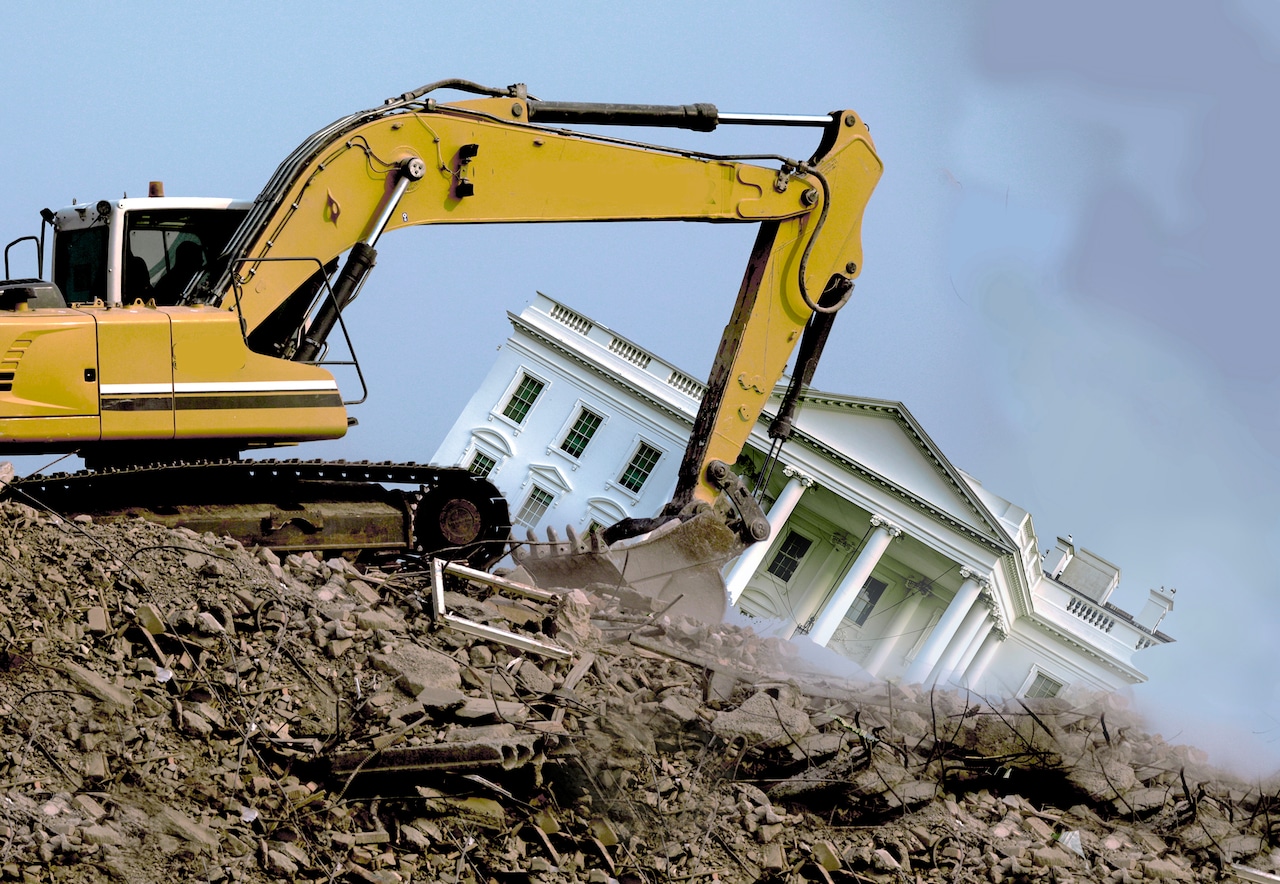
“Nothing is more destructive of respect for the government and the law of the land than passing laws which cannot be enforced.” – Albert EinsteinOn July 31, 2025, the Trump administration announced plans to demolish the East Wing of the White House to construct a 90,000-square-foot ballroom in its place. The ballroom would seat 650 people and cost $200 million. However, taxpayers would not pay for it. Instead, President Donald Trump and “other patriot donors” would finance the project.Things moved quickly thereafter. By September 2025, work crews were cutting down trees and digging up parts of the White House South Lawn. Demolition of the East Wing began the following month.As you can imagine, some questioned whether this unilateral project — the demolition of half of the White House and construction of an entirely new structure in its place — was legal. Indisputably, it is a historic building. The structure is so much part of the American ideal that we placed its image on our currency. Generally, historic buildings must go through specific processes before they may be modified. The idea being that the public has an interest in preserving their history as told through structures. This is besides the ethical question of whether such a monumental change to this house, traditionally referred to as “The People’s House,” should be made at the whim of one man — a temporary resident — as opposed to the will of “the people” to whom the structure truly belongs.The relevant law depends on which project stage you are considering; demolition or construction. You may be surprised to know that there really is no law barring demolition. The federal law that requires agencies to examine the impact of construction projects on historic properties specifically exempts the White House. Thus, at least in theory, a president could tear the building down in its entirety if desired. Although, I doubt many Americans would support that.Construction is a different matter, however. “A building or structure shall not be erected on … public grounds of the Federal Government in the District of Columbia without express authority of Congress.” The White House is located on federal grounds. It doesn’t take a lawyer to understand what that means. As with most of Trump’s decrees, litigation followed. In December 2025, the National Trust for Historic Preservation sued to stop construction. The Trust, a nonprofit dedicated to preserving historic sites across the country, argued that the project was illegal. It asked a federal court to pause construction until the National Capital Planning Commission and the Commission of Fine Arts could review the construction plans, approve them, and congressional authorization could be obtained. The Trust seemed to be winning as the case worked its way through the courts. The district court issued a preliminary injunction halting construction of the ballroom in March 2026. The court of appeals affirmed the district court’s ruling in August 2026. The problem was, while the case was proceeding, nothing changed on the ground. The district court’s order never went into effect while the government was fighting it. And just when it was set to go into effect, the U.S. Supreme Court stepped in to pause the order while it considered the prior rulings. In other words, although two courts had ruled that construction was illegal, construction never stopped. Last week, the U.S. Supreme Court issued its ruling. Importantly, the Court did not consider whether the project was illegal (again, it plainly is). Instead, the Court said that the Trust had no “standing” to bring the lawsuit. Essentially, this means that the Trust is not the right party to bring the lawsuit. Noticeably, no guidance was offered on who the right party would be. This brings me back to Einstein’s quote. What is the use of the law requiring congressional approval if it cannot be enforced? You might say that Congress is the right party to bring a lawsuit. You’re probably right, but what flows from that conclusion? Congress is a political animal. Thus, enforcement of this law depends not on whether it is complied with, but on which party controls Congress. Such a law is hardly a law, in the sense that it applies where the facts support it. Instead, it is a tool to be wielded only when politically advantageous.Eric Foster is a columnist for The Plain Dealer and cleveland.com.You should know that the Supreme Court’s decision was close. The split was 5-4. The dissent, written by Chief Justice John Roberts, not only argues that the Trust does indeed have standing to bring the lawsuit but also says that the ballroom construction project “is likely unlawful.” Thus, judges at every level of the judicial branch have found that the project is illegal. The ballroom project is now estimated to cost $400 million. Although, the administration insists that private donations will cover it, it has sought (and used) public dollars for “security” in the East Wing. I don’t think this administration has earned the benefit of the doubt on that.We live in a nation of laws, and not of men. Yet, here is a man destroying the People’s House. And the law says that the people cannot stop it. Eric Foster, a community member of the editorial board, is a columnist for The Plain Dealer and cleveland.com. He is a lawyer in private practice and writes from Atlanta. The views expressed are his own.To reach Eric Foster: ericfosterpd@gmail.comHave something to say about this topic?* Send a letter to the editor, which will be considered for print publication.* Email general questions about our editorial board or comments or corrections on this opinion column to Elizabeth Sullivan, director of opinion, at esullivan@cleveland.com.
What is the use of the law requiring congressional approval if it cannot be enforced?
Full Article
Original Source
Read the full article at Cleveland →KhanList aggregates and links to publicly available news content. We do not host full articles from third-party sources. Always verify important information with original sources.