
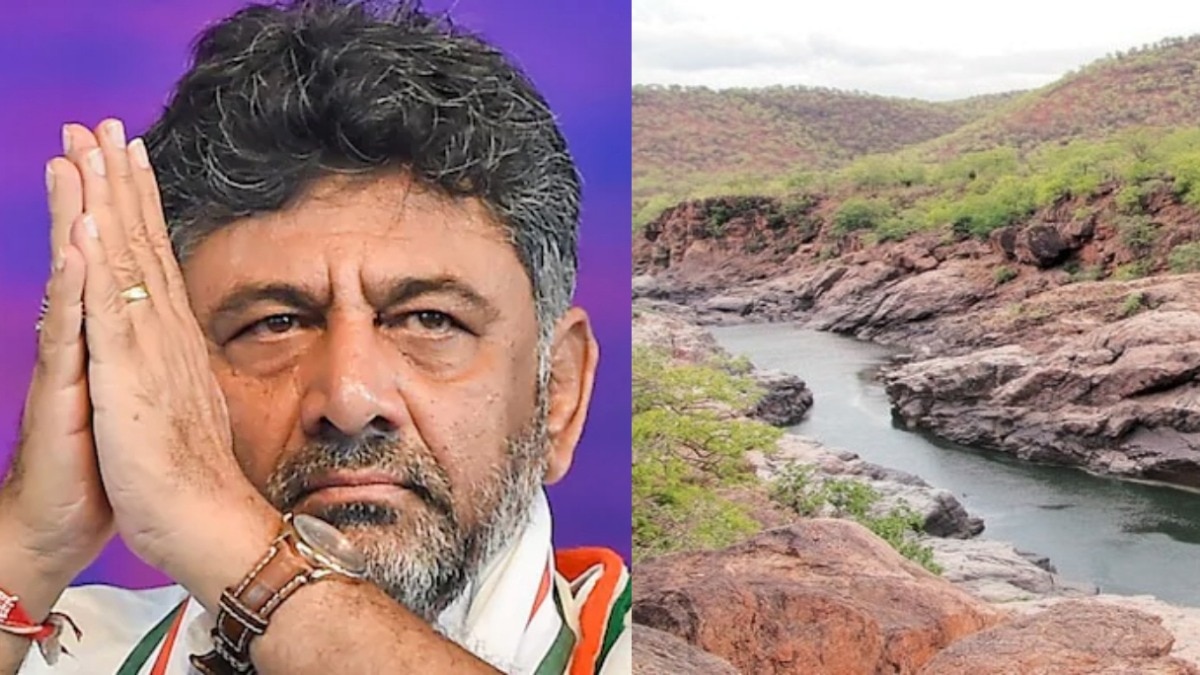
Two southern states are facing off over a dam proposal that could become an important source of water for Bengaluru in the years ahead. With the Cauvery's waters and the lives of millions at stake, the Supreme Court's latest ruling and Karnataka Deputy Chief Minister D.K. Shivakumar's stand have raised fresh questions, which the Tamil Nadu government under Vijay continues to press.New Delhi,Nov 14, 2026 20:12 ISTA political tussle is once again unfolding in southern India, with Karnataka and Tamil Nadu at its centre. The sharing of Cauvery waters has become a fresh point of concern for the Congress-led Karnataka government and the TVK-led government in Tamil Nadu.The Mekedatu dam project, proposed by Karnataka across the Cauvery river, has now brought the two neighbouring states face to face.The matter took a visible turn when the Vijay-led government in Tamil Nadu unanimously adopted a resolution opposing the project.This is hardly the first time that two Indian states have locked horns over a river and a project proposed upon it. But the Mekedatu dispute has a bearing on something far more important than a political disagreement: the sharing of a river upon which millions depend.The Cauvery is one of the principal rivers of southern India. Rising in the Brahmagiri hills of Karnataka's Kodagu district, it flows through Karnataka and Tamil Nadu before emptying into the Bay of Bengal. The matter has also been before the Supreme Court. In November 2025, the apex court declined to entertain Tamil Nadu's challenge at that stage, observing that the project was still under examination by the competent authorities.Karnataka CM DK Shivakumar has repeatedly pressed for the project to move forward, including making a case for it before Prime Minister Narendra Modi. Tamil Nadu, meanwhile, remains opposed to the proposal, insisting that its water rights must be protected.What exactly is the Mekedatu project? Why does Karnataka consider it necessary, and what makes Tamil Nadu so apprehensive about it? To understand the dispute, let us first look at the project, the river and the long-running disagreement over its waters.WHAT IS THE MEKEDATU PROJECT?The Mekedatu project, formally called the Mekedatu Balancing Reservoir and Drinking Water Project, is Karnataka's proposal to build a dam across the Cauvery river, near the Karnataka–Tamil Nadu border.The plan is to construct a concrete gravity dam and a reservoir that can store water and regulate its release. Karnataka has three principal objectives in mind: meeting Bengaluru's drinking water needs, managing the flow of Cauvery water towards Tamil Nadu and generating hydroelectric power.As per the project proposal, the reservoir would have a total storage capacity of 67.16 TMC, of which 59.46 TMC would be live storage. It is also expected to generate 400 MW of electricity.The location is central to the proposal. Mekedatu lies downstream of the Cauvery–Arkavathi confluence but upstream of the interstate boundary. Karnataka believes a reservoir here would help it manage the river's waters while addressing the needs of Bengaluru.There is, however, a long way between proposing a dam and building one. The project remains subject to examination and the requisite statutory clearances. A Detailed Project Report, by itself, is no licence to begin construction.WHY DOES KARNATAKA WANT TO BUILD THE DAM?Karnataka's principal argument for the project is the growing demand for drinking water in Bengaluru and its surrounding areas. The city has expanded considerably over the past few decades, placing greater demands upon its water supply.The state maintains that the Mekedatu reservoir would provide an additional means of storing and regulating Cauvery water. Of the proposed allocation, about 4.75 TMC is earmarked for drinking water needs in the Bengaluru Metropolitan Region and adjoining areas.The second objective is to regulate river flows. Karnataka argues that the reservoir would help it manage the monthly release of Cauvery water to Tamil Nadu at Biligundlu, the interstate point where these releases are measured.The third is power generation. The project proposes a hydroelectric plant with an installed capacity of 400 MW. Thus, Karnataka presents Mekedatu as a project intended to serve three purposes: drinking water supply, regulation of river flows and electricity generation.WHY IS TAMIL NADU OPPOSING THE MEKEDATU PROPOSAL?Tamil Nadu's objection arises from the long-standing Cauvery water dispute. As a lower riparian state, it receives the river's waters from Karnataka. Its agricultural regions, particularly the Cauvery delta, depend greatly upon the river for irrigation. The state therefore fears that a new reservoir upstream could affect both the timing and quantity of water reaching its territory.Tamil Nadu's chief concern is that the reservoir would give Karnataka greater capacity to store and regulate Cauvery water before it flows downstream. It fears that this could affect the prescribed releases, particularly in years of deficient rainfall.The state has also maintained that Karnataka cannot proceed with a new storage project in the Cauvery basin without the necessary approvals and due regard for the interests of the other basin states, Tamil Nadu, Kerala and Puducherry.The dispute thus turns on a question of assurance: whether the reservoir can be operated without affecting the water rights of the state downstream.THE CAUVERY WATER DISPUTEThe Mekedatuv dam controversy cannot be understood apart from the larger Cauvery water dispute, whose origins lie in agreements between the princely State of Mysore and the Madras Presidency under British rule.The agreements of 1892 and 1924 governed the use of Cauvery waters. Their terms later became a source of disagreement between the successor states. After Independence and the reorganisation of states, the dispute took on a new inter-state character.Karnataka and Tamil Nadu continued to differ over the sharing of the river, while Kerala and Puducherry also asserted their interests as basin states. After years of negotiations failed to settle the matter, the Cauvery Water Disputes Tribunal was constituted in 1990.The Supreme Court's 2018 judgment led to the establishment of the Cauvery Water Management Authority (CWMA) and the Cauvery Water Regulation Committee (CWRC), which oversee the implementation of the water-sharing arrangement.The Mekedatu proposal must therefore pass not only technical and statutory scrutiny but also the test of cooperation between the states.The Cauvery flowed through this region long before modern state boundaries were drawn. Its waters must now be managed within the framework of the law, and with due regard for the rights of all concerned.- Ends
What is the Mekedatu Dam project? Why Karnataka wants it and Tamil Nadu objects
Full Article
Original Source
Read the full article at Indiatoday →KhanList aggregates and links to publicly available news content. We do not host full articles from third-party sources. Always verify important information with original sources.