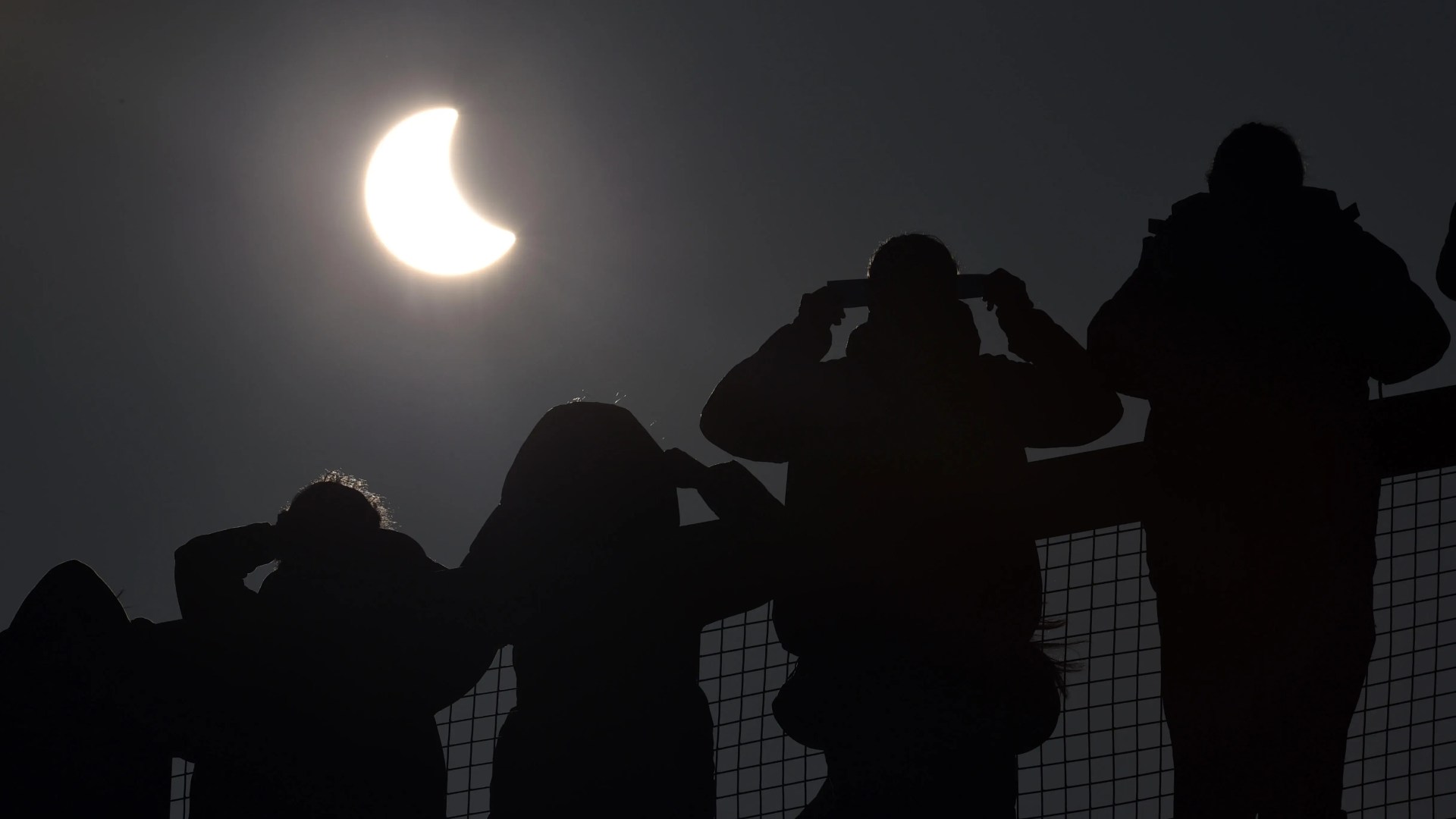
ECLIPSES can turn daylight into dusk or transform the Moon into a blood-red orb. While both a solar eclipse and a lunar eclipse involve the Sun, Earth and Moon lining up, the three bodies stand in a different order. A partial solar eclipse will grace UK skies this week Credit: Alamy Later in August there will also be a partial lunar eclipse Credit: Alamy A solar eclipse blocks our view of the Sun, while a lunar eclipse sees Earth’s shadow fall across the Moon. The UK will see both in August 2026 – a partial solar eclipse on August 12, and a partial lunar eclipse on August 28. Sign up for the Tech newsletter Thank you! What is a solar eclipse? A solar eclipse happens when the Moon moves between Earth and the Sun, casting its shadow onto our planet. It can only occur during the new Moon phase. A total solar eclipse occurs when the Moon completely covers the Sun for observers inside its darkest shadow. This reveals the corona, the Sun’s outer atmosphere, and can make the daytime sky appear as dark as twilight. Totality can only be witnessed from a narrow path because the Moon’s shadow covers a small area of Earth. A partial solar eclipse occurs when the Moon and the Sun are not precisely aligned, meaning that only some of the Sun is covered. You can also witness an annular eclipse, which occurs when the Moon appears too small to hide the Sun completely, leaving a ring around it. Most read in Tech Because of the striking visual effect, this can also be known as a “ring of fire” eclipse. Then there is the rare phenomenon of the hybrid eclipse, which appears total from some locations and annular from others. What is a lunar eclipse? A lunar eclipse occurs when Earth moves between the Sun and Moon, causing our planet’s shadow to fall across the lunar surface. It can only happen during a full Moon. A total lunar eclipse sees the whole Moon pass into Earth’s central shadow, known as the umbra. Instead of disappearing, it can turn orange or red as sunlight passes through Earth’s atmosphere, where shorter blue wavelengths are scattered, while redder light reaches the Moon. This is why a total lunar eclipse is sometimes called a Blood Moon. A partial lunar eclipse covers only part of the Moon with the umbra, while a penumbral eclipse produces a subtler dimming in Earth’s lighter outer shadow. Unlike a total solar eclipse, a lunar eclipse can be watched from anywhere on Earth’s night side where the Moon is above the horizon. Eclipses don’t happen every new and full Moon. This is because the Moon’s orbit is tilted by about five degrees compared with Earth’s orbit around the Sun, which means most months the three bodies don’t line up precisely enough. Is it safe to look at solar and lunar eclipses? A lunar eclipse is completely safe to watch with the naked eye, binoculars or a telescope. However, looking directly at a solar eclipse without proper protection can permanently damage your sight. Viewers must use eclipse glasses or a handheld solar viewer complying with the ISO 12312-2 standard, or watch indirectly, such as with a pinhole projector or colander. Comment now
What is the difference between a solar eclipse and a lunar eclipse?
Full Article
Original Source
Read the full article at Thesun →KhanList aggregates and links to publicly available news content. We do not host full articles from third-party sources. Always verify important information with original sources.