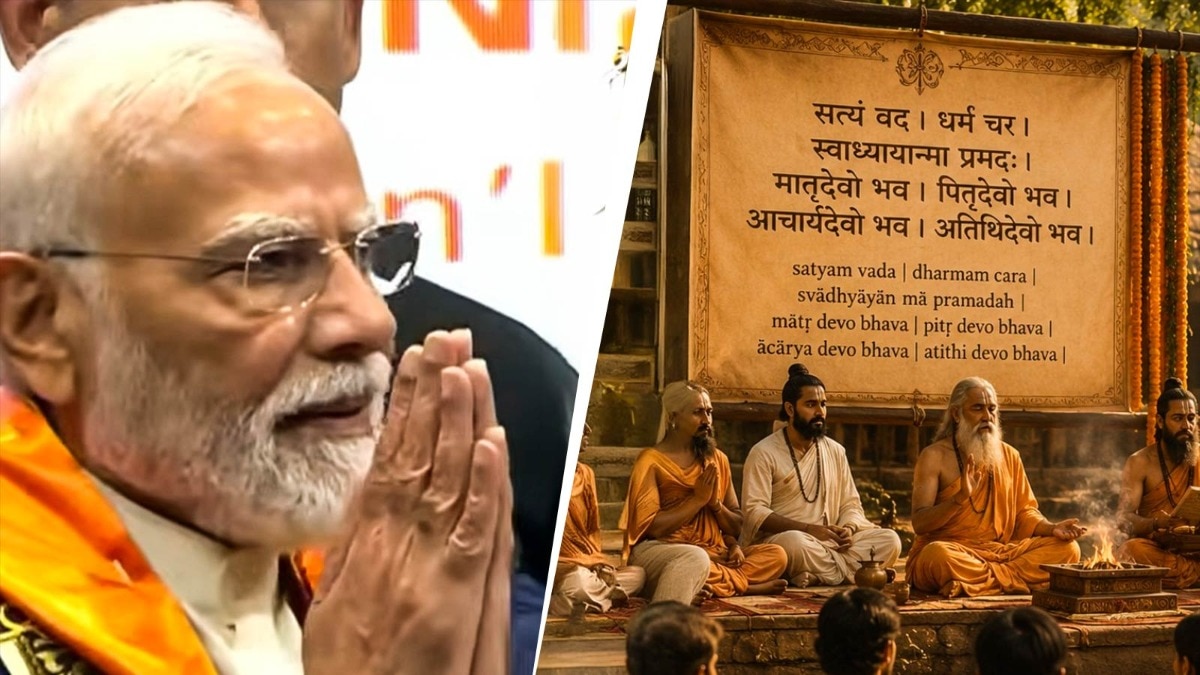
A centuries-old Sanskrit chant at IIT Delhi's convocation became the subject of a very modern social media debate after Congress spokesperson Shama Mohamed identified it as the Gayatri Mantra. But the verses were from the Shikshavalli of the Taittiriya Upanishad, a text rooted in learning and the teacher-student bond. So what is Shikshavalli, and why was it recited at an IIT convocation?What began as a few minutes of Sanskrit at IIT Delhi’s August 8 convocation has turned into a much bigger argument about religion, education and India’s ancient intellectual traditions.The ceremony, attended by Prime Minister Narendra Modi, came under scrutiny on social media after Vedic verses were recited during the presentation ceremony. Congress spokesperson Shama Mohamed identified the recitation as the Gayatri Mantra and questioned why "a religious chant" was being used at a convocation of one of India’s premier technological institutions.But there was a problem with that identification.Academics, alumni and scholars pointed out that the verses were not, in fact, the Gayatri Mantra. They were from the Shikshavalli, the opening section of the Taittirya Upanishad of the Krishna Yajurveda. That distinction may sound technical, it is anything but.IIT Kanpur alumnus G C Mehta, now based in the US, pointed out that Shikshavalli has been part of convocation traditions at several IITs for decades. More importantly, the text itself is about learning, it is about the responsibilities of the student and teacher, ethical conduct and the passing of knowledge from one generation to the next. In other words, the verses at the centre of the controversy were not simply a religious chant picked at random for an academic ceremony. They came from a text whose very name and purpose are rooted in shiksha... learning.The controversy has, perhaps inadvertently, brought an ancient text back into the spotlight, and given a new generation a reason to ask what Shikshavalli actually says.SO, WHAT IS SHIKSHAVALLI?Shikshavalli (ikvall) is the opening chapter of the Taittirya Upanishad, one of the principal Upanishads associated with the Krishna Yajurveda.The Sanskrit word "ik" means instruction, education, or phonetics, and the text deals with the discipline of learning, proper pronunciation of Vedic sounds, ethical duties, self-control, respect for teachers, and the responsibilities of students as they enter society after completing their studies.Traditional editions of the Taittirya Upanishad divide the work into three sections:ikvall – dealing with instruction, discipline, and student conduct;Brahmnandavall – exploring the nature of Brahman and ultimate bliss;Bhguvall – presenting the enquiry of the sage Bhgu into the nature of reality.Scholars of Vedic literature have long regarded ikvall as a foundational text on education because it combines intellectual training with moral and social responsibilities.WHY IS IT RECITED AT CONVOCATIONS?The portion most commonly recited during university and convocation ceremonies is the celebrated convocation address found in ikvall. In this passage, the teacher gives final instructions to students who are about to leave the institution and enter public life.Among its best-known injunctions are:Satyam vada — Speak the truth;Dharmam cara — Follow the path of righteousness;Mt devo bhava — Regard the mother as divine;Pit devo bhava — Regard the father as divine;crya devo bhava — Regard the teacher as divine;Atithi devo bhava — Regard the guest as divine.These verses are widely interpreted as ethical and civic instructions intended to guide graduates in their professional and personal lives. Because of this character, many educational institutions have treated the recitation as a ceremonial affirmation of academic values rather than as an act of worship.SHIKSHAVALLI AND THE PHILOSOPHY OF EDUCATIONThe present discussion has also drawn attention to the broader educational philosophy embedded in the Taittirya Upanishad. The text presents education as a threefold relationship:the teacher at the beginning,the student at the receiving end,and the subject of knowledge as the connecting medium between them.This conception views learning not merely as the transfer of information but as the cultivation of character, discipline, clarity of speech, self-restraint, and social responsibility.The introductory portions of ikvall even discuss phonetics, pronunciation, intonation, and the correct articulation of sounds, reflecting the ancient Indian belief that precision in language was essential for preserving knowledge. Modern scholars of Indian education have often noted that these features resonate with contemporary concerns about ethical education, teacher-student mentorship, and value-based learning.Some supporters have argued that reciting ikvall at a technological institution does not diminish scientific inquiry; rather, it acknowledges that technical competence and ethical responsibility should develop together. They maintain that institutions producing scientists, engineers, and administrators also have a duty to encourage integrity, social commitment, and respect for knowledge.Critics, however, continue to debate the place of ancient cultural expressions within publicly funded institutions. The IIT Delhi episode has therefore become part of a larger national conversation about how India’s civilisational heritage should be represented in modern academic spaces.TRADITION OLDER THAN THE CURRENT CONTROVERSYHistorical records and accounts from IIT alumni indicate that Vedic invocations from the Taittirya Upanishad have been used in convocation ceremonies at various IITs for many decades.Alumni have pointed out that similar recitations were heard even during convocations attended by former Prime Minister Indira Gandhi, suggesting that the practice predates contemporary political debates.The chant is generally performed during the academic procession or convocation opening, symbolising the transition of students from formal study to responsible participation in society. In this context, the emphasis is placed on learning, discipline, gratitude to teachers, and ethical conduct.- EndsPublished By: Rishab ChauhanPublished On: Aug 10, 2026 12:50 IST
What is Shikshavalli? The ancient chant that sparked a debate after IIT Delhi's convocation
Full Article
Original Source
Read the full article at Indiatoday →KhanList aggregates and links to publicly available news content. We do not host full articles from third-party sources. Always verify important information with original sources.