
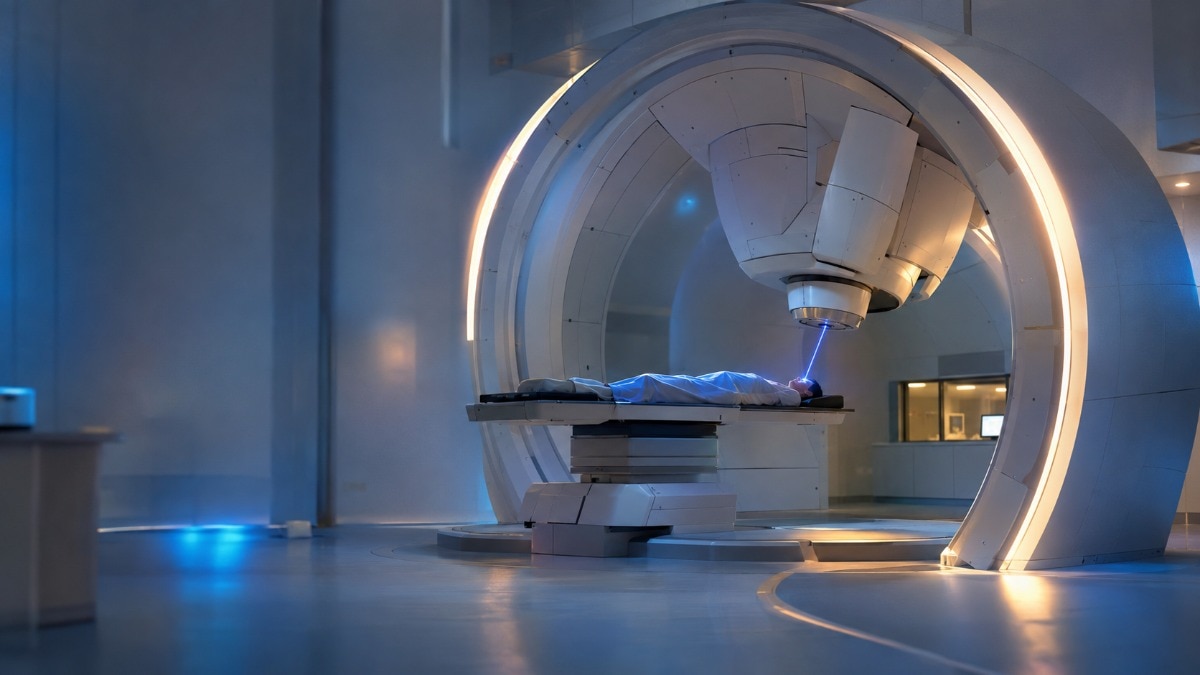
In a hushed treatment room, beneath a steel gantry nearly as tall as a three-storey building, a child lies perfectly still. A beam of invisible particles enters her body at almost two-thirds the speed of light. It slips through skin and healthy tissue, sparing the delicate organs that lie beside the tumour. Then, at precisely the right depth, it surrenders almost all its energy, and stops.Nothing travels on, and nothing passes out the other side.This is proton therapy, one of the most precise weapons medicine has ever turned against cancer. And it is coming to the Northeast.Assam is now building a proton beam therapy centre at Gauhati Medical College and Hospital in Guwahati, at a cost of about Rs 600 crore, with Rs 315 crore from the World Bank. Once ready, it will be India's first proton therapy centre run by a state government. WHAT IS PROTON BEAM THERAPY?Proton therapy is a form of radiation treatment for cancer. Instead of X-rays, it uses protons, the tiny positively charged particles found in the centre of every atom.Dr Srinivas Chilukuri, Senior Consultant in Radiation Oncology at Apollo Proton Cancer Centre, Chennai, told India Today Digital how the beam is made. "We speed them up in a machine called a cyclotron to roughly two-thirds the speed of light. Then magnets steer them into the patient," he said. A proton therapy treatment room at Apollo Proton Cancer Centre, Chennai, India’s first proton therapy hospital. The beam is delivered through the nozzle at the centre of the rotating gantry, while a robotic arm positions the patient with precision. (Image: Apollo Proton Cancer Centre) A cyclotron is a machine that whirls charged particles round and round, faster and faster, before releasing them as a beam.The hospital's credentials are strong. The Chennai centre was the first hospital in India and South Asia built for proton therapy, and it is also India's first cancer centre to be accredited by Joint Commission International (JCI), a global body that checks hospitals for quality and patient safety.HOW DOES PROTON THERAPY WORK?The magic lies in how a proton loses its energy. "As a proton travels through the body, it slows down. Most of its energy is released right at the end of its path, in a sharp burst called the Bragg peak. After that, it stops completely," Dr Chilukuri said.Doctors set the energy of each proton so that this burst lands inside the tumour. "Protons have no exit dose," he said. In other words, the beam does not carry on beyond the tumour.Today, the tumour is treated with a pencil-thin beam that moves across it layer by layer, a method called pencil beam scanning. "That lets us shape the dose closely around the tumour and spare the organs next to it," he said.IS PROTON THERAPY BETTER THAN RADIATION THERAPY?Not always, and that is the honest answer. "Protons do not kill cancer better. Their advantage is in what they spare," Dr Chilukuri said.Conventional X-rays pass right through the body, giving a dose to healthy tissue on the way in and on the way out. Yet most patients are still treated very well with modern X-ray techniques. "Proton therapy adds to conventional radiotherapy; it does not replace it," he said. If a tumour is not near anything critical, the extra cost may bring no real gain.WHO NEEDS PROTON THERAPY?Children stand to gain the most. "Their tissues are still growing, and they have decades of life ahead in which radiation side effects or a second cancer could show up," Dr Chilukuri said.A 2022 review in Frontiers in Oncology found that proton therapy reduces the stray radiation dose, and with it the estimated risk of a second cancer, in young patients compared with X-ray treatment.Among adults, the clearest benefit is for tumours close to vital organs, such as those at the base of the skull, near the spine, in the brain, in the head and neck, and in the eye.IS PROTON THERAPY PAINFUL?Patients often fear the treatment will hurt. It does not. "Proton therapy is completely non-invasive and painless, just like conventional radiotherapy," Dr Chilukuri said. Non-invasive means nothing cuts or enters the body. Patients feel no heat or pain, and they go home the same day.Each session takes about 20 to 45 minutes, though the beam itself is on for only a few minutes. Young children usually need a short anaesthetic to keep still. A full course runs from one to seven weeks.WHAT IS HADRON THERAPY?Proton therapy belongs to a wider family called hadron therapy. A hadron is a particle made of the same building blocks as the atom's core, such as protons, neutrons and heavier atomic nuclei like carbon.Yogendra Narain Srivastava, professor emeritus at Northeastern University, told India Today Digital why these particles matter. Electrons travel only a short distance, so they suit tumours near the skin. X-rays reach deeper but "are active over a larger area, and thus they relatively damage more normal cells as well," he said.Srivastava is no ordinary voice on the subject. Born in Gorakhpur, Uttar Pradesh, he earned a PhD in physics from Indiana University at 23. He is a fellow of the American Physical Society, and the Royal Swedish Academy of Sciences has invited him three times to help nominate candidates for the Nobel Prize. For the past couple of years, he has been studying cancer care across India.Heavier particles pack more energy into a tiny space. That lets them break both strands of a cell's DNA, the molecule that carries its genetic instructions, rather than just one, so "there is less probability of repair of a broken DNA of a damaged cancer cell," Srivastava said. But he added a warning: "Any normal cells within the ions' reach will meet the same negative treatment."WHY IS PROTON THERAPY SO EXPENSIVE?The answer lies in the machinery. "The cost comes mostly from the infrastructure," Dr Chilukuri said. A centre needs a particle accelerator, magnets weighing many tonnes, a rotating gantry, the giant frame that turns the beam around the patient, and thick concrete walls to block radiation. "A single centre can cost several hundred crore rupees before it treats its first patient."Srivastava estimates that a high-energy proton accelerator can cost five times or more than a conventional radiotherapy machine, and needs four to five times the space.HOW MANY PROTON THERAPY CENTRES ARE THERE IN INDIA?India has two today: Apollo Proton Cancer Centre in Chennai and the proton centre at Tata Memorial Centre's ACTREC in Navi Mumbai. Assam's will be the third.For families in the Northeast, the distance is punishing. "A family from the Northeast who needs proton therapy usually has to move to Chennai or Mumbai for six to eight weeks," Dr Chilukuri said. "Some families simply cannot do it, so they settle for a less suitable treatment, or none at all."He called the Guwahati centre a sign that "advanced radiotherapy belongs inside the public health system and is not a luxury," but stressed it needs trained staff, child anaesthesia and good imaging to succeed.Srivastava raises a sharper concern. Before choosing any treatment, doctors must first see where the cancer is, using imaging that relies on short-lived radioactive tracers such as fluorine-18, which loses half its strength in under two hours.He says these are produced in only a few Indian cities. Without wider access to such imaging, he warned, costly machines risk serving only "the ultrarich and powerful" rather than the whole nation.A beam that knows exactly where to stop is a remarkable gift. The bigger task is making sure it reaches everyone who needs it.- Ends
What is proton therapy for cancer, and why is Assam betting Rs 600 crore on it?
Full Article
Original Source
Read the full article at Indiatoday →KhanList aggregates and links to publicly available news content. We do not host full articles from third-party sources. Always verify important information with original sources.