
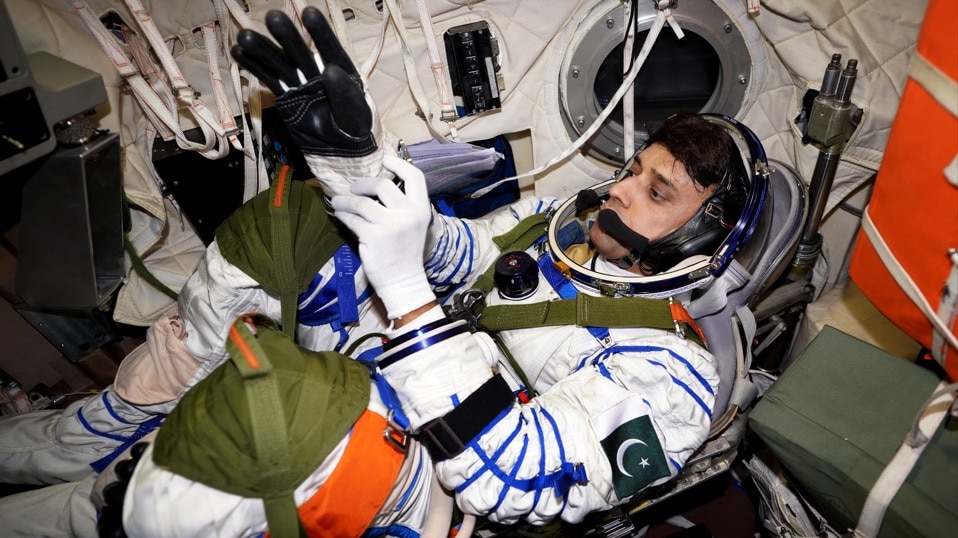
The former air force pilot has joined an international crew for a mission involving experiments that could help scientists understand life beyond Earth.Muhammad Zeeshan Ali is seen during ground training in China. (Photo: AFP)New Delhi,Nov 27, 2026 12:16 ISTPakistan's first astronaut, Muhammad Zeeshan Ali, made history by travelling to space just days ago, and boarding China's space station as the first international person to arrive there.But that's not all Ali is doing; he is also taking part in scientific experiments that could help researchers understand how living organisms and materials behave beyond Earth.Ali, a 40-year-old former Pakistan Air Force pilot, reached China's Tiangong space station aboard the Shenzhou-24 spacecraft on November 25, becoming the first Pakistani to travel into space and the first foreign astronaut to board China's space station. Muhammad Zeeshan Ali address a news conference at the Jiuquan Satellite Launch Center. (Photo: AP) He is part of a three-member crew, alongside Chinese astronauts Tang Hongbo and Wu Yi. The spacecraft lifted off from the Jiuquan Satellite Launch Center in northwestern China before docking with Tiangong, where the new arrivals joined three astronauts already living aboard the station.Ali is expected to spend between five and 10 days in orbit before returning to Earth aboard the Shenzhou-23 spacecraft with two members of the earlier crew.WHAT EXPERIMENTS WILL PAKISTAN'S ASTRONAUT CONDUCT? Ali's primary responsibility is to assist with scientific experiments under a joint China-Pakistan space cooperation programme.According to the China Manned Space Agency, four joint projects involving biotechnology and materials research are part of the mission.Pakistani astronaut Zeeshan Ali & Shenzhou-24 crew kick off Tiangong mission https://t.co/LcygtVOKiU— ShanghaiEyeofficial (@ShanghaiEye) November 27, 2026Ali will help install experiment samples and equipment, operate them in space and carry out scheduled research activities.One of his key assignments involves studying photosynthetic cyanobacteria, the tiny living organisms that use sunlight to produce energy, much like plants.Researchers are interested in understanding how they behave in space, where conditions such as weightlessness can affect biological processes.The wider Shenzhou-24 mission will involve more than 90 scientific experiments and technology tests.These include research and equipment trials designed to improve the understanding of how things work in space.LAUNCH! Chang Zheng 2F/G launches Shenzhou-24 and a crew of three to the Tiangong space station from the Jiuquan Satellite Launch Center. Overview: https://t.co/yGXnC2ClNE Live: https://t.co/SSpo1ozfEM https://t.co/s6hGI15Ydz— NSF - NASASpaceflight.com (@NASASpaceflight) November 25, 2026WHY DOES CHINA HAVE A SPACE STATION?Tiangong, which means Heavenly Palace, is China's permanently occupied space station and a major research facility orbiting Earth.Unlike a spacecraft that carries astronauts on a journey, a space station stays in orbit and provides a place where astronauts can live and work for extended periods. It allows scientists to conduct experiments in conditions that are difficult to recreate on Earth.The station has three main sections: a central module where astronauts live and control the station, and two laboratory modules equipped for scientific research. An image of Chian's Tiangong Space Station. (Photo: X) China uses Tiangong to study subjects ranging from biology and materials science to the effects of long stays in space on the human body. The research is also important as the country prepares for future crewed missions to the Moon.Ali's participation is significant beyond the experiments themselves.His flight follows a February 2025 agreement between China and Pakistan on astronaut selection and training, marking a new phase in their space cooperation.The mission also opens the door for Pakistani scientists and researchers to participate more directly in China's human spaceflight programme.- Ends
What is Pakistan's first astronaut doing aboard China's space station?
Full Article
Original Source
Read the full article at Indiatoday →KhanList aggregates and links to publicly available news content. We do not host full articles from third-party sources. Always verify important information with original sources.