
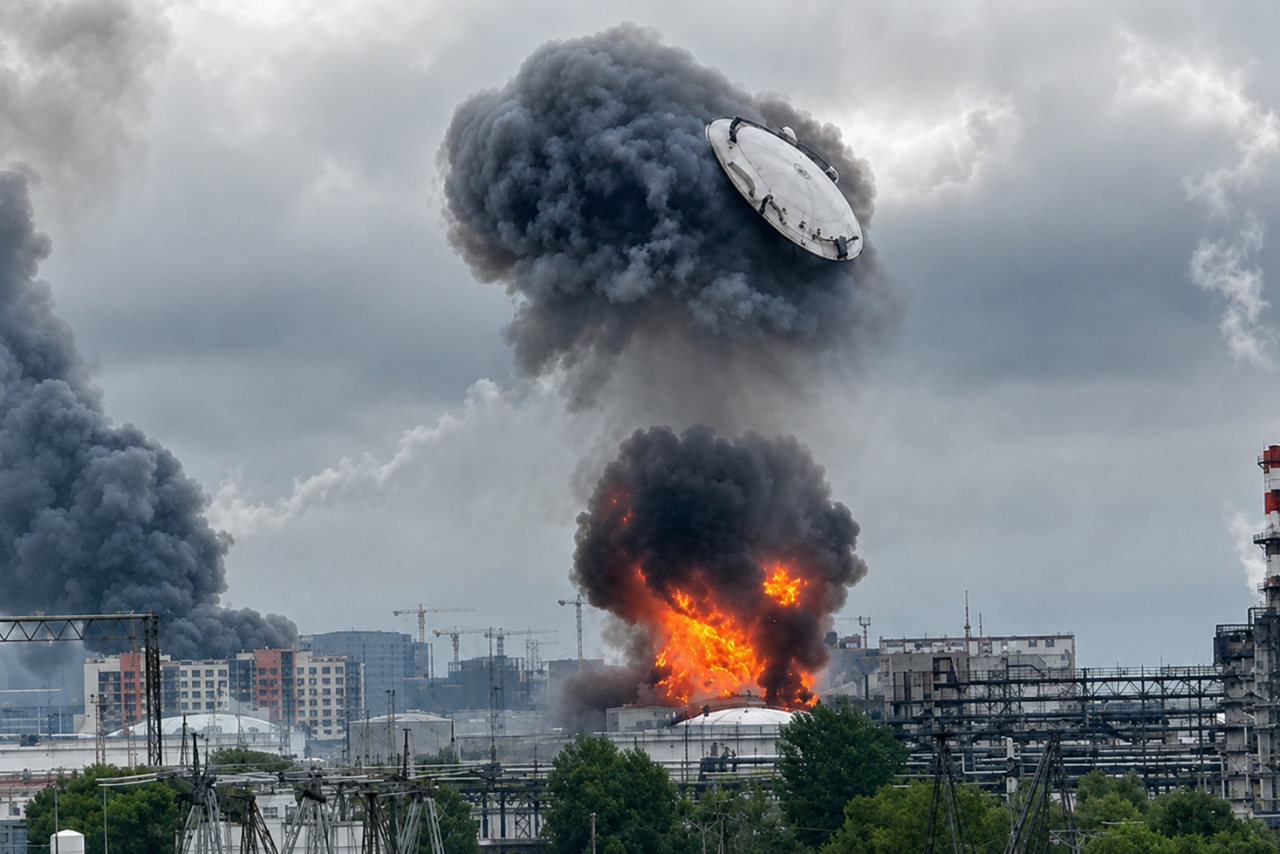
Every day, the Ukraine Battlefield update newsletter offers a clear look at how the war is unfolding on the ground. Subscribe for free here to get the full text delivered to your inbox. Thermal analysis from space helps determine the extent of the damage. Ukrainian soldiers advanced towards the important village of Komar. The Russians claim to have captured another village 50 kms away. Russian attacks have emptied food shelves in Kyiv. Mutual attacks on grain exports continue — this time, Ukrainians cut off a sea terminal in Novorossiysk from the mainland. Maps of the day — Komar and its surroundings Videos of the day — a half-empty shop in Kyiv; dozens of drones waiting for a target; a Russian lorry driver drives beneath Russian soldiers’ machine-gun fire; a Ukrainian lorry driver did not survive a Russian drone attack Thermal analysis from space helps determine the extent of the damage. In recent weeks, attention has shifted from attacks on Russian refineries and oil depots to the mutual destruction of large warehouses. This does not mean, however, that attacks on the oil industry have stopped. They continue regularly. However, assessing their effectiveness requires more than watching a video in which something is burning and smoking. In some cases, the damage may be serious, but in others it may be largely a visual effect that does not mean the facility has been taken out of operation. Both armies have various intelligence capabilities to verify the effectiveness of their strikes. Modern technology also makes some of these available to OSINT analysts and journalists. This is also the case with a recent article by the independent Russian exile website Meduza. The outlet published it on Tuesday (11 August), analysing the situation at two large refineries — in Moscow and Nizhny Novgorod. The better known of the two is the former. It is called Kapotnya, after the Moscow district where it is located. It lies on the south-eastern outskirts of Russia’s capital and became famous in June for a massive explosion that sent the roof of one of its storage tanks high into the air. Ironically, it was destroyed by a Russian anti-aircraft missile while repelling an attack by Ukrainian drones. Ukraine's latest drone strike on Moscow exposed how weak Russia's air defenses around the city are.New footage shows that a Russian shoulder-fired surface-to-air missile may have struck and detonated an oil tank at the Kapotnya refinery, less than 20 km from the Kremlin. The… pic.twitter.com/OW3Vdhj3MN— Vatnik Soup (@P_Kallioniemi) June 20, 2026 However, the refinery suffered far more serious damage than it first seemed, which Meduza sought to assess using images from satellites operated by Constelrr. As the Russian journalists explained, these allow for much more precise thermal analysis of the Earth’s surface than the Nasa system known by the acronym FIRMS. Data from it have occasionally also appeared in Ukraine Battlefield update. They are commonly used as an indication of the intensity of fighting or the results of bombing. However, FIRMS’ resolution — approximately 400 metres — is insufficient to reveal the precise and longer-term consequences of a fire. The satellites operated by Constelrr are called Skybee. The first was launched into space only last year. They provide a resolution of 30 metres and high sensitivity to changes in surface temperature. This makes it possible to obtain an accurate picture of what is happening at refineries even weeks or months after they have been hit. The Kstovo refinery in Nizhny Novgorod is one of the largest in Russia. It processes approximately 17m tonnes of crude oil a year, almost three times the capacity of Bratislava’s Slovnaft refinery. Drones attacked it on 5 April, 20 May, 24 June, and 2 July. Meduza had satellite images available from 3 May to 18 July. The video shows footage from 20 May, when the damage was particularly severe. A drone then struck the refinery’s key AVT-6 processing unit, where crude oil is refined. The process requires high temperatures. The presence or absence of detected heat therefore serves as evidence of whether the facility is operating or has been shut down. The General Staff confirmed the strike on the AVT-6 primary oil refining unit at the "Lukoil-Nizhegorodnefteorgsintez" refinery in Kstovo. This unit accounts for more than half of the refinery’s total primary processing capacity. pic.twitter.com/4VGnWazjQm— WarTranslated (@wartranslated) May 20, 2026 Meduza’s analysis of satellite imagery shows that the AVT-6 unit and its associated facilities remained cold even at the end of July. The other four AVT-6 units — the plant has five in total — continued operating. “Although AVT-6 is still not operational, this does not have a significant impact on the plant’s overall fuel production,” Meduza wrote. The refinery was therefore able to compensate for the lost capacity of one unit because the others remained undamaged. Kapotnya is in a somewhat different position. It has only one AVT-6 unit. In this case, Meduza had satellite photographs from 23 May and 27 July. Here is the latter: The AVT-6 processing unit, in the lower centre, is blue, like the surrounding facilities — meaning it is cold and has cooled down. The red spot nearby is a cooling tower. “Based on the satellite imagery available to us, it can be concluded that the refinery was completely out of operation for at least a month — and had not even partially resumed operations by 27 July,” Meduza said. Ukrainian soldiers advanced towards the important village of Komar. This is the result of a “creeping” counteroffensive that has been under way, largely unnoticed, for several months. Komar is not a large village; fewer than 2,000 people lived there before the war. Russia has occupied it since June 2025, after gradually capturing the nearby towns of Kurakhove, Vuhledar, and Velyka Novosilka over years of fighting. After capturing Komar, Russian forces managed to advance approximately 15 kms further west towards Dnipropetrovsk oblast, but have gradually been losing positions there since February. Locations where drone footage confirms the presence of Ukrainian soldiers: French analyst Clément Molin adjusted DeepStateUA’s current map to better reflect what he believes is the reality on the ground. He believes the grey zone should extend further into Russian-held positions and follow the red line added to the map. More grey can be added to deepstate, about 140 km2 in total. Many grey parts are also blue. Deepstate are not only late in Kostiantynivka, they are late for Ukrainian advances. pic.twitter.com/SNPN3V2rSD— Clément Molin (@clement_molin) August 11, 2026 For comparison, see a map of roughly the same area from the Russian Telegram channel Rybar. Its author claims that Ukrainians are sending forward small groups of soldiers whose task is to display flags. He is therefore describing a common practice of the Russian army across all sectors of the front. However, there are indeed known cases in which the Ukrainian army has acted in the same way. It did so recently in Kostiantynivka, for example. Rybar nevertheless acknowledges Ukrainian movement near Komar. On its map, this can be found in the centre-right, to the left of the map legend. However, it sees Ukrainians only west of the neighbouring village of Myrne, where it says the grey zone begins. It does not consider this a recent development, but a longer-standing situation. By contrast, Russians reported only one change in this region today — the alleged capture of the village of Nove Pole, which is in the bottom-left corner of the map. The lesser-known Russian OSINT channel Slivochny Kapriz places its assessment somewhere between Rybar’s and those of Ukrainian and independent sources. It acknowledges that Ukrainians are present in Myrne. Russian attacks have emptied food shelves in Kyiv. Throughout the war, entering a grocery shop in Ukraine meant finding it very well stocked. At first glance, nothing suggested that the country was defending itself against aggression. However, shops in the capital are now facing supply problems, with some shelves standing empty.
What is now happening at the viral Moscow refinery whose ‘roof flew off’ in a blast in June? (Ukraine Battlefield update, Day 1,630)
Full Article
Original Source
Read the full article at Euobserver →KhanList aggregates and links to publicly available news content. We do not host full articles from third-party sources. Always verify important information with original sources.