
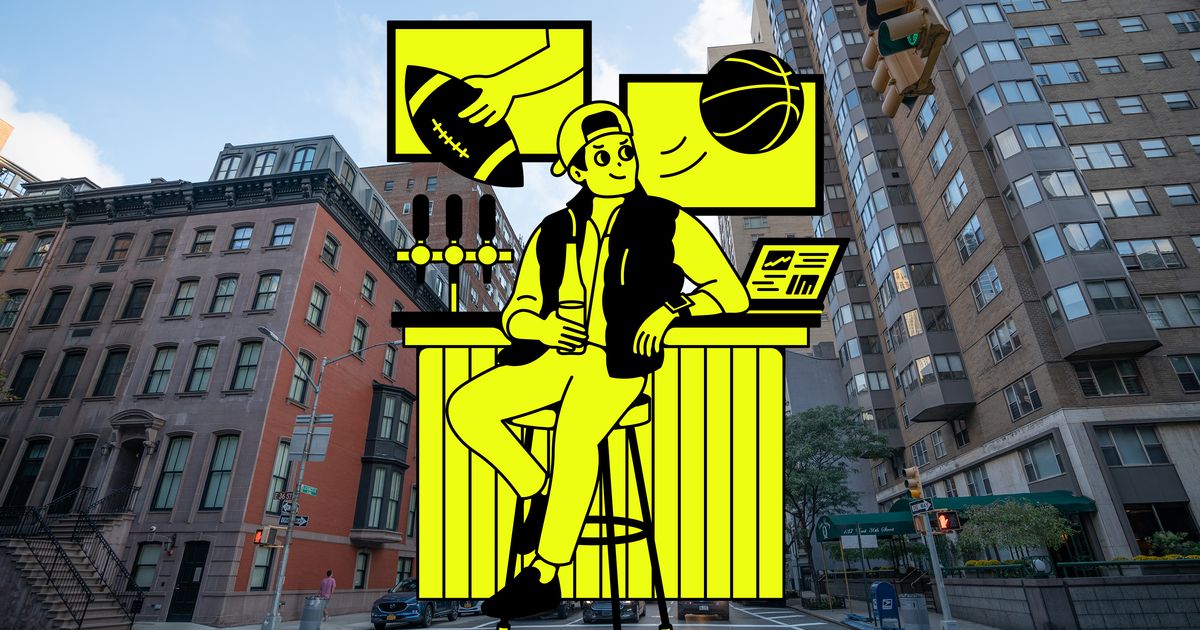
Intelligencer The Cut Vulture The Strategist Curbed Grub Street Subscribe What Is Murray Hill? Life in a neighborhood that’s become a punch line. Illustration: Emma Erickson; Photo 1103 NYC/Flickr Illustration: Emma Erickson; Photo 1103 NYC/Flickr ‘You’re an asshole!” the young woman is screaming. The guy she’s berating is not saying much in response. They — or rather, we (because the couple is right below my window) — are on a corner in the East 30s, about a block from the strip on Third Avenue where the bars are emptying out. It’s after 3 a.m. on a warm Saturday night turned Sunday morning, and I can hear her heels click on the concrete as she stomps away and then returns to give him some more of the business. This is a postcollege breakup, I groggily realize, and it’s going to take a while. This isn’t the first young couple to have a loud dispute mere yards from my apartment in Murray Hill, and it won’t be the last. Over 35 years of living in this neighborhood (mostly in the same building — first solo, then coupled up, and now married and a dad), I’ve seen hordes of 20-somethings glide from the dormitory to its not-quite-equivalent, the least edgy version of a “starter life” in New York. Owing mostly to these young adults’ presence, Murray Hill has become a punch line for postcollegiate uncoolness — it is the rare New York neighborhood that is young and affluent but also somehow unhip. If anything, Murray Hill is the opposite of hip. I’ve put that “if” there because I’m not sure the neighborhood is actually anything. It may be more accurate to say that it just is. Recently, Mindy Kaling set a Friends-ish sitcom about a clutch of early-20s people awkwardly chasing careers and coupledom here. The show was first announced under the name Murray Hill but ultimately aired as Not Suitable for Work. (Hulu last week decided not to pick up a second season; Kaling is shopping it around.) I suspect that she and the network retitled it because “Murray Hill” as a phrase communicates so little. “Soho” or “the Upper East Side” or “Harlem” or “Bushwick” immediately supplies a familiar narrative and feeling. But “Murray Hill” means almost nothing if you don’t live in the city, and if you happen to be from Queens, where there is another Murray Hill out by the northeast fringe of Flushing, it is just confusing. It is a great drag-king name, though. Murray Hill is broadly defined as the area east of Madison Avenue from 34th to 40th Street, although the boundaries are muddy, particularly the southern one, which fades into the gray zone of Kips Bay–Rose Hill–Gramercy Park. Tellingly, much of what draws people to live in the neighborhood lies outside it. Realtors will say to you, “You can walk to Grand Central.” “To the New York Public Library.” “To the Indo-Pak restaurants and grocery stores of Curry Hill.” “To Koreatown.” You’re also near the jarringly avant-garde array of fashion at Dover Street Market and the vast assortment of doctors in the NYU Langone/Bellevue/VA corridor. You can even walk to the Theater District, and I can attest that a late stroll home from Broadway at 11 p.m. when the weather is nice can be a perfect way to wind down an evening. Within the neighborhood’s tight quasi-official borders, there’s the Morgan Library & Museum, splendid but small, and comparatively little culture beyond that. There is also a widely accepted cliché of the Murray Hiller: a native of White Plains or Roslyn or Fairfield or Morristown, freshly graduated from a good school that is neither impeccably prestigious nor artsy (the Auburns and Arizona States of the world rather than the Princetons and Oberlins). It’s a short, parent-approved commute to the job at JPMorgan Chase or D.E. Shaw, or Salesforce, or in fashion merchandising over on Seventh Avenue. The Murray Hill man wears a fleece vest embroidered with his employer’s logo (the bank, the fund) ten months out of the year. The Murray Hill woman has a lot in common with the West Village Girl, particularly a shared affection for the Aperol Spritz and the Alo workout set, but her family is not quite as rich. The M.H.G. sometimes heads downtown on the weekends to cosplay as a W.V.G., particularly around brunch hour. The archetypal Murray Hill couple — usually a boy and a girl; this is a noticeably un-queer neighborhood — lives a very short walk from the Morgan Library, but it’s off their radar, whereas Medium Rare, the nearly menuless all-steak-frites-all-the-time restaurant, is a regular stop. (There is often a line to get in, sometimes even on weekdays.) At home, they might stock the fridge with White Claw, but for a while there was also the option of Murray Hill Girl, a private-label wine whose label read, “It’s Pinot Noir from, like, Slovenia, which is somewhere by, like, Italy.” Eventually, some of these couples marry, and some of them move to a “real” New York neighborhood, which is to say the Upper East or Upper West Side or brownstone Brooklyn. Others, like salmon, return upstream via Metro-North or the Long Island Rail Road to the suburban headwaters in which they were born, in order to spawn. We don’t have a ton of celebrities among us these days, but Michael Musto — longtime columnist at The Village Voice, now at W42ST — lives here, and that is itself a mild surprise. “My life has often been involved in nightlife, running around town, so you’d think it would be advisable to have a neutral home base, and Murray Hill always had a reputation as the Switzerland of neighborhoods,” he says. “It’s never going to be a very sexy neighborhood, for better or for worse.” He moved here after graduating from Columbia and never quite left; he’s been in his current apartment for 18 years. “People are always shocked to hear that I live in Murray Hill — it doesn’t seem quite fabulous enough, and I consider that a compliment. We did have the cred of having Liz Smith here for years, though.” And he completely agrees that the neighborhood is just about the straightest in Manhattan: “There’s not enough gays! In the old days, there were gay bars — all over Manhattan, but including in Murray Hill. You see a lot of beautiful guys walking, as if it’s a runway, but they’re walking with their girlfriends.” Ask Musto what the neighborhood has to offer, and he mentions the 24-hour Duane Reade on 34th Street and the new Lidl supermarket. Although it may not seem like it, I write not to bury my neighborhood but, guardedly, to praise it. For one thing, archetypes are by definition reductive, and there are plenty of people around here who are older, or parents, or retired, or indifferent to the bar scene, or all of the above. Even so, I recognize that telling people I live in Murray Hill is a little like calling Sbarro my favorite New York slice joint. For the sake of clarity, I usually just offer to outsiders that I live in midtown. If I need to be more specific, I use a stock phrase: “In Murray Hill. Please do not judge.” They do anyway. When the subject comes up with my younger Brooklynite colleagues, or the ones who live downtown, I know the look I’ll get: The cocked eyebrow, the unspoken “really?,” the suppressed smirk. To them, Murray Hill is in Manhattan but not of Manhattan; it is neither gritty nor gorgeous nor irreproducible. If (to them, at least) the East Village has a lingering vibe of Tom Verlaine, Murray Hill is Billy Joel. Gramercy Park and Greenpoint have the two branches of Caffè Panna, the ice-cream phenomenon of the moment; we have the world’s last Tasti D-Lite, the low-cal phenomenon of the Ed Koch years. (It is a few doors down from a branch of its Bloomberg-era counterpart, 16 Handles.) We are — as Peter Kaplan’s fondly remembered New York Observer put it in a front-page story in 2005 — Murray Hell. “It’s the thing to do. All of our friends live here,” one local M.H.G. told the Observer’s reporter, Lizzy Ratner. The mark of the basic beast is 10016. I did not know that any of this would come to pass when I moved here 35 summers ago. What I did understand was that, on an assistant editor’s salary, I could afford it, at least marginally. I’d wanted to live downtown, but even at a time when rents were vastly lower than they are now, it cost more to live in the West Village. Murray Hill was also relatively safe, which was a major concern in the years of 2,000 murders. I drew an imaginary walking-distance circle around the office of the small magazine in Chelsea where I worked, and it led me to a row of brownstones and ginkgo trees on East 36th Street. It felt like the middle of the world. Before the decade was out, I had bought a place a block away. (You could swing that, back then, on a middling editorial salary. A studio apartment could be had for $50,000 or so, and a one-bedroom for perhaps twice that.) I had not intended to put down roots in the neighborhood. Both times, a good deal had presented itself, and I had simply taken a path of low resistance, which I suppose is the Murray Hiller’s basic way of doing things. Also, I had by then begun working for New York, and its office was on Second Avenue near East 41st Street. The phrase “convenient to work” comes up a lot in the real-estate pitches for Murray Hill. If you happen to work in Hudson Yards, you can get across in one crosstown bus trip, on the 7 train, or a very short cab ride; if you’re on Wall Street, it’s straight down on the 4-5-6. My commute, back then, was about six minutes on foot, nine if it was snowing. This magazine has moved four times since then, each new office slightly farther from home than the last, but I have not. I hasten to add that, at the time I arrived, Murray Hill was not yet the fratty, bro-ey neighborhood it was to become. Instead, Murray Hill was — if I can put it a little flatly — an old-lady neighborhood. There were days when I felt like the youngest person around by several decades. A trip to the supermarket on a weekday afternoon would put me in the company of lots of tiny elderly well-dressed women with tiny elderly well-dressed dogs. There was also an odd-looking guy, I remember, who shuffled around the neighborhood very slowly, daily for many years, his face nearly expressionless, his pants hiked up like Ralph Kramden’s, his bent arm raised and rigid as he held a cigarette a few inches from his lips, its ash lengthening with each block he covered. Now that I think about it, I haven’t seen a proper New York weirdo around here in a long time. It’s said that when you are at a poker table, if you can’t spot the sucker, it’s you. Perhaps I have aged into being the street eccentric myself. A theory I have about the elegant-elder population in which I landed in the early 1990s is that they were holdouts from the long era when Murray Hill was chic. It was, for many years, where the swells lived. From Edith Wharton’s time up until not too long before I got there, this was a patrician area, corresponding roughly to today’s affluent Sutton Place. J.P. Morgan himself built his house here. A few feet away, J.P. Jr. did the same (his brownstone is now the landmark corner property of the Morgan Library), and so did a variety of Phelps-Dodge-Stokes importing-and-mining heirs. When Eleanor and Franklin Roosevelt married in 1904 — she the niece of a president, he a future one — they lived here, barely a block from Morgan himself, before moving uptown. A little later, in the 1940s, Jessica Tandy and her husband and co-star Hume Cronyn moved to East 35th and stayed for decades. Cole Porter lived in one of the little converted carriage houses on Sniffen Court, a tiny mews off East 36th Street. New Yorker writers lived in Murray Hill, both in their fictionalized lives and their real ones. So did that magazine’s founding editor-in-chief, Harold Ross, in the penthouse at 22 East 36th. A play titled Murray Hill ran on Broadway in 1927, starring and written and directed by Leslie Howard, the man you may know as Ashley Wilkes from Gone With the Wind. He played an Englishman visiting his three elderly unmarried aunts who occupy a Victorian townhouse you-know-where. That was wealthy life. There is even elegance in the details of the neighborhood’s founding myth, which played out exactly 250 years ago. Robert and Mary Murray lived out in the country, north of British New York, at the future intersection of 37th and Park, atop an actual hill. Robert had made a bunch of money in the importing business and was a loyalist to the king; Mary, perhaps without her husband’s knowledge, supported the colonist rebels. During the battle of Kips Bay in September 1776, Mrs. Murray distracted the English generals with tea and wine and cakes served at her home, buying the Americans several hours to retreat and regroup. Had she not done so, the American Revolution might well have been finished off that day. Mrs. Murray’s tea party continues to figure in patriotic lore, a bite-size moment of resistance from a “my businessman husband votes Republican” spouse. I can’t put a precise year on the neighborhood’s turn from sedate-burgher comfort to post-fraternity row. It happened in tandem with the real-estate boom that began in the mid-1990s and has, despite a few brief pauses, never stopped. Some of the change was natural evolution owed to rising rents; long-established residents and business were replaced by less interesting, more transient ones. I watched the ancient butcher shop on Third Avenue, a sawdust-on-the-floors place with a big wall of solid-oak refrigerator doors behind the counter, become a corner deli, then a burger restaurant, then a different burger restaurant, and then an upscale New American place. The wine-and-liquor store a block up, in place at least since Prohibition, has in the last 30 years become a Chinese restaurant, then another Chinese restaurant, then a third Chinese restaurant, and then a pile of rubble where a dead-eyed new apartment building is now rising. But I think there were also inherent qualities that pushed Murray Hill into second-tier-neighborhood status. The West and East Villages have their respective arts and punk pasts, allowing you to persuade yourself that you’re following in the footsteps of Djuna Barnes or Richard Hell as you go off to work at McKinsey & Co. By contrast, Murray Hill’s past was plain old bourgeois, and has been for a century. I couldn’t begin to tell you when (if?) we last had a new culture-adjacent business like a bookstore or a guitar shop or even a stationer’s. (We had a lovely rare-book dealer and a ballet-supply boutique on Madison Avenue near 35th Street; those storefronts are now a coffee place and a vacancy, with a vape store in between.) There is also almost no green space at all. St. Vartan Park, over on First Avenue, is useful and pleasant, but it’s mostly pavement, playground, and artificial turf. There is also too much car traffic around, owing to the presence of the Queens–Midtown Tunnel, for Murray Hill to be truly cozy. The heart of the Village is Washington Square; the heart of Murray Hill is nonexistent. There’s also a shortage of lively neighborhood businesses. Consider the eastern side of Third Avenue above 35th Street. It now goes, from south to north, as follows: nail salon, weed shop, haircutter, weed shop, haircutter, sandwich shop, nail salon, haircutter. There’s yet another nail salon across the street, with three more within a block or so. I would pretty nearly kill for one of those cultural businesses — or a good fishmonger, or even a shoppy shop — around here, but the economics seem hopeless unless you’re in the business of trimming keratin. Or, weirdly, selling pastrami: In an five-block radius, we have the 2nd Avenue Deli, a new place about to open at 40th and Lex, and Sarge’s Deli. (I hesitate to say this, lest I get shoved aside at the counter, but Sarge’s — which isn’t nearly as famous as Katz’s or 2nd Avenue — is at least as good and very possibly better. It’s a goddamned civic treasure.) What we also have, in quantity, is bars. That at least has some continuity with the old days, because Third Avenue’s saloons at mid-century were where the sots washed up, like Ray Milland in The Lost Weekend. The men slumped in those long-ago joints would not be at home in a Murray Hill bar these days, however. Most are now sports bars, with big TV sets and a lot of noise, especially on a playoff night. (A few have in the past few years matured, with age, into upscale-cocktail-bar territory.) It surprised me, as I watched Not Suitable for Work, how little of that scene showed up onscreen. There wasn’t really a third-place hangout of the Central Perk or MacLaren’s Pub variety. A South Asian restaurant (of which we have many) made repeat appearances, yet it was called Royal Bangladesh, a name that references an old place on 6th Street. Most unexpected of all, the exterior shots outside the principal characters’ apartment building were made on West 11th Street. In real life, Murray Hill sometimes serves as an also-ran alongside its chic cousin, a Walmart Great Value version of the Village, but in this TV version, the opposite somehow came to be. And there, hidden in that odd inversion, you can spot the Secret Weapon of Murray Hill. Beloved, obsessed-over neighborhoods, from the Village to Greenpoint, have all been commodified and branded within an inch of their lives, to the point where they’re becoming stage sets of themselves. The W.V.G.s have all but crowded out the last gray-ponytail elders from Greenwich Village, and its turnover will soon be complete. The Upper East Side’s affluent parents just grow more affluent, their Hamptons lawns more manicured, their strollers taller and more Danish-looking, their immense consumption ever more BPA-free. If you were to make a TV show out of any of these neighborhoods, you’d have to exaggerate those cultural stereotypes to make it work. Murray Hill, by contrast, can’t be a stage set of itself, because it’s not distinctive enough. (As my editor once said some years ago when I mentioned where I live, “What a non-neighborhood.”) I suspect that Not Suitable for Work skipped creating a real-life local hangout for that very reason: You’d have to invent, out of whole cloth, whatever it is. There may be a cliché of the postcollegiate Murray Hill resident who spends a few years here before moving on, but there is (Slovenian Pinot Noir aside) no Murray Hill brand, or at least there isn’t one yet. That, oddly enough, is itself distinctive. When so many pieces of New York have been relentlessly framed as an out-of-towner’s idea of themselves, Murray Hill just keeps being its everyday nail-salon-next-to-a-weed-shop self. There’s a name for that quality: authenticity. I live in what may be the last slice of lower Manhattan that is underpackaged, and that leaves it manageable and steadily, uncomplicatedly livable. Let the junior executives pass through, coming and going; I’m staying right here. Probably forever. Where Is a Celebrity to Live in This Town? Where Did the Italians of Carroll Gardens Go? What Is Murray Hill? Your product is saved! You’ll receive emails when your saved products go on sale. Manage preferences. Every product is independently selected by editors. Things you buy through our links may earn Vox Media a commission. Where Is a Celebrity to Live in This Town? Where Did the Italians of Carroll Gardens Go? Simon Huck Lists His Greenwich Village Townhouse for $12.5 Million The Shmancification of the U.S. Open Who Was the Man in 2B? Where Is a Celebrity to Live in This Town? Where Did the Italians of Carroll Gardens Go? The Shmancification of the U.S. Open Simon Huck Lists His Greenwich Village Townhouse for $12.5 Million A Murray Hill One-Bedroom With Serious Wood Paneling for $875,000 Where Is a Celebrity to Live in This Town? Where Did the Italians of Carroll Gardens Go? Simon Huck Lists His Greenwich Village Townhouse for $12.5 Million The Shmancification of the U.S. Open Who Was the Man in 2B? Where Is a Celebrity to Live in This Town? Where Did the Italians of Carroll Gardens Go? The Shmancification of the U.S. Open Simon Huck Lists His Greenwich Village Townhouse for $12.5 Million A Murray Hill One-Bedroom With Serious Wood Paneling for $875,000
What Is Murray Hill?
Full Article
Original Source
Read the full article at Curbed →KhanList aggregates and links to publicly available news content. We do not host full articles from third-party sources. Always verify important information with original sources.