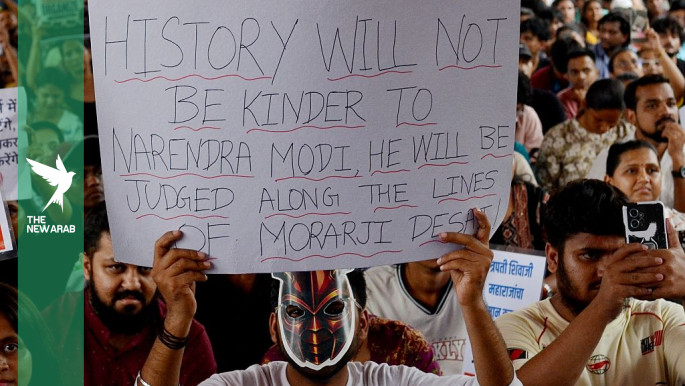
The movement was launched on 16 May in response to comments by Indian Chief Justice Surya Kant, who compared unemployed young people to "cockroaches" and "parasites of society". [Getty]The Cockroach Movement has, in just two months, become an influential movement among young people in India, despite increasing official violence against its members, culminating in the arrest of its founder, Abhijit Debki, on Monday evening during anti-government protests. The movement was launched on 16 May in response to comments by Indian Chief Justice Surya Kant, who compared unemployed young people to "cockroaches" and "parasites of society". The Cockroach Movement attracted hundreds of thousands of members in a short period, with its followers on Instagram exceeding 20 million, most of whom are from Generation Z. Supporters of the movement participated in protests and cleaning campaigns while wearing cockroach costumes. In this context, the Cockroach Movement announced on Tuesday, 21 July, that it would continue its anti-government protest but would no longer continue its march towards parliament, a day after dozens of its supporters were injured in clashes with police who attempted to stop their march. New Delhi police said around 180 people, including 118 security and police personnel and 60 protesters, were injured when clashes broke out in central New Delhi. On Monday evening, police said 70 protesters had been detained. For its part, the movement said that more than 150 protesters were receiving medical treatment. During the clashes, police fired tear gas and charged at protesters with batons after demonstrators attempted to break through security barriers surrounding the protest site in central New Delhi, in one of the most serious confrontations so far during the movement's campaign against Prime Minister Narendra Modi's government. Many Cockroach Movement supporters carried backpacks containing water and food, preparing for a long day, while others waved Indian flags. Police urged protesters to disperse through loudspeakers while the crowd chanted slogans against Prime Minister Modi. New Delhi police said they had not granted permission for the protest march. Indian media quoted the party spokesperson as saying on Monday that the government was trying to begin talks with them and that the Cockroach Movement was ready to participate, adding, "They came too late, but we opened our hearts and said we were ready to talk with them." A session of the lower house of parliament had already begun inside the parliament building shortly before that. The movement said Health Minister J.P. Nadda had requested time to discuss their demands within the government after meeting with two leaders on Monday. Parliamentary Affairs Minister Kiren Rijiju said on Tuesday that Prime Minister Narendra Modi had addressed lawmakers from his Bharatiya Janata Party, saying, "I believe that when talks are moving in the right direction, the atmosphere should not be spoilt." Cockroach Movement supporters have demanded the resignation of Education Minister Dharmendra Pradhan over leaked exam papers that affected more than two million students in May, according to the movement. The movement considered the leak of the National Eligibility-cum-Entrance Test for medical colleges, which forced students to retake the exam and led some to take their own lives, a sign of entrenched corruption in education. Tensions escalated after activist Sonam Wangchuk began a hunger strike on 28 June, but authorities forcibly transferred him to a hospital on Saturday, 18 July. What are the movement's demands? During Monday's clashes, rumours spread that movement founder Abhijit Debki had been arrested. Still, he appeared again on Tuesday at a press conference, announcing the cancellation of the march to parliament "because the group does not want more young people to be harmed". He apologised to supporters, particularly women, who he said had been beaten by male police officers, and confirmed, "We will not march again because the police will harm young people." With around 500 of his supporters present at Jantar Mantar, Debki called for Wangchuk's release, Pradhan's resignation, and compensation of 10 million rupees (around $104,000) for each student who died by suicide after the leak. Local media reported that around 10 students had taken their own lives after the exam paper leak. The crowd at Jantar Mantar, a protest site located only a few kilometres from the parliament building, included students, professionals and families accompanied by young children. Sahil Singh, a protester from the northern state of Uttar Pradesh, told Reuters, "They beat us badly and destroyed our protest site." "We want accountability through Pradhan's resignation," he added. Amnesty International said in a statement on Monday evening that police actions showed "how peaceful opposition is being suppressed in India", adding that "the role of authorities is to protect and facilitate peaceful protests, not suppress them. The right to freedom of peaceful assembly is recognised under international human rights law and the Indian Constitution." Article translated from Arabic by Afrah Almatwari. To read the original, click here.
What is India's 'Cockroach' movement?
Full Article
Original Source
Read the full article at Newarab →KhanList aggregates and links to publicly available news content. We do not host full articles from third-party sources. Always verify important information with original sources.