
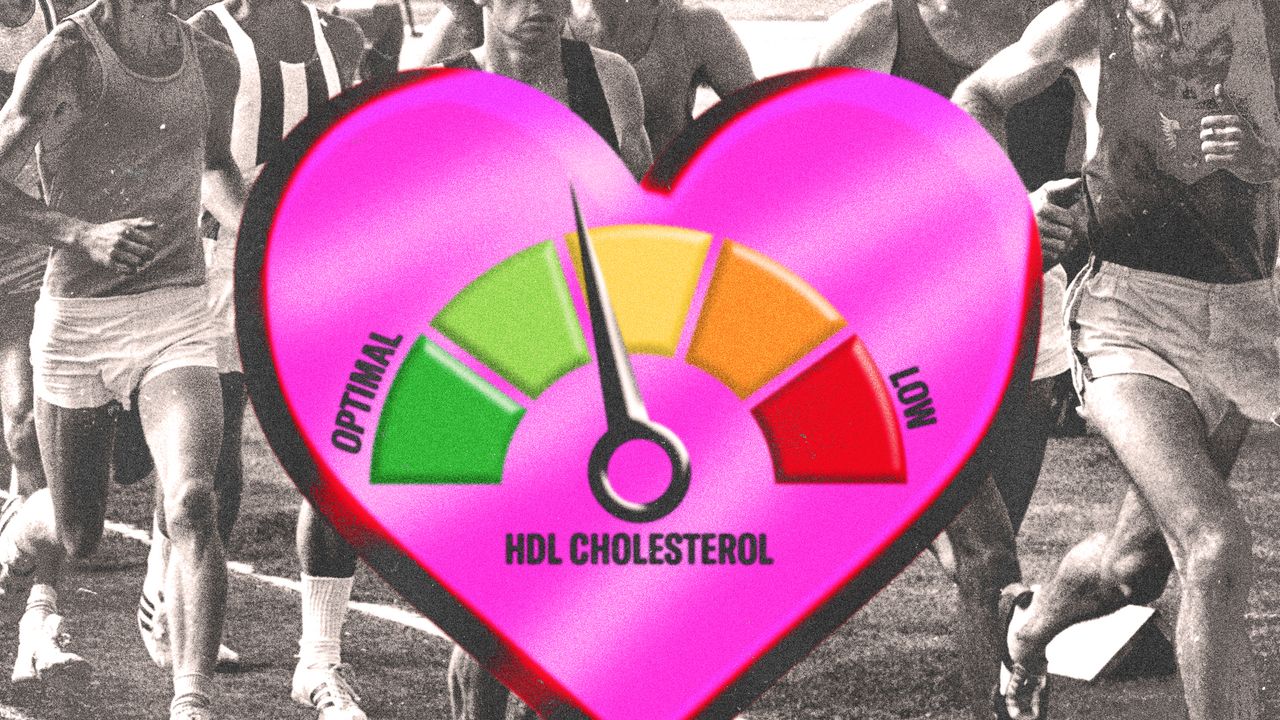
If you care about your cholesterol levels at all, you’re already doing better than most men. More than 40% of US adults with high LDL cholesterol have no idea they have it, according to a 2023 study in JAMA Cardiology. That means they aren’t being treated for it and are unknowingly at high risk for all sorts of health problems we all want to avoid, namely heart attacks, strokes, and cardiovascular disease.Any focus that is on cholesterol tends to center around low-density lipoproteins, better known as LDL. LDL transports cholesterol to cells. Too much of it can lead to plaque buildup in the arteries. That’s why it’s often referred to as “bad” cholesterol.Paying attention to your LDL is important, but so is keeping your HDL in check and it’s a health marker that’s often completely ignored. Unlike LDL, HDL, or high-density lipoprotein, is typically something you want more of, which is why it’s referred to as “good” cholesterol. Having low LDL doesn’t get you off the hook for having suboptimal HDL, explains Sunny Intwala, MD, a cardiologist with Northwell Health. Curious how to get HDL cholesterol? We spoke to experts to find out.What is HDL cholesterol?“When we talk about HDL cholesterol, what we’re really talking about is the amount of cholesterol that’s present in HDL particles,” says Corey Bradley, MD, FACC, a preventive cardiologist at Columbia University Irving Medical Center.Dr. Bradley explains that the purpose of HDL is to carry excess cholesterol from blood vessels and tissue to the liver, where it is then metabolized and excreted. “This is called reverse cholesterol transport and it’s the opposite of what LDL is doing,” she says. In simple terms: LDL brings cholesterol to cells, which is bad. HDL transports cholesterol out, which is good.Rohit Vuppuluri, DO, FACC, an interventional cardiologist with Chicago Heart and Vascular Specialists, says that a lot of people assume that if their LDL levels are at a good place, that automatically means their HDL must be too. Or, similarly, if you have high HDL then you must have low LDL. But that’s not exactly true. “You can still have heart disease even if your HDL is high because your LDL is high. There is no data showing that high HDL negates high LDL,” he says.What causes low HDL?Ideally, you should get your cholesterol levels checked every five years if you’re in good health and once a year if you are at increased risk for diabetes, high blood pressure, or heart disease. According to the cardiologists, having a HDL level of 60 mg/dL or higher is considered optimal. That said, Dr. Bradley says that there are no added benefits beyond having an HDL greater than 100 mg/DL. For men HDL levels under 40 mg/DL are considered low.Dr. Intwala explains that low LDL is like a warning light on your car dashboard; it’s a sign that there’s an underlying problem going on. “The real job is getting under the hood, which is where further testing comes in,” he says. Dr. Bradley says that a common health condition associated with low HDL is insulin-resistance. Insulin resistance lowers the amount of HDL and alters its quality, as a scientific review published in Lipids in Health and Disease explains. Obesity and high blood pressure are associated with low HDL too, according to the cardiologists, adding that sometimes, it simply comes down to genetics.The danger of HDL remaining low is similar to the danger of that warning light on your car dashboard staying on. It means the underlying problem is still there. In the cases of untreated metabolic disorders, the doctors explain that this poses a big threat to cardiovascular health, including increased risk for heart attacks, strokes, and cardiovascular disease.How to get HDL cholesterolAll three cardiologists explain that instead of getting hyperfocused on raising HDL, it’s better to treat the underlying condition that’s causing it to be low. HDL is different from LDL in this way. Focusing on lowering LDL is a great health goal because it’s directly associated with lowering your risk for heart disease, stroke, and heart attack. It doesn’t work this way with HDL.“Don’t try to design your diet around raising HDL. There aren’t any foods that dramatically do this,” Dr. Intwala says. Dr. Vuppuluri adds to this, saying, “It’s really hard to raise your HDL. There’s not even an effective medication that can raise it,” he says, which is in stark contrast to LDL cholesterol-lowering medications, which are effective.All three cardiologists also point out that if your low HDL is due to genetics, there’s really no way you’ll likely be able to raise it anyway. In these cases, they say that genetically low HDL is treated as an increased risk factor for cardiovascular disease and requires being monitored more closely than people who don’t have this genetic knock against them.With all this in mind, the best way to raise HDL is treating any underlying health condition that’s a detriment to your cardiovascular health. Dr. Intwala says this could mean discussing if a GLP-1 is right for you, if you are obese. It certainly means having diet and lifestyle habits in place that prevent metabolic disorders such as insulin resistance. You already know what that means: Eating a nutrient-rich diet, exercising regularly, not using tobacco, and consistently getting good sleep.This is the advice all three cardiologists give to anyone with low HDL who wants to raise it: Focus on the basic cornerstones of health (eating nutrient-rich foods, exercising regularly, and getting good sleep) as well as treating any underlying health condition you know it’s good for your cardiovascular health. Your HDL will likely go up as a byproduct of that. And if it doesn’t, don’t obsess. The doctors say that some people just naturally have low HDL no matter how healthy their lifestyle is. It’s a risk factor to be aware of, but not worth tormenting yourself over.
What Is HDL Cholesterol and How Do You Raise It?
Full Article
Original Source
Read the full article at Gq →KhanList aggregates and links to publicly available news content. We do not host full articles from third-party sources. Always verify important information with original sources.