
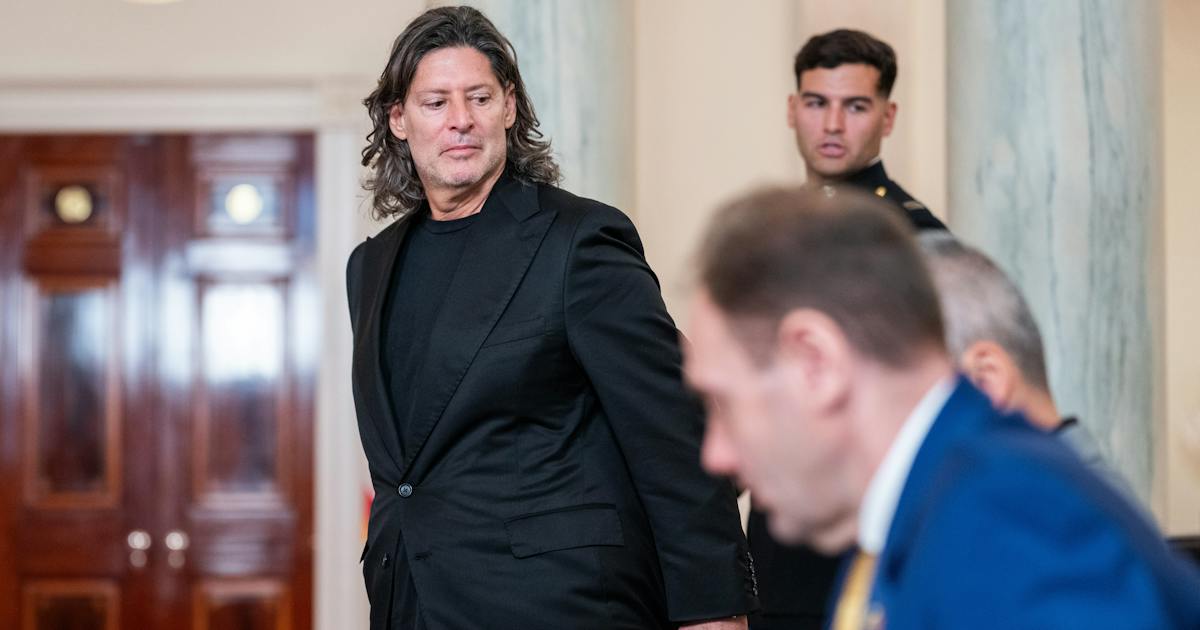
First lady Melania Trump’s “exclusive senior adviser” is a movie producer who has no security clearance, no political expertise, and no actual boss in the White House. He’s also reportedly been speaking with Ukrainian and Russian officials on the first lady’s behalf.Marc Beckman, who first worked as a lifestyle consultant to the first lady and produced Amazon’s poorly received Melania documentary, has been advising Melania diplomatically for at least a year. He was specifically credited as a primary connector in the most recent humanitarian ceasefire declaration between Russia and Ukraine, although his role in that process is also unclear. He even posted a picture of himself, Russian envoy Kirill Dmitriev, and Ukrainian official David Arakhamia at the White House on Sunday to celebrate the ceasefire.Not even the first lady’s former staffers seem to know who Beckman is. First-term adviser Stephanie Grisham told MS NOW that she “never heard [Melania] utter his name for the whole time I was around her.” One current administration member couldn’t seem to remember Beckman’s name when asked. “Is that the guy who looks like Fabio?” he said, referring to Beckman’s shoulder-length hair. “He’s like the shadow first lady,” Grisham continued. “She does want to do meaningful things, but she lets you bring them to her in a bow. The whole thing is bizarre. I’ve thought, ‘Who the fuck is this guy?’ I remember her saying she felt like she was losing her voice because I was putting so many statements out.… She doesn’t like people speaking on her behalf yet he keeps speaking.”This is one of many instances in which the Trump administration has ignored the proper rules of engagement for politics and diplomacy, allowing private citizens with potential conflicts of interest—like Elon Musk and Jared Kushner—to have a massively outsize impact on the administration’s decisions. The Trump administration is levying legal threats at any Democrat attempting to investigate it. On Thursday, the Justice Department accused Connecticut Senator Richard Blumenthal of harassment for his probe into the wealthy private donors who funded President Trump’s $400 million White House vanity ballroom. U.S. Attorney Aaron Reitz ordered Blumenthal to lock away any of his findings or face “significant legal consequences.”“After the election, [Senator Blumenthal] & his allies think they can intimidate Americans for their constitutionally protected associations w/ President Trump,” Reitz wrote online on Wednesday. “Congress is not a weapon to be wielded against the American people. I’m taking the first step to stop this abuse of power.”Last month, The Washington Post reported that 57 companies donated $100,000 or more to the vanity project. Some of those companies are headed by people who have already donated to Trump in other ways—and have been rewarded in return, in the form of business contracts and dropped investigations. It’s unclear how Blumenthal looking into that constitutes using Congress “against the American people,” as Reitz argues. It’s also unclear why Reitz, the U.S. attorney for Texas, is threatening a senator from Connecticut in the first place—especially given that Blumenthal’s probe is well within the confines of the Constitution. “Why is a Houston-based US Attorney threatening a Connecticut-based Senator over constitutionally-mandated oversight of DC figures? Because the DOJ is hemorrhaging staff, who don’t want to do this dirty work, and this US Attorney is a trained seal for Trump,” wrote Adam Klasfield, All Rise News editor in chief, “No other reason.”Blumenthal later responded. “This investigation into me for conducting a congressional inquiry is just the latest in a series of unlawful actions on the part of the Trump Admin attempting to intimidate Members of Congress for engaging in constitutionally protected activity,” he wrote Thursday night. “The implied threat of an investigation is baseless. As incoming Chair of the Permanent Subcommittee on Investigations, I will not be intimidated.” Nevada’s incoming Democratic governor wants to negate the Electoral College.Aaron Ford said Wednesday that he thinks the state should join the National Popular Vote Interstate Compact, an agreement where member states give their electoral votes in every presidential election to whoever wins the national popular vote.“I didn’t initially support it frankly because I hadn’t done enough research on it, but I have researched it and, looking at the Electoral College, understanding the, frankly, racist underpinnings of it in the first place leads me to believe that we need to get rid of it,” Ford told Nevada TV station KOLO regarding the compact. “Not only for that reason, but because we’ve seen several times now the person who wins the popular vote not win because of the Electoral College.”After last week’s midterm elections, Democrats have taken over control of state legislatures and governorships not just in Nevada but also Pennsylvania, Michigan, Arizona, and Wisconsin, which haven’t agreed to the compact. If all five states agree to join the compact, their electoral votes combined with the states that have already agreed to it would be enough to effectively nullify the Electoral College.Ford’s comments give the idea more weight, especially considering that he’s one of the country’s five Black governors who won their elections last week. But the idea faces constitutional hurdles. In Article 2, Section 1, Clauses 2 and 3, the Constitution says that states can appoint electors “in such Manner as the Legislature thereof may direct.” But in Article 1, Section 10, Clause 3, it also prohibits interstate compacts without the consent of Congress.The current Supreme Court has six conservative justices who are more than likely to take a narrow interpretation and shoot down the compact, and require Congress and the president’s consent on any deal. That means even if enough states agree to the compact now, it could be years before it takes effect, if ever. Still, for now, Democratic-led states could set up that legal challenge.Former Nvidia CEO Jensen Huang has responded to Republican Representative John Moolenaar’s request for a closed-door meeting, and he is reportedly in talks to coordinate a date.Moolenaar told NBC News’s Brennan Leach that he expects Huang to appear before Congress while the GOP is still in the majority.“I would hope he would want to come in and have that discussion with us,” Moolenaar told NBC News.Huang resigned as Nvidia’s CEO, president, and board member Thursday morning, after The New York Times caught Huang in another scandalous affair with one of his direct reports: Kimberly Powell, the company’s vice president of health care. Huang was already facing fire for a different affair he had with a Chinese businesswoman, former Megaspeed executive Alice Huang (no relation of Jensen’s), who U.S. intelligence agencies identified as a spy and a state asset.Nvidia emerged in recent years as the largest semiconductor company in the world, and a precious American asset in the burgeoning AI tech wave. In January 2025, Nvidia was announced as one of the “key” technology partners in the Trump administration’s $500 billion public-private initiative to jump-start AI-focused data center development, dubbed the Stargate Project. Months later, Donald Trump allowed the company to export previously banned chips to China, loosening trade restrictions on tech that Washington feared could be used against U.S. national security interests. Trump reportedly knew about Huang’s affair—and his spying partner—for months. State Secretary Marco Rubio informed Trump about the alarming relationship moments before Huang joined the presidential trip to Beijing at the president’s request. It was at least the second time that Trump had been informed of Huang’s ties to the Chinese government, inside sources told The New York Times.But Trump did not act on the information.Instead, Trump has denied any knowledge of the illicit affair. On Tuesday, Trump refuted the Times’ report, telling a reporter in the White House press room that he “didn’t hear about” the scandal in May. Trump added that he spoke with the Nvidia leader earlier that day, when Huang claimed he had “absolutely no idea that the person in question was a spy.”“And I really believe him,” Trump added.But not everyone is convinced by the Trump administration’s blind eye. Connecticut Representative Jim Himes, who is expected to become chair of the House Intelligence Committee in the new year, expressed alarm that the FBI had not opened an investigation into the apparently suspicious relationship, despite the internal circulation of a memo detailing the Megaspeed executive’s myriad links to the Chinese government.“I would hope that the FBI would launch a major counterintelligence investigation. I haven’t heard that they did,” Himes told Politico, noting that Director of National Intelligence Jay Clayton and CIA Director John Ratcliffe apparently “didn’t know” whether the FBI had opened an investigation either.Vice President JD Vance secretly met with one of his top donors days before the Trump administration invaded Venezuela and cut a deal that would make his company millions from selling the country’s stolen crude oil.A week before the U.S. military invaded Venezuela and kidnapped its leader, Nicolás Maduro, Vance traveled to Bozeman, Montana, where he secretly met with John Addison, a U.S. gasoline trader at Vitol, the world’s largest energy and commodity trading company, Reuters reported Wednesday.In 2022, Addison poured $300,000 into Vance’s successful bid for one of Ohio’s U.S. Senate seats. He and his wife later gave a combined $7 million to groups supporting Donald Trump’s presidential campaign in 2024.At the meeting, the two men spoke about Venezuela, and the vice president expressed a particular interest in how fast Venezuelan crude oil could be sold in the case that the U.S. gained control of the country’s energy supplies, a person who was given an account of the meeting from Addison told Reuters. Addison assured Vance that Vitol was more than able to get the job done.Addison’s private Embraer jet and Vance’s government plane sat together on the tarmac at Bozeman Yellowstone International Airport on December 27, according to flight records reviewed by Reuters.This meeting was previously unreported, but gives insight to the backroom deals to enrich allies of the Trump administration. Both Addison and Vance denied the meeting took place.On January 5, just two days after the operation to kidnap Maduro, Addison got a call from Energy Secretary Chris Wright, who asked whether Vitol would be interested in selling Venezuelan crude oil.Addison wasn’t a natural choice to receive a call from Wright. He wasn’t a regional CEO, or an expert in Latin American gasoline, but rather, a senior trader involved in sales of U.S. oil. But Vance had told Wright that he was the right person for the job, Addison told Reuters.The Department of Energy, however, claims that Vance and Wright never discussed the sales of Venezuelan oil, and Vitol was chosen solely because of the firm’s scale.By January 9, Vitol and Trafigura, its direct competitor, had obtained special licenses to sell Venezuelan crude oil. Since then, the companies have raked in hundreds of millions of dollars in profit from selling stolen supplies.Typically, large U.S. government contracts are awarded through a competitive bidding process—a standard that has seemingly gone out the window during Trump 2.0.Representative Robert Garcia, ranking Democrat on the House Oversight Committee and its incoming chair, sent a letter to the heads of Vitol and Tafigura demanding answers about how exactly they received these licenses, and voicing concern that the companies may have been given advance notice about U.S. military action in Venezuela. Both Vitol and Trafigura declined to answer Garcia’s letter, but the companies told Reuters that they did not receive any advanced knowledge.
What Is Going On With Melania Trump’s “Exclusive Senior Adviser”?
Full Article
Original Source
Read the full article at Newrepublic →KhanList aggregates and links to publicly available news content. We do not host full articles from third-party sources. Always verify important information with original sources.