
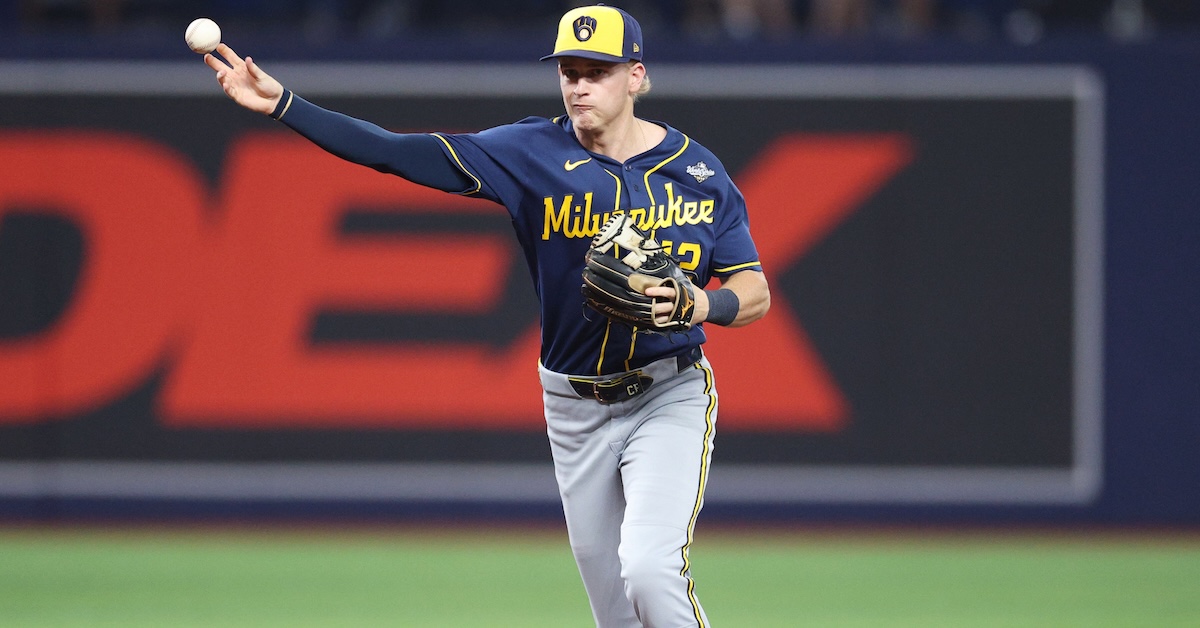
Nathan Ray Seebeck-Imagn Images Cooper Pratt was one of the revelations of the Brewers’ run to the World Series. He hit .354 overall and .421 in the Fall Classic itself, with hits that gave the Brewers the lead in Games 2, 4, and 5. His WPA was the third highest in World Series history for a player aged 22 or younger. All that, in concert with the eight-year contract Pratt signed before he even made his big league debut, would seem to indicate that the precocious Mississippian is Milwaukee’s shortstop of the future. Perhaps even the far future; a little motivated reasoning and you can get to Pratt being Middle America’s 1996 Derek Jeter. Except, having seen the best two weeks of Pratt’s life up close, I’m still not completely sure where he fits in the Brewers’ long-term plans. Let’s get dialectical about it. WPA and batting average are both useful stats, but they only tell you about a player’s contributions as a hitter. Batting, as you know, is just one of three phases of play for which a position player is responsible. And in the other two — defense and baserunning — Pratt had a pretty terrible postseason. Defensively, he made four errors in the playoffs, which is as many as any two other players this postseason. That doesn’t include the infamous phantom double play call that could’ve ended Game 2 of the World Series but didn’t. I’m not sure how fair it is to harp on that; it was a razor-thin call that would’ve gone unnoticed in any situation other than the ninth inning of a World Series game. The number of errors is obviously a factor of playing everyday at a position that sees a lot of action for a team that went all the way to the World Series, but a championship contender doesn’t want to have its shortstop rushing and short-hopping throws, or worse, doing whatever this is: You Aren't a FanGraphs MemberIt looks like you aren't yet a FanGraphs Member (or aren't logged in). We aren't mad, just disappointed. We get it. You want to read this article. But before we let you get back to it, we'd like to point out a few of the good reasons why you should become a Member. 1. Ad Free viewing! We won't bug you with this ad, or any other. 2. Unlimited articles! Non-Members only get to read 10 free articles a month. Members never get cut off. 3. Dark mode and Classic mode! 4. Custom player page dashboards! Choose the player cards you want, in the order you want them. 5. One-click data exports! Export our projections and leaderboards for your personal projects. 6. Remove the photos on the home page! (Honestly, this doesn't sound so great to us, but some people wanted it, and we like to give our Members what they want.) 7. Even more Steamer projections! We have handedness, percentile, and context neutral projections available for Members only. 8. Get FanGraphs Walk-Off, a customized year end review! Find out exactly how you used FanGraphs this year, and how that compares to other Members. Don't be a victim of FOMO. 9. A weekly mailbag column, exclusively for Members. 10. Help support FanGraphs and our entire staff! Our Members provide us with critical resources to improve the site and deliver new features! We hope you'll consider a Membership today, for yourself or as a gift! And we realize this has been an awfully long sales pitch, so we've also removed all the other ads in this article. We didn't want to overdo it. In case you didn't read all that, here's the short version. Membership includes:✓Ad-free browsing✓Unlimited FanGraphs & RotoGraphs articles✓Historical & platoon projections✓Leaderboard & player-page stat heatmaps✓One-click data exports✓Customizable player-page dashboards✓Dark & Classic site modes✓Weekly Members-only mailbag✓FanGraphs Walk-Off, your year in review✓Optional homepage photo removal✓Gift articles to non-Members✓Full postseason coverage Pratt’s baserunning bugged me more than his defense. His biggest booboo came in the ninth inning Game 4 of the World Series, when he got thrown out trying to steal second base to end the top of the ninth with pinch-hitter Andrew Vaughn at the plate. That out, which Pratt made representing the go-ahead run in a championship clincher, took Milwaukee’s best bench bat out of the game. Whenever there’s an even moderately fast runner on first, my personal inclination is that he should run until the base ahead is occupied. But in this situation, the downside of getting caught was so enormous, Pratt needed to be completely sure he was going to make it. Now, he was 19-for-22 in stolen base attempts in the regular season and has 88th-percentile sprint speed, and Tampa Bay’s battery of Bryan Baker and Liam Hicks is good, but not great, at controlling the running game. Pratt even picked the right pitch — a changeup in the dirt — to run on, and got a huge lead. And yet, a combination of a bad jump and a worse slide left him vulnerable to being called out on replay. Then there’s this: It went almost completely unremarked upon, because Pratt was on second base only because he’d just batted in the go-ahead run, but how in the world did he not tag and go to third base there? He doesn’t throw players under the bus, especially not players who are red-hot at the plate while the team’s winning. But from time to time, Murphy did insinuate that he’d studied the transit schedule and knew where to be if he were ever to make an exception. What I can say for sure is that Pratt did a lot of things this October that would’ve driven me absolutely nuts if I were his manager. Especially coming from a shortstop with limited offensive ability: Pratt had three homers and a .088 ISO in 74 regular-season games, and he’s never posted double-digit home runs in any professional season. Anyone who hits .400 in the World Series is kissed by the BABIP gods, but are we being fooled by Pratt sneaking a couple hot grounders past the Rays infield? I haven’t even mentioned the reason this question is worth asking: The no. 1 prospect in baseball is another young Brewers shortstop, Jesús Made, who hit .271/.344/.430 in 122 games at Double-A as a young 19-year-old this past year. If he’s not big league ready yet, there’s every possibility he will be by the end of 2027. So the Brewers have their franchise shortstop, but it probably isn’t the 22-year-old who just signed a long-term extension and made a serious run at World Series MVP. Let’s say Made really is the goods — where does that leave Pratt? The most obvious landing spot for a fast shortstop with limited power is second base. The Brewers can’t do that, because Brice Turang is coming off a 5.9-WAR season in which he hit 21 homers and posted a 127 wRC+. Long-term exposure to Pratt’s defense made me anxious; long-term exposure to Turang’s was a religious experience. I don’t think there’s a better second baseman in the world right now. The Brewers could move Pratt to third, which is currently being held down by a platoon of David Hamilton and Joey Ortiz. Postseason heroics aside, both Hamilton and Ortiz hit like utility infielders, and both had less-than-perfect postseasons with the glove. If you move Pratt to the hot corner, you might just be replacing Hamilton and Ortiz with a more expensive version of what you had already. That’s the pessimistic view. Having spent hundreds of words projecting Pratt’s faults onto a screen, let’s try to understand why the Brewers guaranteed this kid more than $50 million over the next eight years. The simplest explanation is probably the truth: Pratt’s defensive and base-running woes this October were likely some combination of rookie jitters and small-sample weirdness. Pratt was never an elite prospect — he was an over-slot sixth rounder, and he was only 10th on last season’s Brewers list — but the expectation has always been that he’s got plenty of glove to stick at shortstop. In half a season in the majors, that’s basically proved true. Pratt was two outs above average in 607 regular-season innings. Nobody is going to confuse Pratt with Masyn Winn, but that’s just fine. And in addition to the excellent stolen base numbers I mentioned earlier, Pratt was plus-3.7 runs as an overall baserunner. In half a season, that’s great. So if you wanted to chalk up Pratt’s concerning defense and baserunning to a brainfart or two, and the instant replay cameras taking a special interest in the rookie, I don’t know if I’d have a great counterargument. I do have questions about his bat long-term. Pratt was a 102 wRC+ guy this year, which for a rookie shortstop who played most of the season at age 21, is quite good. That said, his offensive profile relies on batting average way more than I’d like. Pratt batted .281 this regular season, with a 9.8% walk rate and a slugging percentage of just .368, and he needed a .332 BABIP to do it. Of the 318 big leaguers who batted at least 250 times this year, Pratt was 297th in ISO and 281st in EV90. In both of those cases, he was a rounding error away from his teammate Sal Frelick. Pratt is 6-foot-4 and a lean-but-not-skinny 210 pounds. Frelick is the size of a seventh grader and played most of this season with a busted shoulder. That’s not the guy you want to be under on these leaderboards. I’m actually slightly surprised how someone as big as Pratt generates so little bat speed. His Statcast-derived expected stats don’t show clear signs of his rookie season being a batted-ball fluke, but this version of Pratt would probably post wRC+ values in the 90s, and there’s some downside to come when pitchers realize they don’t have to be afraid to throw him strikes. For an average defensive shortstop who runs well, that’s a decent everyday starter. But it’s not the kind of player you’d displace Made or Turang for. And while $50 million and change over eight years is a trivial risk for most teams, the Brewers spend like I get my car washed — only on special occasions — and they probably had more and better in mind when they locked Pratt up. That sounds pretty bleak, doesn’t it? So why is it in the section that’s supposed to be about how Pratt’s future is actually really bright? Two reasons. First, the Brewers have a knack for getting guys to the majors quickly and continuing to develop them once they’re on the big league roster. By this, I don’t mean to say that Matt Arnold has a magic wand that turns any old Quad-A schmuck into Jake Bauers, but just look at Turang, who was worse than useless in his first 1,000 or so big league plate appearances. It’s reasonable to hope that more time under Daniel Vogelbach’s wing will unlock more offense for Pratt. Reason no. 2 is my own personal research hobbyhorse over the past 11 months: Hitters with good bat-to-ball skills, plate discipline, and athleticism but zero power. Last year, I went in search of the next Geraldo Perdomo and identified four young, up-the-middle players who fit the following criteria in 2025: 500 or more competitive swings, average bat speed under 73.0 mph, fast-swing rate of 18% or less, whiff rate under 20%, chase rate under 25%, Z-Contact% of 87.5 or better, hard-hit rate of 30% or less. Those four players: Hicks, Xavier Edwards, Bryson Stott, and Caleb Durbin. Last Year’s Perdometer Finds Name G PA BB% K% AVG OBP SLG wOBA wOBA Gain xwOBA wRC+ Liam Hicks 142 554 10.1% 9.9% .284 .367 .434 .352 .039 .319 123 Xavier Edwards 142 595 11.4% 13.9% .280 .360 .371 .325 .017 .311 103 Bryson Stott 155 608 10.2% 16.4% .256 .334 .401 .326 .011 .330 102 Caleb Durbin 153 586 8.7% 13.5% .248 .332 .378 .317 -.002 .291 100 Durbin’s overall 2026 numbers look underwhelming thanks to a slow start, but in the second half of 2026, he had a .336 wOBA and a 113 wRC+. Looking at Pratt’s underlying numbers, the Perdometer is clicking like mad. He only had 421 competitive swings in 2026, but he got over (or under, I suppose) five of the six bars for contact skills and plate discipline. The one exception: Pratt had a 29.8% chase rate in 2026. That’s not a trivial distinction, but on the whole, there’s some low-hanging offensive fruit to be picked here. So where does that leave Pratt long-term? A Made-Pratt-Turang-Hamilton-Ortiz logjam is only going to be problematic for the Brewers under certain circumstances. That would require one or both of the third base platoon guys to hit well enough to demand regular playing time, and for Made to force a promotion early in 2027. Neither circumstance is anything like a given. Once Made comes up, the Brewers can play one of him or Pratt at third base and enjoy the fruits of an infield defense that includes two shortstops and a second baseman with freakish range. Turang only has three years of team control left; we’ll see if he’s in the Christian Yelich–Brandon Woodruff Zone that makes him a Brewer for life, or if a championship unlocks more spending from owner Mark Attanasio. If not, Turang might end up on the trade block not long after Made establishes himself in the majors. At that point, Pratt can slide over to second. Pratt will probably end up somewhere in the middle ground between expensive Joey Ortiz and blond Geraldo Perdomo — in other words, somewhere around where Stott’s been for the past few years. That’s a fine player, but in order to maximize his skills, Pratt is going to have to iron the bumps out of his game the way Stott has. That seems like a reasonable enough expectation. We’re never as good as our most shining moments, nor as bad as our worst.
What Is Cooper Pratt Going To Do Now?
Full Article
Original Source
Read the full article at Blogs →KhanList aggregates and links to publicly available news content. We do not host full articles from third-party sources. Always verify important information with original sources.