
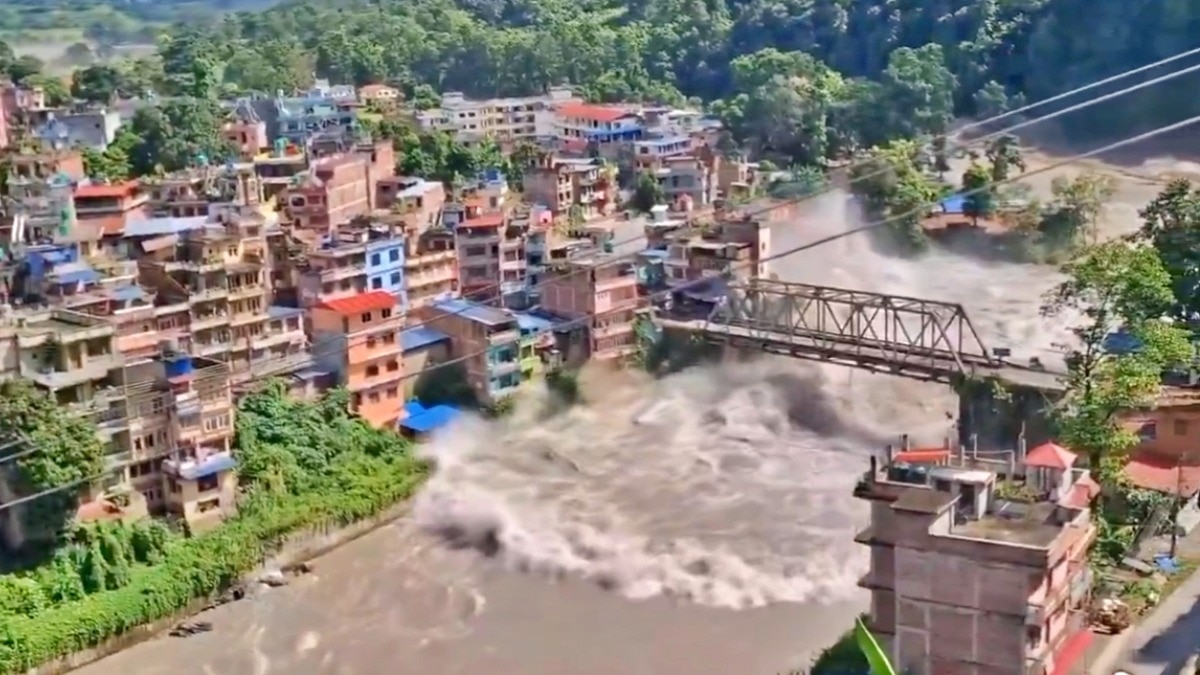
A flash flood in Nepal's Rasuwa district has killed at least nine people and left 105 Indians missing. The disaster has renewed focus on how mountains, monsoon rain and glacial risks can trigger sudden downstream threats.Nine Armed Police Force personnel are also missing after the flood reached Timure near the Nepal-China border. (Photo: X)A devastating flash flood in Nepal’s northern Rasuwa district near the Tibet border has once again highlighted the Himalayan nation’s extreme vulnerability to sudden and destructive floods.At least nine people have died, and 105 Indians remain missing after floodwaters swept away homes, vehicles, bridges and infrastructure sites, while authorities in Bihar have also been placed on alert as the water moves downstream.Unlike conventional floods that can develop over hours or days, a flash flood is a rapid and sudden surge of water, often arriving with little warning.It can be triggered by intense rainfall, a cloudburst, landslides blocking and then releasing a river, or the sudden bursting of a glacial lake. In mountainous terrain, water races downhill through narrow valleys, gaining enormous speed and destructive power. These visuals from the floods in Rasuwa, Nepal are absolutely horrific. The scale of the destruction looks unreal, almost like a scene from a disaster movie.The entire Himalayan belt needs to seriously work on better early warning systems for such flash floods. Prayers for pic.twitter.com/7iiupXXIzT— Nikhil saini (@iNikhilsaini) August 26, 2026 The Rasuwa disaster appears particularly unusual because Nepal's Flood Forecasting Division said heavy rainfall within the district was unlikely to be the sole cause. Satellite imagery, however, detected significant rainfall on the Tibetan side.Authorities are also investigating whether a glacial lake outburst flood, or GLOF, may have contributed to the disaster.WHY IS NEPAL VULNERABLE TO FLASH FLOOD? Nepal's geography makes it exceptionally prone to such events. The country lies in the young and geologically active Himalayas, where steep slopes feed thousands of fast-flowing rivers.Heavy monsoon rain can quickly funnel into narrow valleys, transforming relatively small streams into raging torrents.Climate change is adding another layer of risk. Himalayan glaciers are retreating, leaving behind expanding glacial lakes held back by fragile natural walls of ice and rock.A landslide, avalanche or sudden inflow of water can destabilise these barriers, releasing massive volumes of water downstream. Monsoon activity seen over Tibet in satellite images. (Photo: IMD) The Bhote Koshi, where the latest disaster occurred, begins in Tibet before rushing through Nepal and joining the Trishuli river system.The water eventually reaches India through the Gandak river, meaning a disaster high in the Himalayas can quickly become a transboundary threat.The region has suffered similar devastation before. Last year's deadly Bhote Koshi flood washed away a bridge linking Nepal and China and was later linked to the drainage of a supraglacial lake in Tibet.This time, villages, the Timure border market, roads, bridges and hydropower infrastructure have again been devastated. Rescue helicopters have struggled to land because of high water levels.For Nepal, flash floods are becoming a growing challenge where mountains, monsoon weather, unstable terrain and a warming climate can combine to create disasters within minutes.- EndsPublished By: Sibu Kumar TripathiPublished On: Aug 26, 2026 16:08 IST
What is a flash flood, and why is Nepal so vulnerable to it?
Full Article
Original Source
Read the full article at Indiatoday →KhanList aggregates and links to publicly available news content. We do not host full articles from third-party sources. Always verify important information with original sources.