
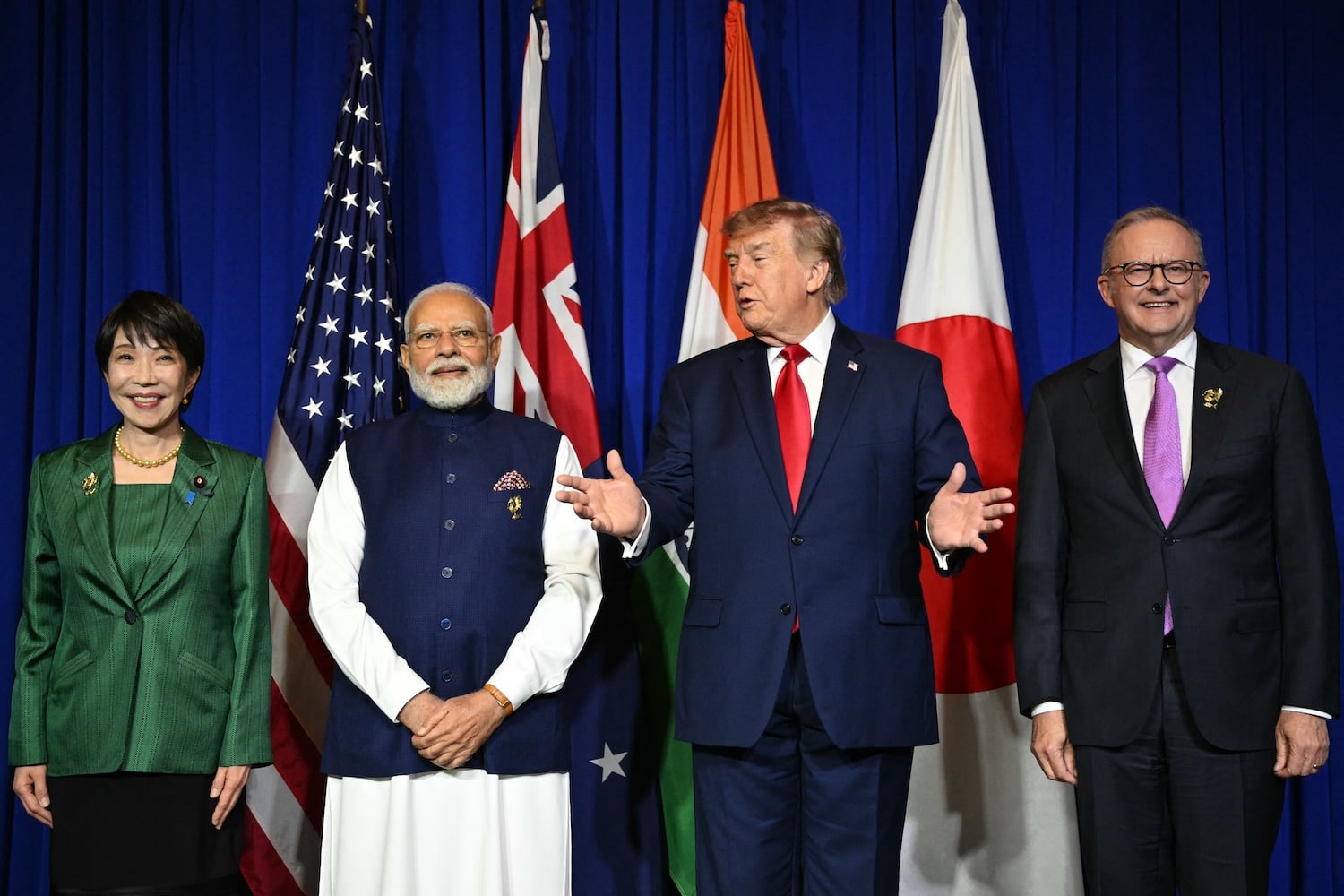
Welcome to Foreign Policy’s South Asia Brief. The highlights this week: High-level diplomacy in Manila and Shenzhen captures the attention of Indian policymakers, Bangladesh is cleared to receive U.S. International Development Finance Corp. funding, and jailed former Pakistani Prime Minister Imran Khan issues a plea for medical treatment. A Whirlwind Week of Asia Diplomacy The Quadrilateral Security Dialogue held its first leaders’ meeting in more than two years on the sidelines of the Association of Southeast Asian Nations (ASEAN) summit in Manila, Philippines, on Tuesday. Australia, India, Japan, and the United States announced initiatives including cybersecurity collaboration, a cable connectivity framework, and a maritime surveillance exercise. The Quad meeting likely brought some relief for New Delhi. The grouping is important for India’s foreign-policy interests, bringing together some of its closest security partners in an effort to counter China. (However, the Quad states rarely mention Beijing in their public messaging about the grouping to avoid antagonizing the superpower.) Though India has engineered a rapprochement with China in the last two years, taking steps to reduce border tensions and scale up trade and investment, they remain bitter strategic rivals. India prioritizes opportunities to work multilaterally to push back against China’s power through non-security collaborations in areas such as technology and infrastructure investment. Scheduling issues and U.S.-India tensions have prevented high-level Quad engagement since September 2024. Quad supporters will point to Tuesday’s meeting as an indication of the grouping’s resilience, much like how it bounced back from quiescence in 2017—interestingly, with another summit in Manila when each member’s ties with China faced increasing strain. Still, the Quad remains mired in uncertainty, mainly because of U.S. President Donald Trump. His administration’s signaling about taking a softer approach to competition with China, coupled with silence about the fate of the U.S. Indo-Pacific strategy, suggests that the current White House may not be prepared to throw its full support behind the Quad. Though an incoming Democratic Congress might take a tougher line on China, this is unlikely to shape the Trump administration’s thinking on the Quad. As a result, the wider ASEAN summit arguably held more immediate significance for New Delhi than the Quad meeting. Indian Prime Minister Narendra Modi has long sought to step up India’s game in Southeast Asia—a region home to key Indian partners and multiple growing economies. India has especially strong incentives to ramp up engagement given China’s large footprint there. In that sense, the stakes were high for Modi’s engagement with ASEAN leaders this week. New Delhi will now closely watch as Trump, Chinese President Xi Jinping, and Russian President Vladimir Putin hold a historic trilateral meeting on Thursday on the sidelines of the Asia-Pacific Economic Cooperation (APEC) summit in Shenzhen, China. There is a lack of clarity, but the discussion will reportedly include the Iran war and nuclear nonproliferation. Such themes are unlikely to concern India, which has a strong interest in the wars in both Iran and Ukraine coming to an end. But the summit will be a vindication of sorts for New Delhi. In 2025, Trump slammed a meeting among Modi, Xi, and Putin in China; now, he is coming to the same table. However, the boost that China is likely to get from the trilateral isn’t ideal for India. The U.S., Chinese, and Russian leaders have never had such a formal face-to-face exchange. Beijing’s capacity to convene the three leaders, against a backdrop of long-standing U.S.-Russia hostility, is a major diplomatic achievement. For New Delhi, the biggest takeaway from this week’s high-level diplomacy in Manila and Shenzhen is that the Quad leaders’ meeting was a relative sideshow. The ASEAN and APEC summits will generate more attention and hold more immediate significance for Indian policymakers. What We’re Following Bangladesh cleared for DFC investment. The U.S. International Development Finance Corp. (DFC) announced on Monday that Bangladesh was now eligible to receive its financing. The DFC, which mobilizes private investment, has taken on added importance since the demise of the U.S. Agency for International Development (USAID) last year. Until now, Bangladesh was ineligible for DFC financing because of U.S. concerns about labor conditions in the country. Negotiations between Washington and Dhaka to address these concerns and clear the way go back to the Biden administration. The announcement couldn’t come at a better time for Bangladesh, which faces serious development challenges and severe economic stress. Some of its most pressing challenges—such as fuel shortages and the world’s worst measles epidemic—are tied to energy and healthcare, two of DFC’s priority areas for investment. DFC-funded projects could bring a boost to U.S.-Bangladesh relations. Development cooperation, for years embodied by the large USAID mission in Dhaka, has long been a major component of the relationship. Khan issues plea for medical treatment. Lawyers for Imran Khan sent an open letter on Monday from the jailed former prime minister to top judges in Pakistan, imploring them to secure better healthcare for Khan and his wife, who is also in prison. In the letter, Khan says he is suffering from high blood pressure and is at risk of a brain hemorrhage and cardiac arrest. For months, Khan’s lawyers, family, and supporters have said his health is worsening, while officials say he is stable and regularly monitored by prison doctors. In August, Pakistan’s Supreme Court ordered Khan to be transferred to a private hospital for an extended period; he was instead brought to a government hospital and only briefly. Concern for Khan’s health was one reason why leaders of the Pakistan Tehreek-e-Insaf (PTI) party announced nationwide protests last month. But aside from some demonstrations in Khyber Pakhtunkhwa province, the only one governed by the PTI, the campaign didn’t materialize. The party might be back-channeling with the country’s leadership to secure concessions for Khan. British royals visit India. The United Kingdom’s Prince William and Princess Catherine completed a three-day visit to India on Wednesday. They began their trip in Mumbai, where they participated in the Earthshot Prize ceremony. William founded the award, which focuses on developing new solutions to climate change. The royal couple then traveled to New Delhi, where they met Modi. Their visit underscores the strong ties between India and its former colonizer. U.K.-India relations have deepened in recent years, buoyed most recently by a free trade deal that formally entered into force in July. For that matter, U.K.-Pakistan ties are also quite warm; William and Kate made a visit there in 2019. Deep people-to-people ties, thanks in part to large Indian and Pakistani diasporas in the U.K., help bolster these relationships. British colonial rule may have left a problematic legacy in the subcontinent, but diplomacy today is in a good place. Under the Radar New Delhi hosts an arts and culture forum this weekend under the banner of the Shanghai Cooperation Organisation (SCO). The idea for the Civilisational Dialogue Forum came from India, which will head the event even though Pakistan is the current SCO chair. Pakistan’s climate change minister, Musadik Malik, will travel to New Delhi to represent Islamabad. With India-Pakistan ties so tense in recent years, the rare occasions when senior ministers from one country have traveled to the other have mostly come in their capacity as SCO members. Pakistani Foreign Minister Bilawal Bhutto Zardari traveled to India for an SCO summit in 2023, while Indian External Affairs Minister S. Jaishankar went to Pakistan the next year. Malik’s visit, however, comes at an especially fraught moment, with the relationship essentially frozen since the brief military conflict between India and Pakistan in 2025. Looking ahead, a big question is whether Modi will travel to Pakistan for the SCO leaders’ summit scheduled for next August. Modi visited Pakistan in December 2015, early in his first term. Several days after his trip, Pakistani terrorists attacked an Indian Air Force base. Since that incident, Modi’s government has taken an especially hard line toward Pakistan. Even though Jaishankar went to Pakistan in 2024, it is unlikely that Modi himself will make the trip next year—especially if the protest movement against his government that has gripped India in recent months remains active. FP’s Most Read This Week Lame-Duck Trump Heads to Asia by Rishi Iyengar What a Hormuz Endgame Could Actually Look Like by Keith Johnson How Netanyahu Lost His Bet on Trump by Azriel Bermant Regional Voices In the Daily Mirror, writer K.K.S. Perera analyzes Sri Lanka’s new budget: “Has the 2027 Budget adequately addressed the economic difficulties confronting ordinary Sri Lankans? The answer must be examined against people’s actual living conditions rather than the Government’s financial projections, development promises, and announcements.” In the Print, education expert Archana Dalmia reflects on Italian-born Indian politician Sonia Gandhi’s new memoir, Belonging. “Destiny had written a very different story from the one she could ever have imagined,” she writes. “Through love, loss and the unexpected turns of life, she became part of a country that was once so distant from her own.” In Dawn, public health specialist Muhammad Aftab Gohar argues the urgency of eliminating rabies in Pakistan. “The global goal is zero deaths from dog-transmitted rabies by 2030,” he writes. “A rabies-free Pakistan is within reach if we act together, and act now.”
What India Makes of Trump’s Asia Trip
Full Article
Original Source
Read the full article at Foreignpolicy →KhanList aggregates and links to publicly available news content. We do not host full articles from third-party sources. Always verify important information with original sources.