
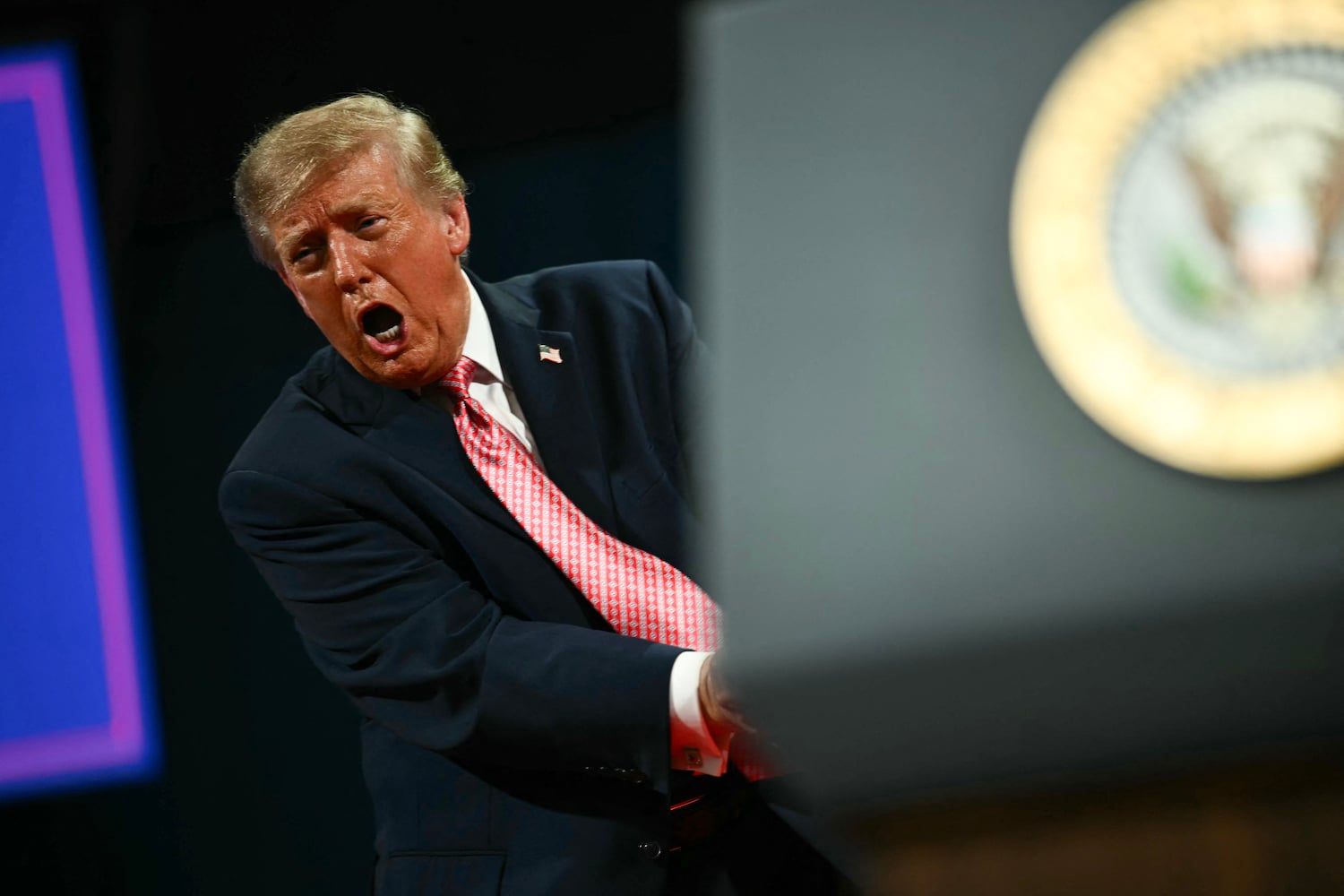
Test yourself on the week of Oct. 17: French protests intensify, Israeli police make arrests, and Trump tempts voters. U.S. President Donald Trump yells during a campaign rally at the Heartland Credit Union Arena in Park City, Kansas. U.S. President Donald Trump yells during a campaign rally at the Heartland Credit Union Arena in Park City, Kansas, on Oct. 19. Kent NISHIMURA/AFP via Getty Images Politics October 23, 2026, 12:28 PM The U.S. midterms are approaching, and they’re beginning to gobble up airtime. Did you manage to keep track of everything else going on in the world? Find out with our news quiz! Have feedback? Email [email protected] to let me know your thoughts. The U.S. midterms are approaching, and they’re beginning to gobble up airtime. Did you manage to keep track of everything else going on in the world? Find out with our news quiz! 1. What did French Prime Minister Sébastien Lecornu on Monday blame for inflaming mass protests sweeping the country? The French people’s belief in the power of the street combined with a centralized government has sparked numerous large-scale protests in recent years, Emile Chabal writes. 2. Israeli police arrested 10 people on Monday as part of an investigation into what? Israeli Prime Minister Benjamin Netanyahu is trailing in the polls ahead of elections later this month. But no other group seems poised to win outright—or have enough votes to smoothly form a coalition government, David E. Rosenberg writes. 3. At a rally in support of a Republican candidate ahead of midterm elections next month, U.S. President Donald Trump on Monday proposed an $8 billion bailout for which group? (Hint: The event was in Kansas.) Traditionally a stable Republican bloc, farmers have been buffeted by Trump’s numerous forays into global conflict and trade disputes, FP’s Christina Lu reports. 4. Mauritius ended a curfew on Monday that was put in place last week due to escalating demonstrations protesting the rising cost of living and what other issue? Water shortages have been exacerbated by drought, climate change, and aging infrastructure, FP’s Nosmot Gbadamosi reports in Africa Brief. 5. Tech company Meta said on Tuesday that it had complied with an order from Brazil’s electoral court to do what ahead of the country’s Oct. 25 runoff presidential election, which will see President Luiz Inácio Lula da Silva face Sen. Flávio Bolsonaro? If the right-wing Bolsonaro triumphs, Brazilians would have reason to fear U.S. military activity in their country, Alexander Main and Guillaume Long argue. 6. North Korea announced on Wednesday that it would wage “psychological warfare” against South Korea by doing what? South Korean President Lee Jae-myung has made easing tensions with Pyongyang a central part of his agenda, but North Korean leader Kim Jong Un has become more combative toward Seoul, Robert A. Manning and Rachel Minyoung Lee wrote last year. 7. Amid rising security concerns posed by Yemen’s Houthi rebels, the U.S. State Department on Wednesday ordered nonessential embassy staff and their families to evacuate from which country? Saudi Arabia’s bet on Trump has backfired, Nicholas Grossman wrote last month. 8. What did Trump ask SpaceX CEO Elon Musk to do this week, as reported on Thursday by the Wall Street Journal? Musk, who tried to distance himself from the slowdown of internet connectivity speeds for Starlink’s military-grade service to Ukraine, apparently discussed the matter with Trump before making the decision himself, FP’s John Haltiwanger writes in Situation Report. 9. A Japanese-led space mission set off on Monday for Phobos, a moon of which planet? The mission project manager, Yasuhiro Kawakatsu, described the moon as “the most important unexplored body within the solar system,” the New York Times reports. 10. U.K. Prime Minister Andy Burnham on Monday announced a nationwide campaign against “one of the most annoying things on public transport.” What was he referring to? Offenders could face fines as high as 1,000 pounds, according to a release from the British government. You scored It’s a big world out there! Brush up on global goings-on by subscribing to World Brief, Foreign Policy’s flagship daily newsletter. You scored Perfection! You’re a pro who needs the in-depth insights offered in Situation Report, our newsletter on national security and defense. Have feedback? Email [email protected] to let me know your thoughts. Politics Drew Gorman is a deputy copy editor at Foreign Policy. OTHER SUBSCRIPTION OPTIONS Stories Readers Liked Go to slide 1 Go to slide 2 Go to slide 3 Go to slide 4 Go to slide 5 Go to slide 6 Go to slide 7 Go to slide 8 Go to slide 9 Go to slide 10 A Taiwanese crowd protests while waving flags of the Republic of China. U.S. Defense Secretary Pete Hegseth and Joint Chiefs of Staff Chairman Dan Caine depart following a national ceremony for POW/MIA Recognition Day in Arlington, Virginia, on Sept. 18. Xi (left) and Trump (right) are shown up close, with Xi looking at Trump. Putin and Xi are both seen in profile as Putin walks to the right and away from Xi, just a few feet of space between them. Xi, meanwhile, is also faced away from Putin, standing and looking down at his feet or the red carpet beneath them. Both men wear dark suits. A man wearing a dark suit jacket, light blue button-down shirt, and patterned red tie sits on a dark gray couch against a textured dark blue wall. He is looking off to the side with a mild smile, next to a teal pillow. The Twilight of the Francis Fukuyama Era By Jeremi Suri An illustration in red and blue tones depicting five silhouetted figures running forward through a dark corridor flanked by large, textured Russian lettering on the walls and floor. Light radiates from the far end of the tunnel behind them U.S. President Donald Trump and Chinese President Xi Jinping after a welcome ceremony in Beijing. A statue of a seated, bearded man with a bare torso and draped cloth around his waist, holding a scroll in one hand, positioned in front of a row of large classical columns. Negotiators from the United States, Canada, and five European countries converse after finishing the draft of the North Atlantic Treaty in Washington on March 18, 1949. Trans-Atlanticism Isn’t Dead—It’s Being Renegotiated By Alexandra de Hoop Scheffer An aerial photo shows Doha in the booming petrostate of Qatar.
What in the World?
Full Article
Original Source
Read the full article at Foreignpolicy →KhanList aggregates and links to publicly available news content. We do not host full articles from third-party sources. Always verify important information with original sources.