
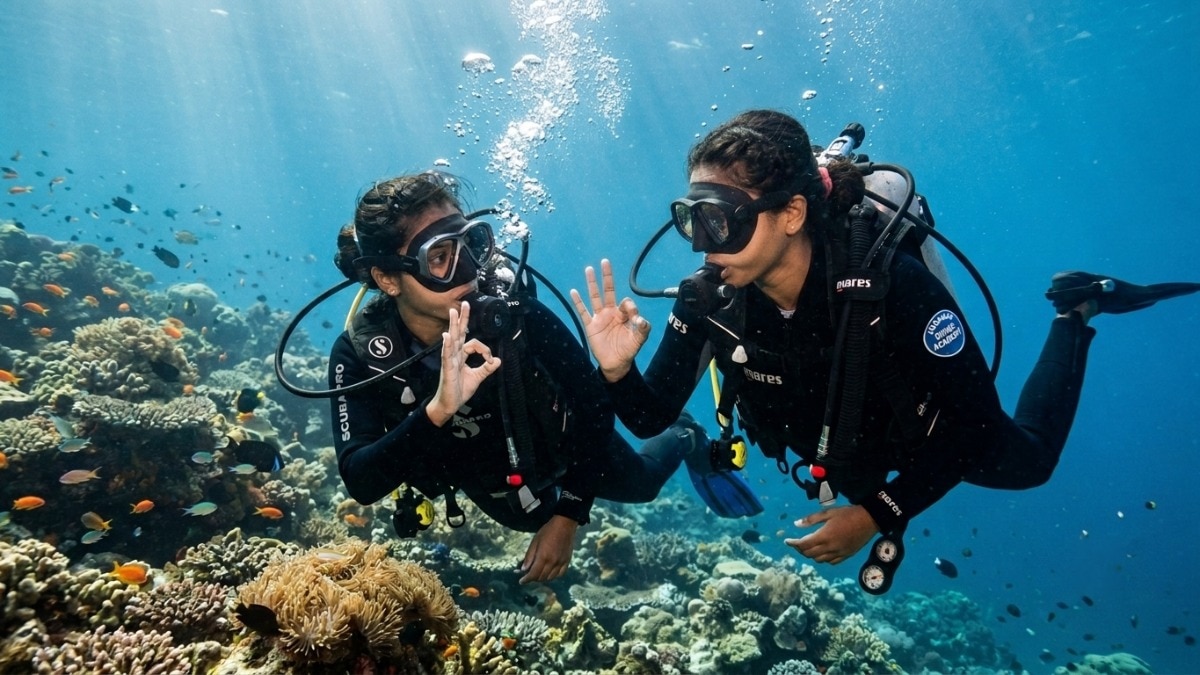
What if one of the most unusual places to learn about problem-solving, confidence and teamwork is 10 metres below the surface?There is a moment in scuba training when everything a learner normally depends on disappears. There is no easy conversation, no phone to reach for, no teacher speaking continuously from the front of a room. There is only the sound of your own breathing, the person beside you and the unfamiliar world beneath the surface.That may be one reason scuba diving is finding a larger audience as India's coastal and island tourism grows.Official Ministry of Tourism data shows domestic tourist visits to the Andaman and Nicobar Islands rising from 2.35 lakh in 2022 to 3.23 lakh in 2023 and 7.10 lakh in 2024. PADI, the world's largest scuba-diving training organisation, currently lists more than 55 dive shops in India offering its Open Water Diver course. Globally, it has certified more than 30 million divers through a network spanning thousands of dive centres and resorts.The numbers point to a growing ecosystem around India's marine and adventure tourism. And once people enter that ecosystem, they discover that scuba training is teaching them much more than how to breathe underwater. (AI-generated image) WHEN PANIC IS NOT AN OPTIONFor Anees Adenwala, founder of Orca Dive Club, one of the most important lessons is simple: “Stop, Think, Breathe and Act.”A problem underwater can become worse if a diver reacts impulsively, which is why training repeatedly builds the habit of pausing, assessing the situation and then responding.Anees believes that lesson belongs outside the ocean too.“Students today are often under tremendous pressure to respond quickly, perform and find the right answer immediately,” he says. “Education could benefit from teaching young people how to pause under pressure, manage anxiety and approach problems calmly.”Eighteen-year-old college student and PADI AmbassaDiver Ashrita Gachumale says she has carried that habit into college.“Diving has made me much more comfortable with slowing down when something feels overwhelming,” she says. “You can be nervous and still think clearly.”That distinction is important. Diving does not necessarily teach people to stop being afraid. It teaches them that fear does not have to make the decision for them.YOU CANNOT LEARN TRUST FROM A TEXTBOOKThere is another thing that changes underwater: communication.Divers cannot rely on ordinary conversation. They use hand signals, eye contact and body language, while constantly monitoring their buddy. The person swimming next to them is not merely a companion but someone they may have to rely on in an emergency.“You have to learn to communicate through hand signals, eye contact and body language, and that makes trust between two divers extremely important,” Anees says.His student Vaishnavi Mehra remembers learning that trust through a surprisingly ordinary sentence from her instructor.“Hey, I’m right here.”“It was much more valuable to me as a student than any amount of tips or suggestions would be,” she says. Knowing that she had room to make mistakes while someone had her back allowed her to move outside her comfort zone.“My instructor trusting me eventually allowed me to trust myself.”That may be one of the more difficult lessons to teach in a conventional classroom: confidence is often built when somebody gives you enough safety to make a mistake. (AI-generated image) THE OCEAN DOES NOT FOLLOW THE TEXTBOOKMia Raghavi, a PADI IDC Staff Instructor, remembers a student who understood how to clear her mask but struggled when water actually entered it. The technique made sense in theory. Her body simply was not ready for the sensation.Instead of repeatedly pushing her through the exercise, Raghavi changed the learning process. The student spent time breathing underwater without a mask in shallow water until she became comfortable with the unfamiliar feeling.Eventually, she cleared her mask successfully in open water.“The moment a student successfully performs a skill often becomes a turning point where uncertainty disappears and trust in their own abilities grows,” Raghavi says.That is the difference between knowing something and being able to do it when the conditions are unfamiliar.Vaishnavi describes another difference between the ocean and a conventional classroom.“Unlike a textbook, the lessons in the ocean are never the same the second time round,” she says.A dive site may look familiar, but currents, visibility, marine life and conditions can change. “I love that unpredictability,” she says. “Every dive feels like opening the same chapter of your favourite book, only to find that the story has taken a new twist.”The learner therefore has to adapt rather than simply reproduce an answer.SOMETIMES THE BIGGEST LESSON IS YOURSELFPerhaps the most unusual part of learning underwater is that there are fewer distractions from your own reactions.Anees has watched students arrive with fear, overconfidence or self-doubt and gradually learn to manage those feelings.“I remember training a student who was so uncomfortable that she struggled to put her face into a shallow pool,” he recalls. Instead of forcing her through the exercise, they spent sessions sitting on the pool floor, practising breathing and building confidence.Months later, she was comfortably diving in open water.“For many divers, that is when fear begins to turn into fascination, and eventually into a genuine love for the ocean,” he says.For Anees, the ocean forces people to confront something they can often avoid on land.“They are forced to confront themselves.” (AI-generated image) LEARNING TO RESPECT WHAT YOU CANNOT CONTROLThere is also a lesson that goes beyond personal confidence.Raghavi tells her students not to treat the ocean as something that exists for their entertainment. Divers are visitors in an ecosystem they cannot control, and responsible diving means observing marine life without chasing animals, touching corals or taking underwater souvenirs.“The underwater world is not ours to interfere with, but one that we are privileged to visit,” she says.Her rule is simple: “Take only memories, leave only bubbles.”For Vaishnavi, the ocean has taught her something slightly different: how to let go of the need to control every outcome.“Do what you can to the best of your ability in the moment and then leave the rest up to nature,” she says. (AI-generated image) That may be the strangest thing about this classroom beneath the waves. It teaches through uncertainty rather than removing it, through mistakes rather than hiding them, and through experience rather than simply explanation.You enter thinking you are learning how to dive.You may come out having learnt how to breathe through fear, trust another person, adapt when the plan changes and trust yourself when nobody can give you the answer.And those are lessons that can be difficult to fit on a blackboard.- Ends
What if students learnt life skills underwater? The lessons from scuba diving
Full Article
Original Source
Read the full article at Indiatoday →KhanList aggregates and links to publicly available news content. We do not host full articles from third-party sources. Always verify important information with original sources.