
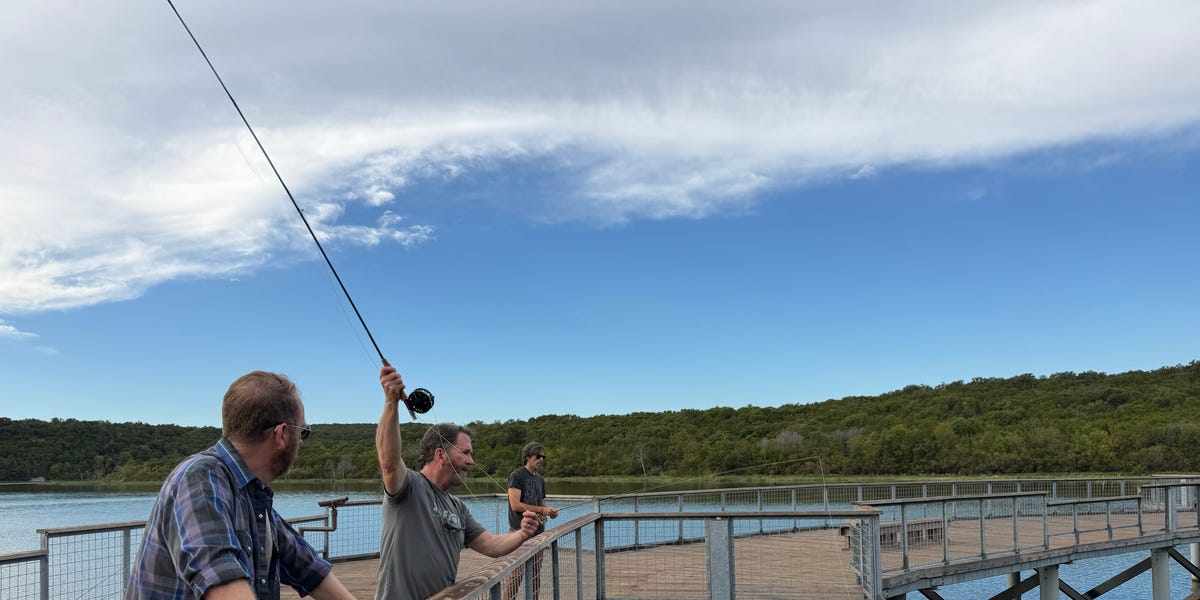
23 min readThere are few Curtis Creeks in this life, so when you find it, keep its secret well…—Sheridan Anderson, The Curtis Creek ManifestoLet me tell you about these two men, Doug Deason and Luke Metzger. Two men who seem like they should be yelling at each other in a Buc-ees. Men who achieved something amazing together.Where to start? Well, let’s see. Deason is a Trump guy. Actually, more salient: Deason is a Ken Paxton guy. And not just one of his guys but one of his big donors. Ken Paxton, yes, Texas’s embattled attorney general and current Republican candidate for United States Senate. Paxton, charitably, isn’t the best candidate the GOP fielded these midterms, but Trump wanted him in the race, and Trump got what he wanted, and now Paxton is locked in the race of his life, at real risk of losing to a candidate whose party hasn’t won a Senate seat in Texas in thirty-eight years. Earlier in the race, none of the GOP donor establishment wanted to support Paxton. But Deason did, out of a mix of genuine friendship and an affinity for some MAGA priorities, especially the ones that want to see the branches of the federal government pruned back.There’s also that: Deason is a major Republican donor. You’ll see stories that call him a “megadonor.” Unfair, perhaps. He prefers “activist,” and while his father was a billionaire GOP donor (Darwin Deason sold an IT company to Xerox for $6.4 billion in 2010, providing plenty of funds for his political interests), there are people who give far more. Deason says in a two-year cycle he usually gives between $1.5 million and $2 million; Elon Musk has reportedly put more than $150 million behind Paxton in this race, via super PAC. But in Texas’s vast GOP machine, Deason greases many gears.Then Metzger. Well. I mean. He’s the executive director of Environment Texas, the state chapter of a nationwide environmental nonprofit. Paxton “routinely sues the federal government to try and block environmental initiatives—for example, suing to undo clean-water protections,” Metzger says. Is that enough? No? Environment Texas describes itself with phrases like “guide our country onto a greener, healthier path” and “grassroots support” and “allow nature to thrive” and “infinite economic growth on a finite planet is neither wise nor possible.”When I met Metzger, he was driving his college-age son’s Chevy Volt, an early plug-in hybrid.When I met Deason, he was driving a blacked-out Ford F-150 Raptor, a pickup truck that is a sports car.Deason is on the board of Galaxy, a data center and digital-infrastructure company that is building Helios, a major data center in Dickens County, near Lubbock.Metzger? Metzger carefully says that “we’re not saying data centers are inherently bad or we shouldn’t have them but want to set the rules of the road first before it’s too late.”Courtesy Thomas GrahamLuke Metzger, left, and Doug Deason met on Twitter, in a fight about wind power. Five years later, the state is about to have a lot more parkland thanks to them. And they’re fishin’.Or how about this one? Deason thinks wind power—Texas is by far the nation’s most productive state—needs a closer look because of all the birds turbines kill. Metzger thinks the carbon pollution forgone, compared with fossil fuels, is far more valuable to avians (and everyone else). A fight about it on Twitter, in fact, is how they met.And yet.Three years ago, Texans voted for a constitutional amendment to create a $1 billion fund, the Centennial Parks Conservation Fund, to buy and develop land into state parks. Before winning over voters, the legislation made it through both chambers of the state’s legislature and was signed by Governor Greg Abbott. Who masterminded the whole thing? Doug Deason and Luke Metzger. After their meet-cute by the windmill, Metzger decided to reach out privately about raising money for parks. He was savvy enough to understand that, whatever else, Deason was an outdoorsman. Deason agreed. Metzger worked the green lobby. Deason deployed his influence. Two years later: $1 billion. Sounds like a fish story.That’s the way you might think, anyway. In 2026. When the midterm election is a partisan exercise par excellence, pitting a morally challenged good ol’ boy against a lab-created liberal Christian and attracting more than half a billion dollars in donations while attempting to draw the lines between people that seem to arise as a matter of course these days. Doesn’t it seem as if no one wants to be with the people who disagree with them? Political opponent, acquaintance, friend, or even family member?But against that backdrop, one of Texas’s greatest and most recent bipartisan successes is starting to pay dividends. In May, the state acquired a ranch of more than fifty thousand acres, which will one day be the second-biggest state park in Texas. And in September, Post Oak Ridge State Park, which was acquired before the Centennial Fund but developed with its monies, opened for day use—the first new Centennial Fund park available to the public.And anyway, to think that way is to ignore one simple fact: All of these reasons for Deason and Metzger to be enemies are about politics. And there’s so much more to life than politics.Like fishing.Which is what Deason and Metzger were doing the very day I met up with the two of them and Deason’s communications advisor, Thomas Graham. On September 21—forty-three days before the midterm election—we went fishing at Palo Pinto Mountains State Park, an hour and a half west of Dallas. Fly-fishing, in particular. Metzger had only been a couple times, and the closest I’d gotten to it was a funny numbness in my jaw at “I am haunted by waters.” But Deason had been fly-fishing for fifty-four years, so he took it upon himself to teach us.We’d left Dallas, where Deason is based, at 5:30 a.m. and arrived at the park to find a perfect morning. I’d flown in from New York girded for 100 degree days, and this might still have become one, but the morning was cool. “Cool”—70 degrees. We parked above the park’s boat ramp and the fishing pier and walked down carrying rods and tackle. The pier arced a couple hundred feet between two points on the shore of Tucker Lake. The water was calm, gently bunched by ripples of wind or rent by the oscillation of a water snake. The lights were on and the sky was beginning to grow big by then, the way the sky does in Texas.If only the fish were biting.Courtesy AuthorMetzger took up fishing this summer after a lifetime spent loving—and fighting for—the outdoors.Fly-fishing, it goes without saying, is not bait fishing. I didn’t fully understand that until I saw Deason preparing the fly rods. We had two—one his, one Graham’s. The line on the reel, which an inexperienced fisherman like me could confuse for a lime-green version of the standard stuff my dad picked up at Walmart when I was a kid, is in fact deceptively complex. It’s engineered with four parts—backing, the fly line, the leader, and the tippet—so that an angler can land a fly in the precise pocket of water where hungry fish reside without any but the smartest fish able to connect the whole system back to the guy with the creel at his feet.Fly-fishing, in other words, is a sport of cunning. Jabbing a nightcrawler onto a hook and dropping it into the water is not unlike bombing an electorate with rage-bait political ads—playing on the most primal, knee-jerk evolutionary instincts. Fly-fishing? It’s a sport of persuasion.Anyway, this is all very fussy to set up. As Deason got to work, he almost immediately began to apologize for the poor quality of his leader, the lack of appropriately sized line, and so on and so forth. He was working at a wooden bench in the middle of the pier, upon which he’d spread his voluminous fishing tackle—line, clippers, forceps, boxes and boxes of flies—and human tackle—jerky from Buc-ees, a Yeti full of waters. He gave me a spinning reel, a bait-fishing rod, to play with while he worked.I took up a position near Metzger and practiced a cast. Tall and scruffy at fifty years old, he was dressed in flannel, shorts above the knees, crew socks, and sturdy boots. Which is maybe a caricature of a crunchy environmentalist but is also simply what one wears if they’re expecting to get outdoors. Metzger and Deason had been telling me about their initial meeting, so wind power was on my mind.“Is there offshore wind in the Gulf?” I asked, metronomically casting out and reeling in.“Not yet,” Metzger said. “Not anytime soon, either,” he added, seeming rueful.“I mean, I don’t even know if it makes sense there,” I said. “I’m just curious.”He answered: “It does.”“To me, the debates about offshore wind are interesting,” I said.“Yeah,” Deason said, hearing our conversation. He couldn’t help himself. “Well—” he started to jump in.I finished my thought first. It seemed to me that the real, if at times unspoken, barrier to offshore wind around us, in New York, was NIMBYs who didn’t want blemishes on their horizon line. “But there’s huge shipping traffic coming in and out,” I said. “You don’t have some pristine, unblemished view when you look out on the water anyway.”“Well, supposedly they mess with whales,” Deason said. “I don’t know if that’s true or not,” he admitted—could be alternative facts.The line came off the rod for me with no carry, the way a paper airplane thrown carelessly dives as soon as the force of the throw dissipates.Metzger picked this right up. “I mean, any offshore disturbance can impact whales, but you know, offshore drilling certainly is, and the boats—that’s one of the big concerns, that boats can drive so fast there’ll be collisions.”Graham had been preparing his rod, and he got Metzger’s attention. “You want to use this rod to try to fly-fish?” he asked.“Oh, sure.” Metzger said. And just like that, offshore wind was tabled.Deason came over to instruct.“I wish I had this magazine, Luke. I’m going to send you one. It’s called The Curtis Creek Manifesto.” Deason had already mentioned it once before. It was written by a hippie, he’d said, but it had its insights. Granted, fly-fishing usually happens at water level, and we were up on a pier. And usually you’re working with moving water, building a strategy around the way fish face upstream, waiting for sustenance to come floating down. Still, “it’s just logic,” Deason said of the Manifesto. Still useful. “It’s just common-sense little things. So you know: Control the line.”The three of them, Graham, Metzger, and Deason, fiddled with the fly rod and adjusted the slack cascading off the reel.Deason got Metzger set, then came to work with me instead. We got a little lost for a minute, looking at the open water on the lake side of the pier, across to the hills of the other side, monochromatic green under a pale-blue sky painted with wisps of white like an old-timey movie backdrop. The temperature was still in the 70s. “God’s country,” a friend from high school, who’d decamped from California to Texas, used to remind me when I visited. Indeed it was.Deason held the cork handle of the second fly rod, the one I was going to use, in his right hand and pulled line off the reel with his left until his hand was ringed with a nimbus of fly line. Then he started showing me the motion. He’s sixty-four years old, but Deason has the compact, solid build of someone who has never gone long without physical activity. His movements were efficient, even elegant. Arm more or less straight, maybe cocked a little at the elbow. The rod is what bends. Arm comes up, back just behind the head, then after the slightest second of a pause pendulums forward. Maybe a flick of the wrist. Line shoots.He let me try. I was not elegant. The line came off the rod for me with no carry, the way a paper airplane thrown carelessly dives as soon as the force of the throw dissipates.I kept trying, and Deason turned to watch Metzger, who was casting repeatedly. He offered a minor correction to his form.“I heard someone said, like, it’s a martini glass,” Metzger said. “So like here, to here.” His fly rod precisely described the shape contained by the sloping sides of a cocktail glass.“Oh yeah!” Deason said. “Yeah, yeah! Looks like a martini. That’s good! I’ve never heard that.”Courtesy Thomas GrahamPalo Pinto Mountains State Park, acquired with the help of the Nature Conservancy in 2011, finally opened this year after a protracted development process. It was one inspiration for the Centennial Fund.That morning, on the drive from Dallas, Metzger got to telling Deason about a guy he knew who was trying to buy a ranch up near Amarillo to turn into a bison range, which he hoped to staff with formerly incarcerated people, to give them opportunities on the outside. Deason was interested, doubly so—criminal-justice reform is one of his passions, the one where he cut his teeth on bipartisan politicking.So the guy asked, Metzger was saying, if he had any idea how to get money from the state. “And I’m like, Ask Doug Deason.”“Willing sellers?” Deason asked.“I think so,” Metzger said. “Yeah, and you know, if we weren’t just spending the interest on the Centennial Fund…”There was a digression, because Graham knew a guy with a bison herd. And he was a guy Metzger knew too, because between these three men they seemed to know all 30 million people in the state. And so—Deason cut back in. “What’d you just say?” He was stuck on something. “Are they still trying to say they’re just gonna spend the interest?”Yeah, Luke said. It was a billion-dollar fund, but they—the lieutenant governor, maybe, or the state budget commission—were only going to spend the interest. Treat it more like a trust than a spend-down.Deason didn’t care for that. When he and Metzger had initially strategized on the legislation, the environmental movement was pushing for modesty. Maybe a few hundred thousand dollars. Deason wanted to shoot for $1 billion to spend over three years. Then he wanted to go back and get more.“That’s absolutely absurd,” Deason said. He stared absently out the windshield as oaks and junipers skipped by. “We should have done $10 billion.”Metzger let that sit for a beat. “I understand you want to stretch the principal out,” he said, “but if you have a once-in-a-lifetime opportunity, you should be able to dip in—”“That’s the whole point,” Deason said. “Because these beautiful places are going to get developed.” In an op-ed the two men wrote in 2022 arguing for more parkland, they noted that between 1997 and 2017, rapidly growing Texas lost ten football fields of land per hour to development. More recently, Metzger has cited an updated statistic: a thousand acres per day. “That happened in my hometown,” Deason said. “There was a spring, and now it’s a culvert that runs into a creek. It was a beautiful spring.” He’s a Texan through and through, but Deason is originally from Arkansas, so he speaks less with a twang and more with a lilt, which makes the word BYOO-tih-ful more beautiful. “It had been pooled up for years, so the family that owned it started raising the trout in this deep, cold water. Dallas got a lot of trout from Rogers, Arkansas. But that pool got knocked out, and they built a culvert.”It was impossible, there on the fishing pier, not to think about whether Texas is changing. Though Texas has always been changing. In the state’s great political novel, Billy Lee Brammer’s The Gay Place, Governor Arthur Fenstemaker—a thinly veiled portrait of Lyndon Baines Johnson—says that “most of us came into town one Saturday a few years ago and stayed. … We’re urban, by God.” That book was published in 1961. Today something like two thirds of the state that prides itself on its open-range ethos lives in the four major metro areas of the Texas Triangle—Dallas–Fort Worth, Houston, San Antonio, and Austin. And now the state might be turning blue—which it once was—at least a little. That too is a tale that’s been told before.Courtesy AuthorDeason removes the fly from a freshly caught fish.“I was telling Luke yesterday,” I said to Deason, “coming down here from outside, where there’s just constant media reporting about the Senate race, I thought I was going to see yard signs everywhere, and I saw almost nothing.” The day before, I’d driven down to meet Metzger at Post Oak Ridge State Park, outside Austin. I’d covered a few hundred miles’ worth of suburbs and small towns. “When we had lunch yesterday, I had seen one. I saw three more on the way home, and that was it.”“Is that right?” Deason asked.“They were all Talarico too, which I—”“Well, that’s what Beto did,” he said. The only way Beto got any traction at all is they spent several million dollars on signs, he explained. They had signs everywhere. The Beto folks even asked Deason if he’d put one up. He donates to Democrats occasionally, so he was on their list. Hell, he has a big yard—maybe he could take two, put one at each end, make it look like his neighbors were supporters?Deason caught sight of Metzger casting, a perfect rhythmic shoot of the line out over the water. He interrupted his own Beto story. “Pretty good there,” he observed.“You think seeing all the Talarico signs, that’s a strategy too,” I said.“Yeah,” he said. “But it didn’t work for Beto. The problem is there’s not a lot of enthusiasm for either candidate. Because I mean, I know Talarico, and I know Paxton really well. He was with me last night at the game.” As in, in a box at the Cowboys stadium. In fact, right now two Paxton signs are staked into his yard. Thanks for the idea, Beto. “And nobody knows Talarico, so he’s trying to create this reimagining of himself.” (Deason, by his account, met with Talarico two sessions ago as he was talking to Democrats about school choice. He found Talarico forthright: The state representative told Deason he had long admired his work on criminal-justice reform but also that his parents were teachers and, thank you very much, he was never going to go for school choice.)“Do you have any predictions for the outcome of the race?” I asked.“I think Paxton wins by six to eight,” Deason said. “The reinforcements have shown up. We had a big ad buy. About $85 million has rolled in from PACs and big donors. We’ve raised another $5 million over the past twelve or fourteen days.”All the while I was casting. Pulling in, straightening my arm, casting again. Deason finally had enough, set political strategy aside. “So you want to let it load behind you,” he reminded me.“Let it come back,” I affirmed. I pulled my arm up. The line was so light I couldn’t possibly feel that it had spanned the space behind me. But I tried to feel it, and convinced myself that I did, and then whipped the line forward. The fly sailed with purpose, then died, dropping into the water a mediocre distance from the pilings holding up the pier.A few weeks later, I called Deason up and asked if it will change how he operates if Talarico wins. He said it will not—as a senator, Talarico would be dealing more with national issues than Deason’s pet state initiatives, and anyway, he was still certain Paxton is going to win. I asked Metzger the same thing. His answer was different. He said that a Talarico win would put the state’s politicians on notice that Republican victory is not preordained, which would make them more inclined to compromise. Bipartisanship might not win the day, but it could win the long game. After all, Metzger said, that’s what happened after Beto’s near miss.Courtesy AuthorPost Oak Ridge, about an hour and a half outside Austin, near the small town of Lampasas, wasn’t officially open yet—it would open for day use the week after I visited. Metzger met me there, the day before our fishing trip, and it was the first time he’d been to see the fruits of the Centennial Fund in real life. Former ranchland was becoming a park—the state was running utilities, turning ranch roads into roads suitable for emergency vehicles, breaking trail, adding shade structures and camping areas. Because of its proximity to Austin, it was an especially valuable addition to the park system: Metzger could remember a time, while working on the legislation, when every campsite anywhere near the capital, where he lives, was completely booked.Superintendent Kacey Sloan hiked with us, taking us to an overlook of the Colorado River, which forms part of the park’s boundary. Metzger, who has been to seventy-eight of Texas’s eighty-nine state parks, debated whether he could count this one.Metzger took a picture of Post Oak Falls, a Seussian waterfall made of tufa, spongy and bulbous limestone formed as minerals precipitate out of water. At another overlook, we could hear people below us, enjoying the Colorado.Sloan next offered to take us to a more remote corner of Post Oak Ridge, one that trails might never reach. We parked by Yancey Creek, a broad and shallow water stubbled with brush and riffles and smoothed stone.“If you can hop from rock to rock, we can get across without getting your feet wet,” Sloan told us. Then, when I was mid-hop, “There could be poisonous snakes. I haven’t seen any poisonous snakes, but there will be snakes. Don’t let them scare you.”On the other side of the creek, we found ourselves under a small tree with low-hanging branches. There, at its base, was a spring. I’ve been to headwaters before. And I’ve been to hot springs. And springs are not remotely rare, I know. But I couldn’t think of another time I’d seen one like this, water actively bubbling out of a cleft in the rock so you felt like Moses.There was a ladle hanging from a tree branch. Who knows how long it had been there—it was dirty enough that we didn’t use it—but its invitation was clear. First Metzger, then I, knelt down and scooped up handfuls of water and drank.Beautiful.Courtesy Thomas GrahamFlies are tied to mimic things fish want to eat, like various insects. The job of the angler is to present a fly on the water in a way that is true to life, persuading the fish to strike.Back at the pier, Deason ambled over to Metzger. “So what are you working on?” he asked. “What kind of bill do you want to pass?”“Oh, a few things,” Metzger said. “Wildlife crossings. Trying to get TexDOT to build some crossings over highways to reduce animal/vehicle collisions. Plastic pollution. Um…”“That one in California is awesome,” Deason said, referring to the Wallis Annenberg Wildlife Crossing on US 101, just north of Los Angeles, which is opening in December.“Yeah, it’s like a little mini park.”“So what highways would you cross?” Deason asked.Metzger, of course, was ready. “Well, TexDOT actually did a study, or commissioned UT to do a study, back in 2019, and they found there’s one hundred segments in Texas where crossings would more than pay for themselves in terms of avoided property damage and loss of life.”I was holding Deason’s fly rod, letting it rest on the railing of the pier while watching them talk. They always seemed to know enough about what the other one cared about to keep a conversation live. It was tactical, but it also reminded me of The Living Mountain, a favorite piece of nature writing. “The perfect hill companion is the one whose identity is for the time being merged in that of the mountains, as you feel your own to be,” writes Nan Shepherd. “Then such speech as arises is part of a common life and cannot be alien.”“So yeah, we would start there,” Metzger said.“How many people a year die in Texas from collisions?” Deason asked.“I think it’s around twenty or so, and then hundreds get injured.” Texas is number one for fatalities from animal/vehicle collisions.Deason was incredulous. And then, almost as if listening in, a spot of color like gunmetal dropped from a perch among the trees beside us, along the shore. “See that kingfisher?!”Deason took over Metzger’s rod to have a few goes of his own, to demonstrate.“It’s a simple move,” he said, and in a sudden but controlled motion, he whipped the line up into the air. “A River Runs Through It with Brad Pitt tries to make it look like casting is an art,” Deason said. He brought the rod forward and down and placed the fly near the foot of a spindly tree, just beyond a long, dark shape in the water. “Look at that snake,” he said.He pulled in some of the slack on the line with his left hand, then, just like that, cast out over the snake again. He pulled in the line. “Oh, you got ’im,” said Graham. No fish, but maybe we could land a serpent. The hook grazed across the snake’s midsection, pulling it briefly into a chevron before slipping free, and the snake sluiced off.Deason laughed. Maybe it was no coincidence we couldn’t get a bite. Maybe the snake was leveraging our lures. “He’s fishin’,” Deason said.Courtesy Thomas GrahamAn hour later, Deason was irritated. He’d wondered aloud a few times whether there was a place in the park to get bait. A ranger came by, and Deason asked. The closest place with bait was a shop in Strawn. We weren’t about to leave and come back. Deason fiddled with his tackle. He put a new fly on the end of the line. “I’d hate for these guys to get skunked,” he said.He gave me the rod and pointed me to a spot several yards beyond where he’d played with the snake. Right in the pocket under the tree, he said. Fish like that.His instinct was good, if for no other reason than that the distance from the pier to the target was one even I could manage. I could place my fly pretty much where I wanted to on the calm water. I cast out, then started slowly pulling line in with my left hand, guiding it along the pole with the index and middle fingers of my right, just as I’d seen Deason do.Metzger was working the other end of the pier. Deason and Graham were still talking to the ranger. Maybe it had broken 80 degrees. I felt like I could be getting a sunburn, a pleasant heat.I looked down at my fly. A pair of fish had materialized next to it. My breath caught. The fish struck at the lure. I yanked the pole so violently the fly lifted off the water and the nearly weightless line bounced unnaturally, like a half-filled helium balloon that can’t make up its mind whether to float or sink.I mean, I looked like an idiot.I checked to see if anyone had been watching. They hadn’t, so I pulled the line in and cast again, to the same spot.As soon as the fly was back on the water, the fish returned. I saw one make its move, and this time, with a little more grace—not much, but a little more—I pulled the line.The fish was hooked.Instead of using the reel, I pulled the slack in by hand, piling it at my feet on the pier until I could grab the line above the fish and pull it over the railing. “I got one!” I said. It was a bluegill, fantastically small, maybe the size of my palm. I started toward the guys at the other end of the pier, ungainly with the fish on a line in one hand and the fly rod in the other and a pile of slack, which I stumbled on, at my feet.Metzger and Graham saw me first. “Look at that!” Graham said, coming over. It was a tiny fish, but I had caught it. And now I needed to let it go—catch and release.“How do I get the hook out?” I asked.“This is the part I’m not so good at yet…” Metzger said.Graham told me to grab the fish around the body with one hand, then pinch the head of the fly between the thumb and finger of my other hand. “Push down, twist, and pull the hook out,” he said. I tried, but the hook wasn’t coming. I could just see the yellow bead at the top—the head—where the fly connected to the tippet. I kept trying. The fish was uncomfortable, and I could feel Metzger wincing. Graham tried. Nothing. The fish had nearly swallowed the thing whole.We took it to Deason. His hands failed, so he got a pair of forceps from his tackle. He gripped the head of the fly with the forceps, and then, with great delicacy, pushed the lure deep into the fish’s throat, so that he could turn it and extract it. There was a tenderness in the way he treated the animal. I don’t mean to exaggerate this, but I thought of an uncle of mine, a hunter, and the way he loves the things he kills. He calls himself a conservationist. The lure was free.Deason tossed the fish unceremoniously off the pier. I saw Metzger wince again.Metzger caught a fish too, before the heat rose too much. I caught another, a second tiny bluegill. This time, when I held the fish in my hand, I could see the hook protruding from the skin just below its mouth. I grabbed the top, twisted until the point of the hook withdrew, and pulled out the fly. I tossed the fish back to the water. I still couldn’t cast worth a damn, but I felt like I’d learned something.We stopped in Strawn on the way home, at a famous greasy spoon called Mary’s. Metzger, Graham, and I all ordered the house special, chicken-fried steak. Mary’s offered small, medium, and large. We each chose small, and none of us could finish the meal. Deason unwittingly ordered a two-pound hamburger. He thought he was getting two patties. It was the biggest burger I’d ever seen by a fair margin. He picked at it with a fork and knife while his phone pinged over and over with messages from the Paxton people.We made the drive back after lunch. It was hardly into the afternoon, but we’d had a full day. We were mostly quiet, except Graham, who was working his phone for a fundraiser the following weekend. “Doug, you’re not going to come on Saturday?” he asked, between tapping out messages.“No, thank you for the invitation, though,” Deason said, eyes on the road.“You sure you don’t want to come shooting with Rick Perry?” asked Graham, trying to sweeten the deal.The key to angling was to recognize that the superior being was the fish.“What are you shooting?” Deason asked.“Clay skeet.”“Ah,” Deason said, dismissively. “I don’t like shooting clay. I think we should preserve the clay,” he added, for Metzger’s benefit, chuckling at himself.“You should see what windmills do to clay,” Metzger said, and the chuckles became true, deep belly laughs.The laughter settled as the truck continued through Fort Worth. Passed a billboard with a massive portrait of the president: TRUMP—“Born in New York, But TEXAN in SPIRIT” A few fishing poles were propped over the center console, and the smallest eyelet on the end of each one tracked imperfections in the road like a phonograph needle. We were all sun-spent. The postmodern skyline of Dallas would soon appear out of the distant haze hanging in heat over the horizon.“Let me know what you guys are trying to do this session and we’ll find something to work on,” Deason said, quietly. Metzger promised that he would. There was always more to do. Soon after, Deason would start calling legislators about lifting the cap on spending only the Centennial Fund’s interest. Metzger published an op-ed in the Houston Chronicle arguing forcefully against the state’s reported consideration of selling Boca Chica State Park to Elon Musk, whose rocket company launches nearby. Metzger and Deason had worked on it together. “Doug and I were 95 percent agreed on language in the op-ed but couldn’t hammer out some of the final pieces quickly enough” to get Deason’s byline on it, he told me. No word yet on the wildlife overpasses. No word yet on the midterms.Courtesy Thomas GrahamThe author with the first small fish he managed to land.When I got home to New York, I ordered a copy of The Curtis Creek Manifesto. It turned out to be a hand-drawn comic in the irreverent style of comix of the sixties and seventies. (“The Upstream Crawl,” it said, describing a careful tactic for approaching fish, “Originated by the Marquis de Sade in February of 1764…”) The author was a Utahn named Sheridan Andreas Mulholland Anderson, whose author photo shows a longhair with a black cape and mustache, hand on chin in a parody of self-seriousness. I could see immediately why Deason liked it. It was populist, prickly, but also eminently practical.I read it in one sitting. On the very last page of the book, Anderson offered a plea. “Most of the waters I fished as a kid have been channeled, piped, or dammed,” he wrote, under the heading “Sanity, Anyone?” “Greedy little minds are ever busy converting our landscape into slag-heaps, housing tracts, canals, freeways and shopping malls, a perversion they zealously pursue under the ragged banner of progress.”As I flipped back to the beginning, I read over the very first page one more time. It explains the basic task of the sport and describes in large type the characteristics of its two principal actors. The fisherman: “deceive — trick — fake — hoodwink — beguile — ensnare — trap — con — bamboozle — inveigle.” The fish: “vigilant — cagey — shy — careful — cautious — alert — wary — guarded — watchful.”All virtue lives between the gills.I thought of Deason delicately releasing the hook from the fish’s mouth and Metzger wincing when it hit the water. The key to angling was to recognize that the superior being was the fish. And maybe that’s why Deason and Metzger are successful. I’m not saying they don’t enjoy the organizing, the activism, the political maneuvering. But even more, I think they love the part today’s politics often forgets, which is the part where you and everybody else around you is just trying to live. These guys. They could be screaming at each other on Twitter or in a Buc-ees or I guess even at the statehouse. Instead, they’re a couple of fish, facing upstream, basking in the holding water, seeing when something good comes floating down.
What Happens When You Take a Major GOP Donor and a Liberal Environmentalist Fishing? Something Beautiful, Actually
Full Article
Original Source
Read the full article at Esquire →KhanList aggregates and links to publicly available news content. We do not host full articles from third-party sources. Always verify important information with original sources.