
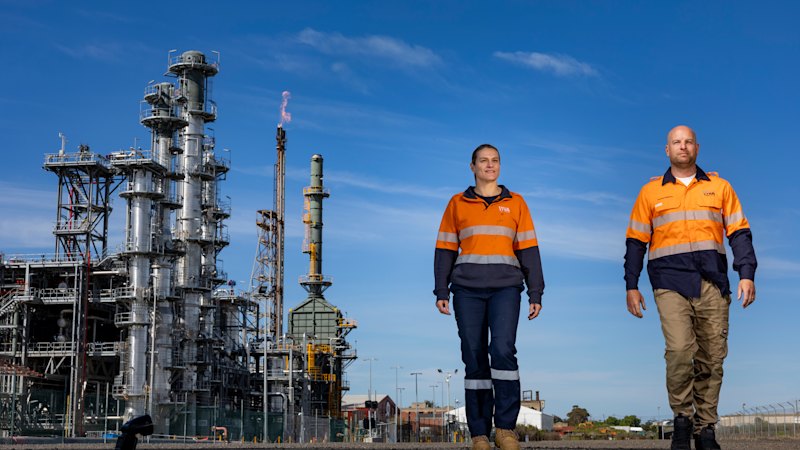
The great red-hooped tower has stood above Geelong for almost half a century. For generations of travellers approaching Victoria’s second city by car or train, the enormous chimney, once emblazoned with the letters SHELL, has been as familiar a landmark as the football stadium or waterfront.Beside it, a flame burns day and night, an industrial beacon visible around Corio Bay. Across the water, the Spirit of Tasmania ferry is docked at the port. It is a reminder of what this city was, what it’s lost and what it – against considerable odds – has managed to keep.Viva Energy’s smokestacks dominate the horizon. Craig SillitoeThe city has spent two decades reinventing itself after the departure of the great employers that once defined its economy. Ford stopped making cars. Alcoa closed its aluminium smelter. Factories that sustained generations of working families gave way to universities, hospitals, government departments and a growing services economy.But beyond the refinery gates at Corio, where pipes twist between towering steel columns and enormous storage tanks, another story has been unfolding. This is a factory – opened 72 years ago – that refused to close.Viva Energy’s Geelong refinery is one of just two remaining in Australia, a country that once operated eight. It produces petrol, diesel and aviation fuel, alongside industrial products that can no longer be manufactured anywhere else in the nation.It has survived changing owners, international competition, the pandemic and the slow disappearance of Australia’s heavy manufacturing base. Then, on April 15, a massive fire tore through its petrol-processing complex. It threatened not just the plant but the country’s already fragile fuel security.Seven months later, the refinery is producing about 90 per cent of its pre-fire capacity. Workers are dismantling damaged machinery while executives negotiate with the Albanese government over arrangements that could secure its operation until 2040.A global energy crisis, sparked by war in the Middle East, has transformed those discussions.For the first time in years, Australia’s remaining refiners have something they previously struggled to command: Canberra’s undivided attention.“We’re now much more appreciated for the role we play in energy security,” says Viva Energy chief executive Scott Wyatt. “Not just in supply in the country, but also in what we do here at Geelong from a refining perspective and the value of having a diverse supply chain.”Viva buys crude oil from all over the world and turns it into petrol at the refinery in Geelong. Inside the sprawling two-kilometre complex, executive general manager Bill Patterson navigates roads winding through an industrial city within a city. Kilometres of pipes spit and hiss, dive under tarmac and wrap around processing towers; Patterson points to a single 21-metre high steel tank holding 90 million litres of crude.Further along stands the refinery’s flare. Its purpose is less romantic than its appearance: burning excess gas during processing disruptions to prevent dangerous pressure building inside equipment.Then the car passes the scene of April’s fire. Scaffolding climbs through damaged machinery. Contractors are working through demolition and decontamination while engineers have rerouted gas systems to compensate for the destroyed equipment.At about 11.15pm on April 15, fire erupted in the refinery’s alkylation unit. Patterson was speaking to Wyatt about securing emergency fuel cargoes when his telephone rang. He arrived about half an hour later. Emergency crews had isolated the blaze, preventing it spreading through the highly flammable complex.The fire at the Viva oil refinery in Geelong.Geelong TV“They really did an amazing job just containing it,” Patterson recalls. “It was bad, obviously, but it could have been much worse.“If it had spread, we might not be doing this tour today.”Nobody was injured. Most major processing units escaped damage, allowing production to be gradually restored. For the refinery’s workforce, its recovery has become another chapter in a much longer fight for survival. Seven months later, it has recovered to about 90 per cent of its pre-blaze production capacity.At 32, Rikki Van Gemert represents the fourth generation of a family connected to the site.One grandfather spent his career here, rising to become a plant controller. Another, who emigrated from the Netherlands along with scores of other families, helped build its jetty. Her mother worked in the laboratory and neighbouring polymers business, while her uncle Terry still returns as a contractor.Yet Van Gemert – whose partner also works on site – took an unconventional route into the family workplace. After growing up in nearby Lara, she travelled to Bali, met people working in Western Australia’s mining industry and moved to Port Hedland. Three years later, she returned home and joined Viva at 22.Her grandfather had died before she could tell him she would be following his career.“I was in tears. I was so excited,” she recalls of receiving the job offer.Now she trains new operators, guiding recruits through programs lasting up to six months.Refinery operations Tom Delamore and Rikki Van Gemert both hope the Viva plant has a strong future.Jason SouthFor a workplace historically dominated by men, cultural change has been considerable. Women now account for about a quarter of operational roles.Van Gemert acknowledges the contradictions of working in fossil fuels during the energy transition, but believes Australians sometimes forget the importance of industrial jobs.“We all have our own opinions on the way the world should go and the way we can all contribute to having a better world and a greener world for future generations,” she says.“But we all need to drive our cars, and we all want the lights to turn on when we turn them on and all that sort of stuff. I think sometimes it’s a little bit lost that that is what this place provides for those people that they can get from A to B whenever they want to and however they want to.”Tom Delamore, 36, knows what happens when a refinery disappears. He spent almost eight years at New Zealand’s Marsden Point refinery before its owners converted the country’s last plant into an import terminal in 2022.When Geelong advertised for experienced operators, he relocated his family across the Tasman.“We hadn’t even known where Geelong was until we started looking at the job here,” he says.Today, he and his wife are raising two children, aged seven and nine, in the region. About a dozen former New Zealand refinery workers followed similar paths.Asked what New Zealand lost, Delamore answers immediately.“Fuel security for one.”But there were also jobs, industrial skills and wages sustaining an entire community.“It was a massive employer, and then that just got wiped out,” he says, doubting those capabilities can readily be rebuilt.“It’s not something that you shut down and leave for three years and then restart.”Australia has already learned much of that lesson. Port Stanvac, Clyde, Kurnell, Kwinana and Altona have closed or been converted into import terminals as smaller Australian refineries struggled to compete with enormous Asian plants.Australia imports roughly 80 per cent of its refined fuel requirements. The surviving Geelong and Brisbane refineries produce about one-fifth of national demand. Yet Geelong’s importance extends beyond petrol bowsers.It houses Australia’s last polypropylene and bitumen manufacturing operations, supplies specialist aviation gasoline and produces industrial solvents.About 800 people work at the refinery, with hundreds more contractors. During major maintenance shutdowns, its workforce can swell to roughly 1500.“Just in case people wonder whether we really employ a lot of people, just look around,” Patterson says. “None of them are getting paid badly. It’s a good job, no matter what sort of job.”The Australian Workers’ Union argues losing the remaining plants would surrender irreplaceable industrial skills and expose vital supply chains.“Without it, Australia stops,” says national secretary Paul Farrow. “Our fuel security is our national security – but for a generation, Australia rarely treated it as the basic guarantor of our wellbeing that it is.”The union is pushing for expanded domestic refining, larger reserves, and a localised renewable fuels industry.Energy Minister Chris Bowen has promised no refinery will close on Labor’s watch – a pointed swipe at the previous Coalition government – while entering into negotiations with the sector.Wyatt says the crisis has shifted repeatedly.“It’s kind of moved from being a crude problem to a refined product problem, and now it’s a shipping problem,” he says, referencing the war which has choked key maritime corridors, triggered a supertanker shortage, and driven freight costs up tenfold.The Albanese government has responded with a $14.8 billion fuel resilience package, including a government-controlled reserve of diesel and aviation fuel, proposed increases to mandatory stockholdings and longer-term support for domestic refining.But economists warn that stockpiling ever-greater quantities of fuel is not necessarily the cheapest answer.Grattan Institute researchers estimate the proposed stockholding increases could require almost 4 billion litres of additional storage by 2050, with construction and operating costs approaching $17 billion.Viva Energy chief executive Scott Wyatt.Wayne TaylorThey recommend holding mandatory petrol stockpiles steady as electric vehicles reduce demand, repurposing existing tanks for diesel and aviation fuel, and accelerating the electrification of heavy transport and mining. Those measures, alongside greater use of sustainable aviation fuels, could save consumers and taxpayers almost $4 billion, they estimate.Energy analyst Tony Wood argues that building new oil refineries is neither economically viable nor a sensible answer to Australia’s fuel vulnerability, given dwindling domestic crude reserves and fierce competition from larger Asian producers.He says modest increases in fuel storage, particularly diesel, should be accompanied by accelerated electrification of cars, trucks and mining equipment to permanently reduce dependence on imported oil.For industries where electrification remains difficult, Wood says developing locally produced biodiesel and other low-carbon fuels should take priority over spending billions on new refining infrastructure.The Viva Energy refinery in Geelong.The competing arguments expose the dilemma confronting Canberra: how to preserve critical industrial capabilities while preparing for an economy that ultimately needs less oil.Nor will arguments for taxpayer assistance be easily won amid an extraordinary financial windfall for both refineries from the conflict. In the first half of 2026, surging refining margins drove Viva Energy to a $452 million net profit – a $647 million turnaround from the previous year’s loss – while Ampol’s Brisbane refinery surged to $533.4 million. Yet, both operators continue seeking long-term government support, arguing high current margins do not resolve multi-decade investment horizons.For Wyatt, that means securing certainty beyond 2030, when the existing refinery support arrangements expire.“Nothing we do here happens quickly,” he says. “These generally are big investments. They’re multi-year investments.”He argues Geelong’s existing infrastructure and specialist workforce could also support the transition towards renewable diesel and other lower-carbon fuels.“The skills of the people here are irreplaceable.”As the tour ends, we pass the refinery’s hydrogen refuelling facility, a glimpse of an energy future emerging alongside the industrial past.Van Gemert wants the plant to continue providing careers for young Geelong workers. Delamore wants his children to grow up without experiencing the upheaval that forced his family across the Tasman.For a city that watched Ford and Alcoa disappear, the stakes are familiar. Australia must now decide whether the last remnants of its refining industry are worth preserving for another generation.Cut through the noise of federal politics with news, views and expert analysis. Subscribers can sign up to our weekly Inside Politics newsletter.
What happens when a country forgets how to make its own fuel
Full Article
Original Source
Read the full article at Smh →KhanList aggregates and links to publicly available news content. We do not host full articles from third-party sources. Always verify important information with original sources.