
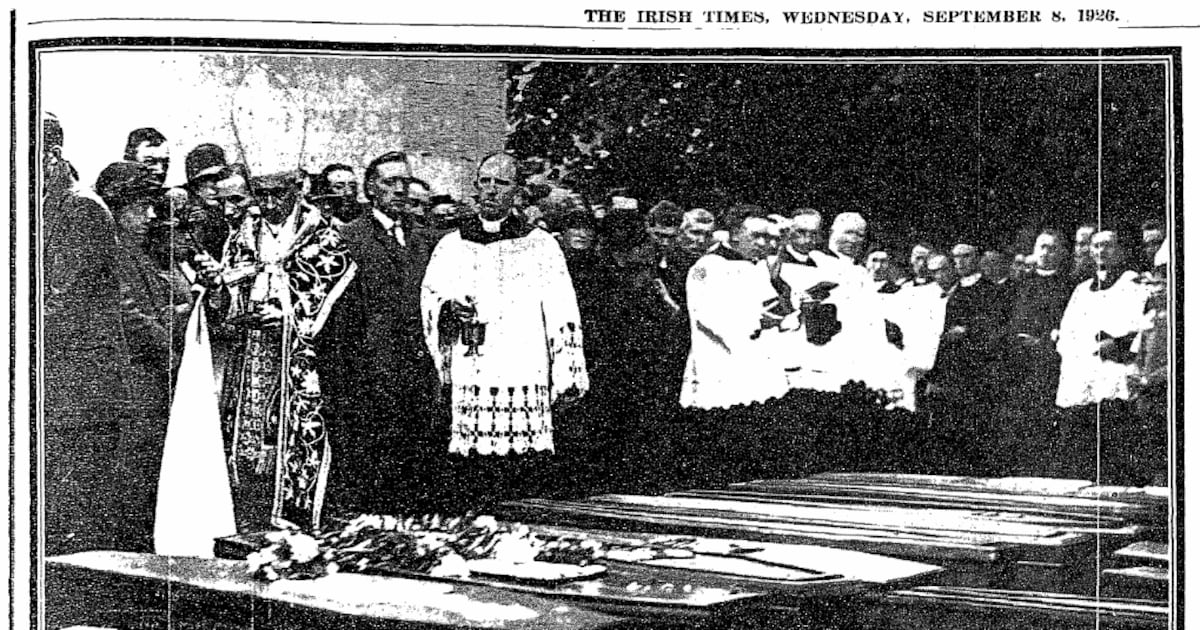
The upstairs loft area of Patrick Brennan’s hardware shop in the Co Limerick village of Dromcollogher once served as its makeshift community hall.The shop was on the village’s one and only street, made famous by the Percy French song Dromcollogher: “There’s only one street in Drumcolliher [sic], But then ‘tis a glory to see: Ye may talk till you’re dumb, but give me old Drum, For Drum is the place for me.”The loft area was the place for community gatherings, plays, dances, and on Sunday night 100 years ago, September 4th, 1926 a film - The Decoy. The reel had been taken by William “Babe” Forde from a Cork cinema, which closed on a Sunday night, for screening in Dromcollogher. Approximately 150 people in the village packed into the loft area on hard benches for the scheduled screening at 9.30pm. The late time was to ensure that locals could attend benediction in the nearby church that evening. READ MOREThe main feature film had just started when a candle located at the back of the loft to light the way for latecomers fell on the projector and ignited the highly flammable nitrate film.[ The Dromcollogher cinema fire disaster – Frank McNally on a fateful day in 1926Opens in new window ]The loft area turned out to be a death trap. The only way out was a narrow door accessible by a steep wooden ladder. There were three windows at the back of the loft beside the projector, but they were barred. The roof, which was made of wood and felt, proved too to be highly flammable. As the flames engulfed the confined area, some of the people out the back made it out the loft door and on to the street below. Eventually, one person prised open the barred window at the back, but it was too late for many of those inside. The fire was so fierce that many locals feared the whole village, where most of the houses were thatched, would go up in flames. Forty-eight people died in what became locally as The Burning - nearly one in 10 of those living in the village. Among them were Jeremiah Buckley, a retired schoolteacher, his wife Ellen, their 10-year-old daughter Bridie, Ellen’s sister Kate Wall, and their maid, Nora Kirwan. A published leaflet carrying the names of the deceased who perished in the Dromcollogher cinema fire of September 4th, 1926. Photograph: Valerie O'Sullivan An Irish Times correspondent at the time noted: “Dromcollogher today is a village of mourners. Nearly every one of its inhabitants lost a relative or a dear friend in the disaster. All day the grim task of searching the ruins has been going on. Many [of the dead] were charred beyond recognition and only eight or nine have been identified. For hours, men, women and children have stood at the ruins watching the searchers at their gruesome work.” At left of page, a report in The Irish Times from September 1926 of the fire in Dromcollogher, Co Limerick, in which 48 people died. Forty-six of the 48 victims were buried in a mass grave. The youngest, James Kenny and Thomas Noonan, were both aged seven; the oldest, Mary Turner, was 68.There were also survivors whose relatives recounted their story in a short documentary entitled The Burning which, along with a hardback book, have been brought out to mark the centenary of the fire. Pat Savage’s great-uncle William died in the fire. “People talk about the silence. That’s the way people coped at that time. They thought it was God’s will, but I’m sure they talked in their hearts or with their sisters or brothers. They just didn’t talk in public about it,” Savage said. [ The Bell Ringer: A glorious, lyrical elegy to ordinary people crafted from a local tragedyOpens in new window ]“This has lasted 100 years. Now we can empathise with them and remember what happened.”Pat Lordon’s father Paddy went to the cinema with two friends. Paddy Lordon and one of the friends got out, but the third, Edward Stack (22), perished. “My father always said that his abiding memory of Edward Stack was him lifting children up to the window to help them escape.”The projectionist, Patrick Downing, and the event organiser, “Babe” Forde, were eventually arrested on suspicion of manslaughter, but the State ultimately decided not to proceed with charges. Laws related to the showing of films in unofficial venues such as town halls were tightened up, but there was no inquiry. Locals, as was the custom at the time, buried their grief, as so many people did during that traumatic period in Ireland. “These people in 1926 just had been through the first World War, the War of Independence and the Civil War,” said Gerry Keyes, chairman of the Dromcollogher 26 committee set up to mark the centenary of the tragedy. Historian Martin Walsh, who is researching another book on the subject, said the striking thing about the disaster is how few people outside Dromcollogher remember it.“Outside of bereaved families, it is a largely forgotten event. I am hoping that this weekend, and my research that I am doing for my own book, will bring to the fore this forgotten tragedy. We are reaching a point where memory is fading, and we need to ensure that future generations do not forget.” The mass grave has a Celtic cross on it naming the victims of the fire. The local memorial library, opened in 1953, is located on the same site where the fire occurred. On Saturday, an official State commemoration will take place in the village with Taoiseach Micheál Martin in attendance. A stamp has been issued by An Post marking the centenary. On Saturday evening, locals will gather in St Bartholomew’s Church in Dromcollogher at the exact time the fire erupted to remember those who died.
What happened in the Dromcollogher fire a century ago?
Full Article
Original Source
Read the full article at Irishtimes →KhanList aggregates and links to publicly available news content. We do not host full articles from third-party sources. Always verify important information with original sources.