
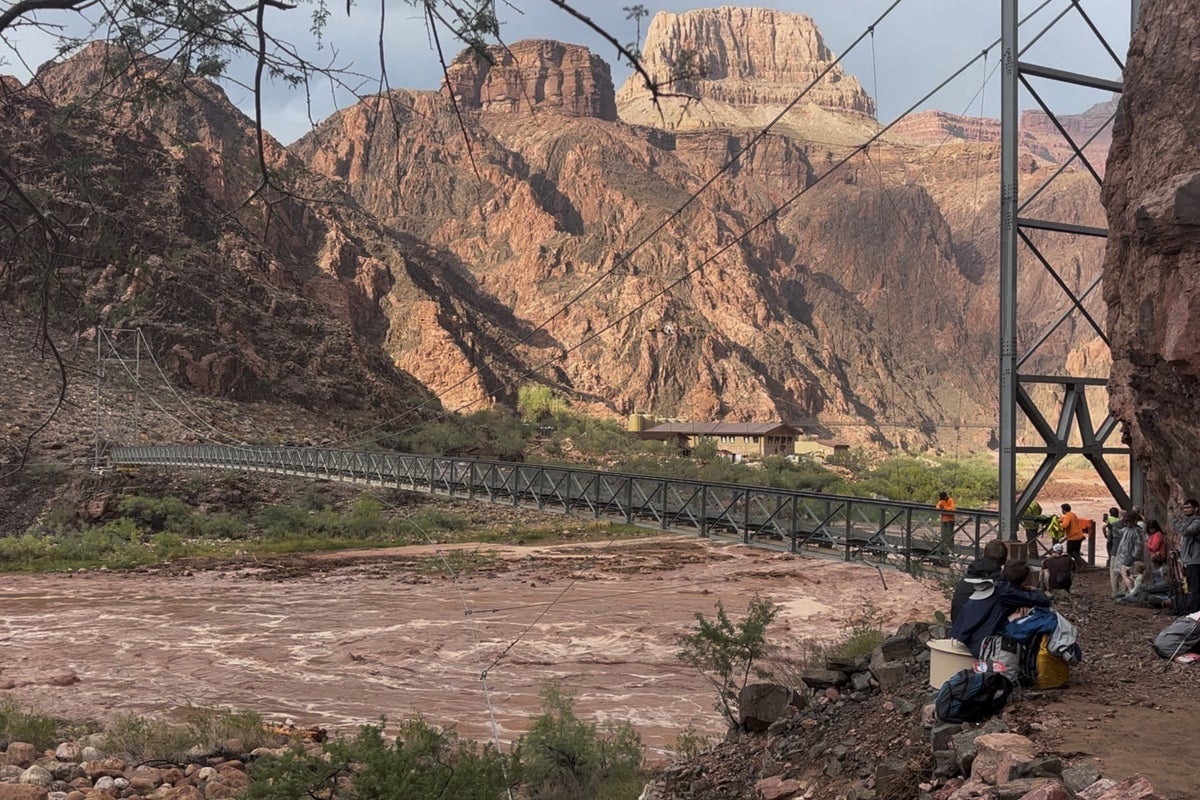
At least two people are dead and 15 others still missing in Arizona’s Grand Canyon National Park after flash flooding from a storm that dropped nearly an inch of rain per hour this weekend.Torrential downpours lasted for three hours Saturday afternoon, washing out popular hiking trails and leaving the historic Phantom Ranch Lodge cabins in the Bright Angel Canyon area under five feet of water.The rains overwhelmed areas already saturated by downpours from earlier that day. It resulted in debris flows that took many park-goers by surprise and led to helicopter rescues for more than 60 people.The search for the missing continues. The body of a 46-year-old man was recovered near Crystal Rapids along the Colorado River Sunday night, and at least one other body has been recovered, according to a Monday statement by the park. Neither of the deceased individuals have been identified. “I don’t think we would have made it out alive if we had fallen into the creek and then we’d gotten carried into the Colorado River,” hiker David Gregory told CBS. “There was, like, a whirlpool in there.”People wait near a bridge during flash flooding in Arizona’s Grand Canyon National Park Saturday afternoon. More than 60 park-goers were rescued (Wieke De Boer via REUTERS)Another hiker, physician Parth Desai, said he was heading through a narrow passage when the rain started.“We saw the creek flood, waterfalls coming up out of nowhere, boulders, mud, landslides happening everywhere,” he said.What is the forecast?The Bright Angel Canyon area remains closed as the risk of flash flooding, debris flows, rockfalls and changing trail and river conditions continues Monday. The National Weather Service has a flood watch in place through Monday evening for northern and central Arizona.“Additional scattered thunderstorms today across the Southwest, including northern Arizona into central Utah, will likely produce intense rainfall rates above 1” per hour,” the National Weather Service said in a post on X.The deluge also seriously damaged the only water pipeline in the canyon. It has led to water restrictions for local communities, and hotel accommodations in the area are closed starting Monday night.“The waterline is currently not operational, leaving the park with limited water reserves and requiring significant water conservation measures to ensure available supplies can be maintained,” the National Park Service said.Grand Canyon National Park remains open for daytime visitors, though visitors are asked to remain out of the closure area while search and rescue operations continue.What caused the flooding?Monsoon rains, driven by shifting winds, are a typical feature in the region during the warm summer months. So are flash floods, which killed four people last September in Arizona’s eastern-central Gila County. But dangerous flooding is also part of the larger story of a super El Niño climate pattern that has developed this summer. El Niño occurs when winds shift over the Pacific Ocean, allowing warm water to flow eastward. This change often brings wetter weather to the American Southwest.Debris in a flooded Bright Angel Creek is seen near the historic Phantom Ranch Lodge in Arizona’s Grand Canyon on Saturday afternoon (AP)A flooded Bright Angel Creek is seen near the historic Phantom Ranch Lodge in Arizona’s Grand Canyon on Saturday afternoon. The rain fell incredibly fast (National Park Service via AP)El Niño’s effects combined with a marine heat wave, worsened by human-caused climate change, helped contribute to the flooding, according to The Washington Post’s meteorologist Ben Knoll. A hotter ocean helps create a warmer atmosphere, which is able to hold more moisture, and is driving hurricane formation on the West Coast.“On the backdrop of climate change, these factors have driven atmospheric moisture levels 5 to 15 percent higher than average. That has loaded the dice for downpours this summer, such as those that hit the Grand Canyon on Saturday,” he explained. This summer is expected to be one of the warmest - if not the warmest - on record. July was the hottest July ever and August has already seen heat records broken.But wasn’t there a drought?The disastrous flooding follows America’s worst-ever spring drought.Heavy rain on drought-ravaged land increases the risk of flash flooding events because it’s harder for the baked earth to absorb the water.Arizona is currently less drought-riddled than a lot of the West, but the federal U.S. Drought Monitor shows most of the state is still in moderate-to-severe drought.The Bright Angel Canyon area gets around 10 inches of rainfall a year on average, the National Park Service says.The National Park Service has asked anyone with information about people who are unaccounted for to come forward. They can contact the NPS Investigative Services Branch Tip Line at 888-653-0009.With additional reporting from The Associated Press
What drove the deadly Grand Canyon flooding?
Full Article
Original Source
Read the full article at Independent →KhanList aggregates and links to publicly available news content. We do not host full articles from third-party sources. Always verify important information with original sources.