
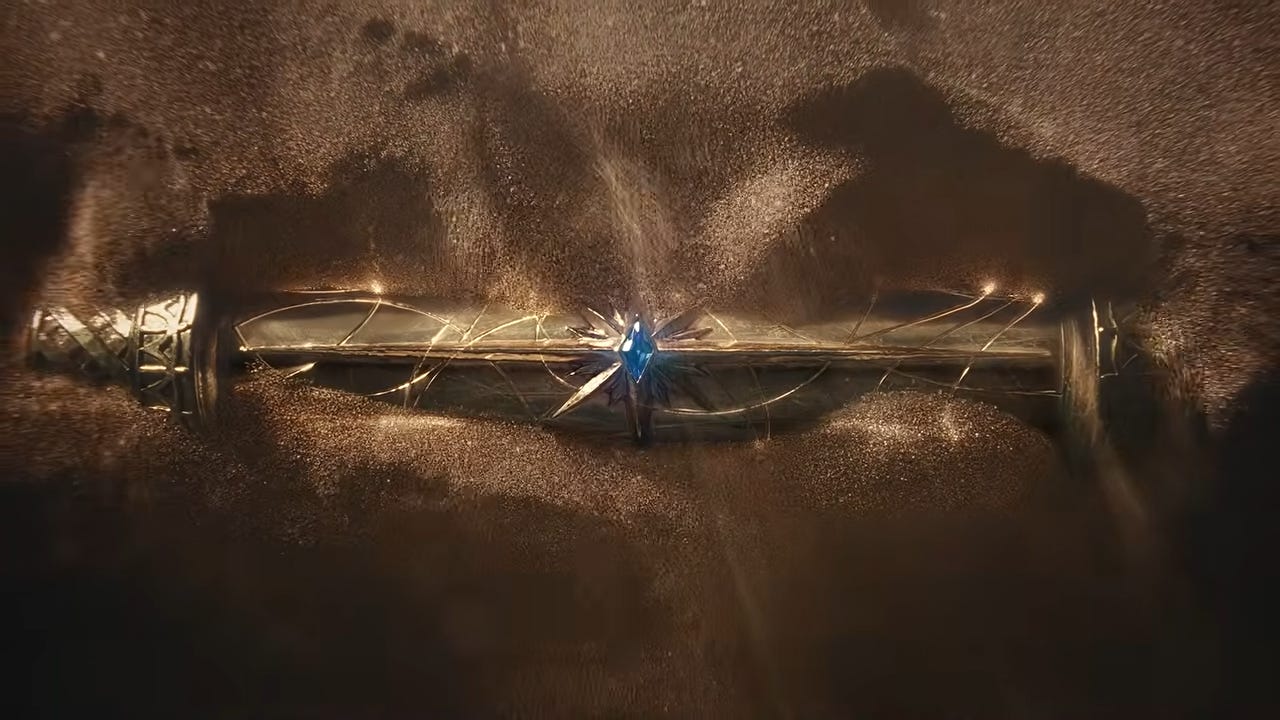
The worst-kept secret in gaming has finally been confirmed: yes, The Elder Scrolls 6 has a title. It’s called Sentinel, and will take place in Hammerfell, the province of northwest Tamriel previously featured in Daggerfall and Elder Scrolls Online (also Arena, but anyone who says they played that recently is lying). The point is, more than any previous mainline entry in the Elder Scrolls series, Sentinel will be depicting a fairly well-trodden location. But given its geographical location and significance in The Lore, I think there’s a fairly good chance that TES 6 will feature two distinct elements: ships and giant robots. Stay with me on this.So what is Sentinel? Well, it’s a city and kingdom – think New York, New York – on the southern shores of the Iliac Bay, the northern edge of Hammerfell province, stretching from the Alik'r Desert and coastal regions in the west to the Dragontail Mountains in the east.It’s a hugely important maritime city in Tamrielic lore, being the founding settlement of the Redguards. Its geography and architecture are heavily inspired by North Africa and the Middle East: the city of Sentinel is often depicted almost like classical Baghdad, with its beautiful domed palace and spires in the centre, river canals lined with palm trees, and sandblasted common districts full of markets and street vendors. It is one of the preeminent locations of TheElder Scrolls 2: Daggerfall, second only perhaps to Daggerfall itself, its opposite number and historical rival across the water. Like Rome and Carthage squabbling over Sicily, Sentinel and Daggerfall’s shared past mostly pivots around a dispute over the island of Betony, a strategically significant fishing community off the coast of High Rock which used to be a protectorate of Sentinel until Daggerfall decided to sink their navy over it.It’s a region rich with naval tradition, arguably with lots of parallels to the Mediterranean. The northern province of High Rock may be taken as a composite of Latin and Germanic Europe as a counterpart to Sentinel’s obvious riffs on the Arab-descended Moorish people who once colonised the Iberian Peninsula. Which is fitting, because if Elder Scrolls is anything, it’s extremely moreish. The rumour from several billion years ago was that The Elder Scrolls 6 would feature some sort of ship-based component.“What’s important is that the Iliac Bay is full of tiny islands. The lore is steeped in boat stuff. The Redguards themselves are a seafaring people in the same way that Bretons are a magic one, or that the Imperials are really good at accountancy: it’s at the heart of their culture, their DNA. Which, given that Sentinel is named for their home nation, would seem to track with the rumour from several billion years ago that The Elder Scrolls 6 would feature, or at least was once intended to feature, some sort of ship-based component. That could mean anything or nothing, of course, but if every Elder Scrolls game is to be its own proposition, then this would certainly be a defining trope for the new one. Skyrim had dragons. Oblivion had portals to hell. Morrowind had big mushrooms. Yum.Beyond the bay itself, we have the fallen continent of Yokuda, where the Redguards originally hail from, and the large island nation of Stros M’Kai, the setting of Bethesda’s one-time experiment in doing a third-person adventure spin-off of the Elder Scrolls. The Elder Scrolls Adventures: Redguard wasn’t a huge success in itself, but it did teach the studio a great deal about the relationship between scale and hand-crafted detail that resulted in a massive difference in approach between Daggerfall and Morrowind. Where the former boasted a map twice the size of the UK, Morrowind crammed infinitely more intrigue into a region barely a full percentage of the size, brought the series to consoles, and subsequently made the studio a household name.Sentinel in The Elder Scrolls 2: DaggerfallBethesda would stick to this philosophy of staunchly hand-crafted worlds until Starfield, which depicted a thousand-planet galaxy of endless walking, pocked with procedurally generated identikit outposts and very little incentive to go off the laid-out path, which many would argue – myself included, and I like Starfield – betrayed a studio that had lost touch with its core appeal.But think of the parts of Starfield which are successful, at least as a proof of concept: a mobile home in the form of a starship, to which you can assign crew, and go adventuring with them. A hugely popular ship builder that simplified the process of pimping your ride down to a snap-together kitbash, that allowed for enormous creativity within a deceptively rigid framework.What’s also not unprecedented in Bethesda’s oeuvre is kaiju.“It’s not a given that any of this will be relevant to Sentinel, or that if any of these systems carried over they would retain their complexity. But it does demonstrate that, if TES 6 were to think about this sort of direction, it’s hardly unprecedented at this point.What’s also not unprecedented in Bethesda’s oeuvre is kaiju. Big bastards smashing the gaffe up. Some years before Fallout 3’s Liberty Prime made us all piss ourselves unintentionally, the end of Oblivion depicted daedric prince Mehrunes Dagon ransacking the Imperial City, and you’ll probably remember that he’s a big dude, so big that he could only be seen off by the literal embodiment of Akatosh as a nine-storey dragon. And yes, the dragons of Skyrim qualify: the entire game being built around the proposition of seeing off a veritable invasion of enormous, scaly bastards. And Morrowind before them was all about preventing Dagoth Ur from building a second Numidium with which to conquer the world: a gigantic Dwarven mech powered by the literal heart of a god, based on the schematics of a weapon of mass destruction that was once used by the city-state of Sentinel to conquer the rest of the region.And there’s a whole other bunch of stuff that happened: if you want to know more, boot up Morrowind, or Oblivion, or Skyrim, and read an in-game book entitled The Warp in the West, which explains a convoluted collision of realities in which every rival faction got to use Numidium to get their preferred Daggerfall ending, making all of them canon at once. Which you might call a cop-out, but it certainly neatly solves the kinds of insurmountable issues that crop up when you try to respect all player choices.The point is this: after the events of Daggerfall, Numidium is destroyed, and pieces of it are scattered all over Hammerfell and High Rock. Perhaps some of it sank to the bottom of the bay. Perhaps some of it is buried in the desert. The quote displayed at the end of the recent Sentinel teaser talks about the experience of Yazar, a Moth Priest, trying to interpret a prophecy from one of the Elder Scrolls and receiving only a faint image of some kind of terrible future. Or past. Or parallel present. “A future lost, a victory undone, sands of time scattered by fate”.Like much of Elder Scrolls lore, it is esoteric and steeped in double-meaning. As a region at the heart of the Warp in the West, the ‘sands of time’ could well refer literally to the Alik'r Desert while caught in a time-warp. A ‘victory undone’ may refer to any number of conflicts referenced in the series’ history, but the most pertinent one would seem to be Sentinel’s “victory” at the end of Daggerfall, in which it became the capital of a vast coastal region as the various bickering city-states and territories were consolidated into the four currently standing kingdoms of the Iliac Bay, which, along with Sentinel, includes the Breton kingdoms of Daggerfall and Wayrest, and the Orcish kingdom of Orsinium.To undo the victory could mean to scatter these territories back to their fragments. Or, it could refer to the events preceding the last Elder Scrolls game, Skyrim, where the empire of Tamriel finds itself in a precarious peace with the treacherous Aldmeri Dominion after decades of brutal war, following the treaty known as the White Gold Concordat. This stipulated, firstly, the criminalisation of Talos worship, which much of Skyrim’s civil war arc is concerned with. Secondly, the disbanding of the Blades, the emperor’s secret service. And lastly, the cession of southern Hammerfell to the High Elves. You can imagine this didn’t go down especially well with the Redguards of Sentinel, which is why they left the Empire shortly afterward.Reassembling the pieces of Numidium left by the warp in the west would seem to be a classic motivation for RPG storytelling.“It’s not a huge stretch to assume that Sentinel will continue the story of this conflict, with the Aldmeri Dominion an occupying army in regions of Hammerfell that the player may be tasked with liberating. Or, perhaps we will be enrolled in an effort to construct a weapon with which to decisively end the war. Say, a giant dwarven mech. Reassembling the pieces of Numidium left by the warp in the west would seem to be a classic motivation for RPG storytelling. And it would be especially fitting to use against the High Elves. Numidium itself is a construct of the ancient Dwarves that has been used in a number of pivotal wars. Most notably, it was used by the founding emperor Tiber Septim to bring the Aldmeri to heel on Summerset Isle: a weapon of mass destruction set loose onto the entire civilian population, an incident which is largely credited with inspiring the general disdain High Elves have for the human races, and the Imperials in particular.Numidium is an offensive cultural trauma for the Aldmeri Dominion. It represents the moment when they lost their sovereignty to the Empire, a subjugation that would last right up until the end of the Oblivion Crisis. The colossal machine is depicted in the Wall of Alduin in Skyrim, a part of the Dragonborn prophecy that is concerned with the warping of time which, according to the UESP, is an effect that occurs along with every known use of Numidium in history.But what could power such a construct, in a world of candlelight and shit dinners? Well, the literal heart of a God. In Morrowind, the player character thwarts the building of a second Numidium by destroying the Heart of Lorkhan, or the Heart of the Red Mountain, one of the most important objects in the entire Elder Scrolls universe, perhaps even more important than the manuscripts themselves.Sentinel is rumoured to be, at long last, concerned with the origins of the titular scrolls: these objects of divine prophecy that have shown up throughout the series but have never been fully understood. They are cared for by the Moth Priests, a sect of blind scholars whose work in interpreting the scrolls robs them of their sight; such is the retina-searing power of creation they are believed to hold. They are said to be byproducts of the creation of the universe, fragments of time, space, and everything. Star stuff. God particles. The celestial parchment on which is written the underlying code of existence. And Lorkhan, the missing god whose heart is required to power Numidium, was there at their creation, having tricked the god Mundus into creating the Elder Scrolls universe in the first place.The Elder Scrolls 6 is likely the culmination of an enormous tapestry of imagined history that goes right back to Daggerfall, and deeply involves every single Elder Scrolls protagonist thereafter. Tracing the Heart of Lorkhan and the pieces of Numidium through history until, perhaps, their final reassembly in the war against Sentinel and the Aldmeri Dominion. And where is Lorkhan said to have died? At the Adamantine Tower, on the island of Balferia in the Iliac Bay. Perhaps something remains of him there that we will have to recover. Maybe we’ll end up flying to one of the moons in a big dwarven rocket to recover one of Lorkhan’s toes. I don’t know. But I’d love to do it.The upshot? The Elder Scrolls 6 is going to be absolutely stacked to the gills with tidbits for sickos. And I can’t wait to play it in 2038.
What Does Sentinel Mean? Are Giant Robots Involved? The Elder Scrolls 6: Sentinel Lore Explained
Full Article
Original Source
Read the full article at Ign →KhanList aggregates and links to publicly available news content. We do not host full articles from third-party sources. Always verify important information with original sources.