
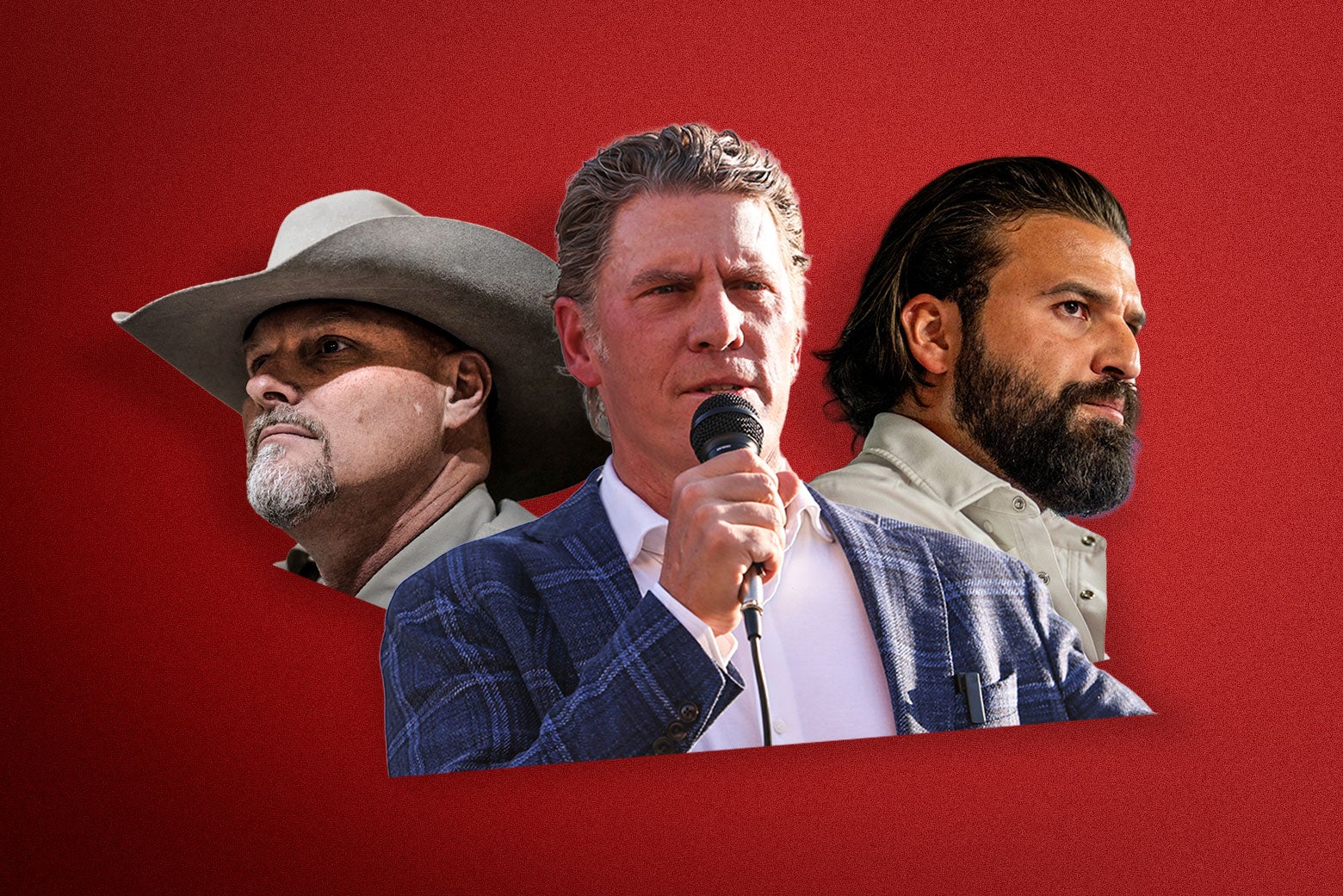
Politics We Went Looking for the Most Extreme Candidates in the Nation. Four Stood Out. It’s not easy to separate yourself from the extremist pack during Trump 2.0. These candidates found a way. By Enter your email to receive alerts for this author. Sign in or create an account to better manage your email preferences. Unsubscribe from email alerts Are you sure you want to unsubscribe from email alerts for Molly Olmstead? Nov 03, 20269:45 AM Photo illustration by Slate. Photos by Drew Angerer/Getty Images, Shafkat Anowar/The Dallas Morning News via Getty Images, and Brandon Bell/Getty Images. Sign up for the Slatest to get the most insightful analysis, criticism, and advice out there, delivered to your inbox daily. It’s hard, these days, to define right-wing extremism. In the second Trump era, the window of acceptable speech has shifted so dramatically that it’s no longer considered apolitical to chastise a political figure for calling for the expulsion of all Muslims from the country, for example, or to expect them to distance themselves from white supremacists. In fact, a candidate in a high-profile U.S. Senate race appears so comfortable with racism that his overtly white supremacist son-in-law attended his election party and that his chief-of-staff was in a group chat with famous white nationalists. And yet, Mike Collins still has President Trump’s endorsement, and he still stands a slim chance of being Georgia’s next senator. Similarly, Rep. Randy Fine has called for Palestine to be “nuked” and tweeted such comments as “if they force us to choose, the choice between dogs and Muslims is not a difficult one” and “mainstream Muslims have declared war on us. The least we can do is kick them the hell out of America.” He is set to cruise to re-election in Florida’s 6th Congressional District. So when Slate set out to identify the most extreme right-wing candidates on the ballot on Tuesday, the bar is (unfortunately) extremely high to make the list. In the post-Jan. 6 era, in which elements of Trumpism have so fully embraced conspiracy theories, gutter racism, white nationalist talking points, violent rhetoric, and authoritarian ideas, the stand-outs have been harder to identify. Subscribing to the Great Replacement Theory, in other words, did not immediately land a candidate on this list. Nor does saying vile things about Muslim, Hispanic, Jewish, or Black Americans; peddling dark conspiracy theories; undermining the results of the 2020 presidential election; or participating in an insurrection. (Pennsylvania Rep. Scott Perry, for example, fits several of these categories.) Instead we decided to look at candidates who represented different kinds of modern extremism, excluding incumbents from our list. Before we dive in, an honorable mention is due to Victor Marx, the Republican candidate to be Colorado’s governor. Marx claims to have killed multiple people, starting at age 7; rescued thousands of women and children from human trafficking; and “hunted” and cast out many demons from possessed people. Marx is clearly very conservative and very religious—he has described abortion as an “occultic activity” and talked of politics as a matter of “spiritual warfare.” But while Marx is loud about his implausible background, he has mostly refused to outline any policy views, instead letting his background speak for itself. He’s also unlikely to have much of a role to play after Tuesday: Polls predict he’ll lose to the Democrat, Phil Weiser. But other extremists are locked in competitive races. And wow these candidates perform on Tuesday will tell us something about the permanence of this Overton Window shift, and the strength or limitations of blind partisan loyalty. The Hard-Right Xenophobe: Bo French, Texas Railroad Commissioner Despite the benign-sounding title of “railroad commissioner,” this statewide position is a notable one, as it is charged with regulating the Texas oil and gas industry. The strategist Steve Bannon himself has called it “the most important race in this country.” For Bannon, though, the importance is less about the industry than about what French’s candidacy represents. That’s because French is really, really, ambitiously racist. Remember that X post where a candidate bemoaned the presence of South Asian students at a University of Texas football game? More than 54 million people saw that post. French authored it: “I heard UT graduation this year looked like this,” he wrote. “I didn’t believe it.” That was only his latest hit. At other times on social media, he wrote “I won’t rest until every Muslim is gone” and “It’s time we remove foreigners from our soil.” He also has publicly identified as an Islamophobe; called for 100 million people (nearly a third of the country) to be deported; and posted a poll asking if Muslims or Jews were a bigger threat to America. To him, there’s nothing unreasonable about expecting the country to be white and English-speaking and from “cultures and values [that] align with America.” But he couches his opposition (albeit with the thinnest of veils) as a matter of immigration, not just racism—making it a policy platform, not just an expression of personal bigotry. While this kind of white-supremacist-chatroom racism isn’t new, it’s only recently that on mainstream conservative social media—and on X in particular—these kinds of comments have become an acceptable part of the discourse. It’s a representation of the encroachment of organized white nationalist politics in the conservative movement. To be clear, French isn’t the only white nationalist-aligned candidate in the country. In Florida, for example, a man named Marshall Rawson is running for a position in the statehouse despite having white nationalist credentials as strong as marching in the 2017 Unite the Right rally in Charlottesville, Virginia. But French’s larger, state-wide victory would be a significant sign. And there’s a decent chance of his success. French ousted the incumbent to get his party’s nomination, he has Texas Gov. Greg Abbott’s endorsement, and polling has shown a close race. The Constitutional Sheriff: Mark Lamb, Arizona’s 5th Congressional District Mark Lamb, formerly the sheriff of Pinal County, was once a celebrity sheriff as a regular on Live PD, the hugely popular show in which law enforcement officers broadcast live feeds of their work. He also formed a civilian “posse” to respond to any potential protests after the murder of George Floyd. (No such protests occurred in Pinal County.) But when he fashioned himself into a kind of resistance hero against COVID measures, refusing to enforce stay-at-home orders, his star rose even further. Lamb believed that he had a duty to protect the public from tyrannical government overreach. In this regard, Lamb was a representative of the fringe right-wing “constitutional sheriff” movement. This movement emerged from white nationalist anti-government groups in the 1970s, and its adherents believe that sheriffs, not judges, have the ultimate authority to decide which laws are constitutional and therefore which should be enforced. They believe this authority comes from the U.S. constitution itself. (Legal experts say this is nonsense.) Lamb, who has spoken at a constitutional sheriffs event, had hoped sheriffs would play a role in overturning the 2020 election and wanted to “empower sheriffs” to investigate voter fraud. Lamb’s cowboy-style approach to our governing institutions, favoring a sense of frontier justice over democratic compromise, bureaucracy, and deliberation, may prove appealing to voters. Trump endorsed Lamb, and Lamb easily pulled off a primary win even after a sex scandal. (Lamb, an Arizona Republic investigation found, had sexted women other than his wife and threatened one with consequences if she didn’t keep quiet. This, despite his campaign slogan “God, Family, Freedom.”) He is favored to win, and if he does, the anti-government demographic will have a strong champion in Congress. The Edgelord: Brandon Herrera, Texas’ 23rd Congressional District The main thing to know about Herrera, a 30-year-old YouTube personality with more than 4 million subscribers, is that he’s a gun influencer aiming to represent a district that includes Uvalde, the site of one of the most horrific school shootings in recent memory. That alone should tell you that Herrera is not afraid of controversy. But Herrera pursues outrage like it’s his calling. Here are just a few things he has done: He tested out a Nazi-era submachine gun while goose-stepping to a Nazi marching song and displayed a vintage copy of Mein Kampf on his podcast.He quipped, “I often think about putting a gun in my mouth, so I’m basically an honorary veteran.”He said of mothers involved in anti-gun activism: “Just because you let somebody creampie you doesn’t mean I have to give a shit about your political opinions. The fact that you kept your cum trophy doesn’t make you any less wrong about the dumb shit that you say.”This is Hererra’s style: shock-comedy bits for young men. He hasn’t moderated or apologized since entering politics. In fact, he reposted the clip with the cum-trophy comment after his opponents surfaced it, making it clear that he wanted credit for the joke. He has consistently right-wing political stances, but there’s no indication he has real conviction behind his most vile comments. (Except for the ones calling feminists fat; it seems pretty clear he hates feminists.) Instead, he seems to live for provocation, and doesn’t care who suffers as a result of him having fun. Herrera became the Republican nominee for this race in part because his opponent, the incumbent Rep. Tony Gonzales, tanked his own campaign with one of the ugliest sex scandals in modern history. (Gonzales had had an affair with a staffer who then died from self-immolation.) Recent redistricting has turned the district solidly red, and Herrera has Trump’s endorsement, so things look good for him. But it’s no shoo-in, and Herrera has had to put in the work to compete against the Democrat, Katy Padilla Stout. (Interestingly, he recently broke with Trump over proposed border wall construction in Big Bend national park, calling it “unnecessary.”) Herrera isn’t the only youthful troll candidate. A 27-year-old named Kelley Dennison running to represent Colorado’s 2nd Congressional District, for example, has posted Groyper-style memes, including one of her as the Groyper mascot, a derivative of Pepe the Frog. (Groypers are the edgy, far-right followers of the white nationalist Nick Fuentes.) But Herrera, unique among the candidates for Congress, has endless hours of content showing just how consistently outrageous he is. And he is on his path to be our first Youtube Edgelord to enter Congress. The Think Tank Type: Jace Yarbrough, Texas’ 32nd Congressional District Some extremists like to shout their most extreme views, while others express them in niche journals or in private, among well-heeled friends. Yarbrough, a constitutional lawyer, appears to be in the latter category. He has the backing of powerful and wealthy conservative figures such as Peter Thiel, the chairman of Palantir, and Nate Fischer, the venture capitalist pushing conservative, Christian, and right-of-center cultural and economic values. He also held fellowships for several influential institutions among the MAGA elite, including the Alliance Defending Freedom and the far-right think tank the Claremont Institute, which has moved toward supporting authoritarianism. These organizations connect and support the intellectual backers of the right-wing movement. Because of this more scholarly orientation, his most extreme ideas sound, at first glance, a little wonky. But the underlying sentiment is just as base as that of the less polished extremists. Yarbrough has, for example, called for the 1965 Hart-Celler Act to be repealed. The Hart-Celler Act ended race-based immigration quotas; its repeal is a long-time white supremacist dream. He has also called for a five-year total pause on immigration and pushed for conservatives in power to be bolder in using their power and resources to defeat progressives as part of a civilizational battle. In a candidate forum in February, he told the audience that traditional conservative governance—what critics would consider authoritarian—was being unfairly maligned. “The kind of good government that I want to offer, that you and I agree with, they call it bigoted and backward and oppressive and Nazi-ish,” he said. He has Trump’s endorsement. The 32nd district, which includes part of Dallas and its suburbs, was, until recently, a thoroughly Democratic one. But the state legislature redrew it in the summer of 2025 to turn it into a heavily Republican one. Thanks to this scheming, Yarbrough’s chances—to represent a district that includes parts of one of the most diverse cities in the U.S.—are looking good.
What Does “Extreme” Even Mean in the Trump 2.0 Era? Here Are Four Examples.
Full Article
Original Source
Read the full article at Slate →KhanList aggregates and links to publicly available news content. We do not host full articles from third-party sources. Always verify important information with original sources.