
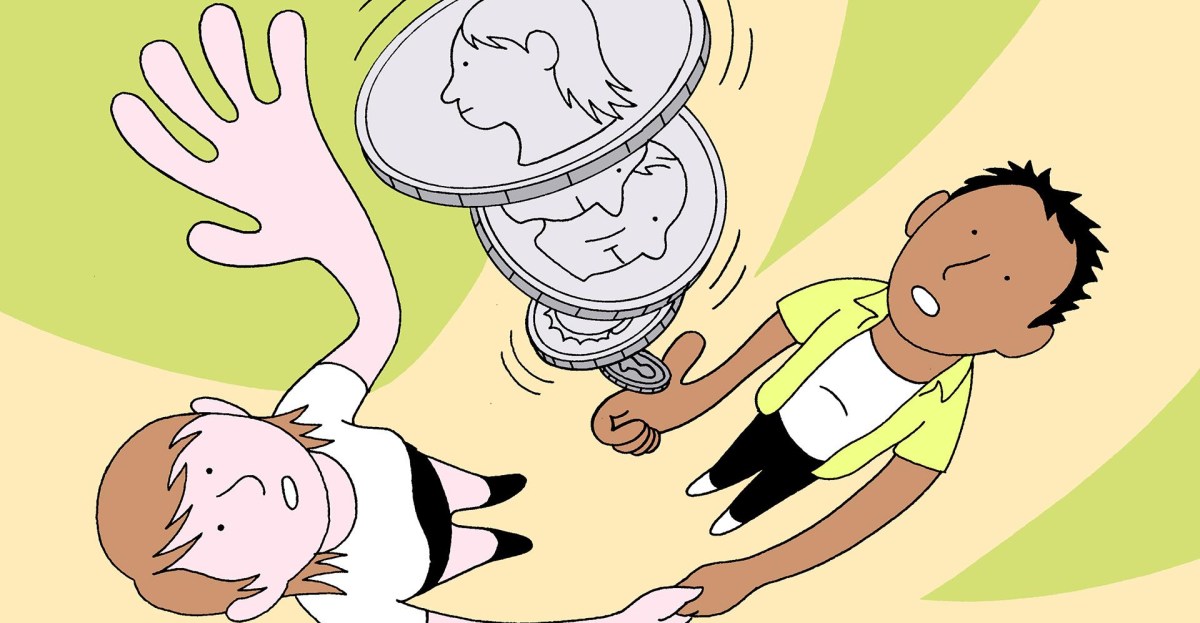
Hi readers! Shayla Love here, science journalist and longtime fan of Your Mileage May Vary. I’m honored to be subbing for Sigal Samuel while she’s out on parental leave. I’m diving into your questions as a way to help understand human nature and our choices through multiple lenses: philosophical, psychological, and beyond. Please send in any emotional, body/brain, sociological, perceptual, or other kind of life quandaries you might have.I am someone who notoriously struggles with big decisions. Over a year ago, I found a wonderful partner, who very much feels like they could be my soulmate. We’ve been dating three time zones apart for a while. Being near our families, communities, and aging parents is a shared value — unfortunately one that makes it hard to compromise on location. Either way, I have to give up something I want and value — a wonderful partner who I can see a life with (the first time I’ve felt this way about someone), or the place I’ve always imagined settling down and that represents the person I am becoming and values I want to live. Two good things are pulling me toward opposite paths and there’s not much room for compromise. How do I make the “right” decision? Dear Fork in the Road,You’ve found a place in the world that you feel connected to and you met a person you envision spending the rest of your life with. Geographically restless and lonely people everywhere are jealous! But with your good fortunes seemingly at odds with one another, it feels that by choosing one, you’ll forsake the other — and doom the choice you did make to feel like a sacrifice.When circumstances have forced me to make a tough decision, I’ve daydreamed about a thought experiment: the Many Worlds Interpretation.In quantum physics, particles behave differently than us mortals. For example, an electron can be in more than one place at once until it’s measured. How can it be in multiple locations and then be observed to be in a single position? In the 1950s, the American physicist Hugh Everett proposed an explanation: The universe splits into alternate versions of itself, one for each place a particle could be measured. To apply this theory to your life, if you chose to move cities, don’t worry, another universe would be created in which you didn’t choose to do this, and you’ll stay right where you are!Have a question you want answered in the next Your Mileage May Vary column?Fill out this anonymous form! Newsletter subscribers will get my column before anyone else does and their questions will be prioritized for future editions. Sign up here!Yes, I know you can’t transport yourself into such a quantum realm, but there is something helpful in thinking about alternative universes. Did you have an immediate reaction to which universe you would be upset not to inhabit? Take that information to heart, because it’s likely you’re not ultimately going to make your choice based on a tidy pro-con list.The psychologists Daniel Kahneman and Amos Tversky won a Nobel Prize for pointing out that most of our decisions are not based on rationality. People use two systems for decision-making: System one is faster and emotionally based, and system two is more logical and slow. But even the slower, more deliberate decision-making can fall prey to any number of cognitive biases.In your case, one called loss aversion may be especially relevant. People have the tendency to worry more about what they’ll lose, even if what they stand to gain is equal in value. For example, it will likely feel worse to lose a $10 bill from your pocket than it would feel good to find a $10 bill on the ground. This bias is relevant in people’s social lives too: They hold onto older, maybe fading, friendships because the thought of losing them is too painful, but don’t seek out new friends with equal effort. Or, they stay in a meh job because it feels scary to let it go, rather than applying that same energy to finding a new one. Once you accept that your decision-making process will be subject to messy feelings and biases, you can let go of trying to make the perfect choice.You opened your question by sharing that you struggle with big decisions, and it makes me wonder if you simply feel anxiety about making a choice at all. This is called analysis paralysis. When outcomes are uncertain, anxiety wakes up, and a voice in your head tells you to avoid taking risks. People with analysis paralysis overthink their options, over-research, and second-guess their first instincts. These actions have more to do with stress over committing to any decision rather than the content of what you’re deciding on.A surprising finding from psychology may ease your paralysis. Researchers told people to make a big life decision — on the order of ending a relationship or quitting their job — by flipping a coin. Heads, they made the change; tails, they didn’t. For those who followed the results of the toss, the people who made the change were overwhelmingly happier, even though their decision to do so was made by pure chance. These random-flip outcomes also show “that people may be excessively cautious when facing life-changing choices,” the authors wrote. The coin helped the participants resist the bias of tending to stick with the status quo, even if it doesn’t make them happier.To begin to loosen your paralysis, something that might assist you, paradoxically, is to introduce more options into the mix. Jacques Derrida, the 20th-century French philosopher, is known for the concept of deconstruction, a way of analyzing texts or ideas more critically, and showing they’re not as stable as they seem. He pointed out that we often think in binaries and false opposites: good vs. evil, man vs. woman, nature vs. culture. This can set up an easy dichotomy in which one of the items is good, and the other, by being its opposite, is bad.You’ve created a binary situation, and you don’t actually have to be in one. What if there’s a third option, or a fourth? What if you and your partner move to a brand-new city, and set out to create new community, together? What if you and your partner find a way to split your time between your respective hometowns? Now you don’t have only two good things pulling you in opposite directions, you would have different options you can be more creative with. You also don’t have to commit to the decision you make now for the rest of your life. You can always move cities again, or try to find another mate.You are with a partner you love, and live in a place that you love. You might reframe your situation as a win-win, rather than a lose-lose. And remember that if you don’t make a choice, you’re not successfully avoiding a decision — it’s a choice of its own. Your partner may get tired of long-distance or end the relationship for another reason. Or, you could start to resent the place you live since you have to travel so much to spend time with your partner.I also want to point out how you describe your partner. Don’t turn your nose up at finding someone who you can see making a life with, especially as you note, if you’ve never felt that way before. Billionaire investor Warren Buffett has said that there were two most important moments in his life: when he came out of the womb, and when he met his wife. “What happened with me would not have happened without her.” Buffett’s view is supported by research that shows that people with supportive spouses tend to take on more rewarding challenges throughout their lives, and end up having more personal growth and happiness.Another quantum idea that might interest you is spooky action at a distance. This is when two particles, even far apart, become connected to one another. Measuring one affects the other, no matter how far apart they are. If your partner feels like your “soulmate,” perhaps you have become entangled already. Don’t fret about making the perfect choice about the next phase of life, but do make a choice (any choice!) that considers your futures as bound up together. For the other details, maybe it’s time to find a coin to flip.Bonus: What I’m readingI’m currently re-watching The Twilight Zone and recommend the episode Mirror Image, about a young woman who encounters her double from a parallel universe. The show’s creator, Rod Serling, was inspired to write the script when he saw a man at the airport who looked suspiciously like him, and had a similar suitcase and jacket. What if he approached the man, and it turned out to be himself? The dreamy story also inspired the movie Us by Jordan Peele. The 2026 Nobel Prize in Chemistry was awarded to Henri B. Kagan and Kenso Soai for their work on “handedness”: how molecules can have variants that are non-identical mirror images of one another. These variants are their own kind of dark doppelganger; only one can exist in the body. The science writer Ann Finkbender wrote a charming essay about understanding this principle of life in Last Word on Nothing. If you haven’t yet read Stoner by John Williams, just put down whatever you’re currently reading and do it. It’s a cautionary tale about what happens when you don’t act, and let your passivity make choices for you.
What do you do when your love and your life are in two different places?
Full Article
Original Source
Read the full article at Vox →KhanList aggregates and links to publicly available news content. We do not host full articles from third-party sources. Always verify important information with original sources.