
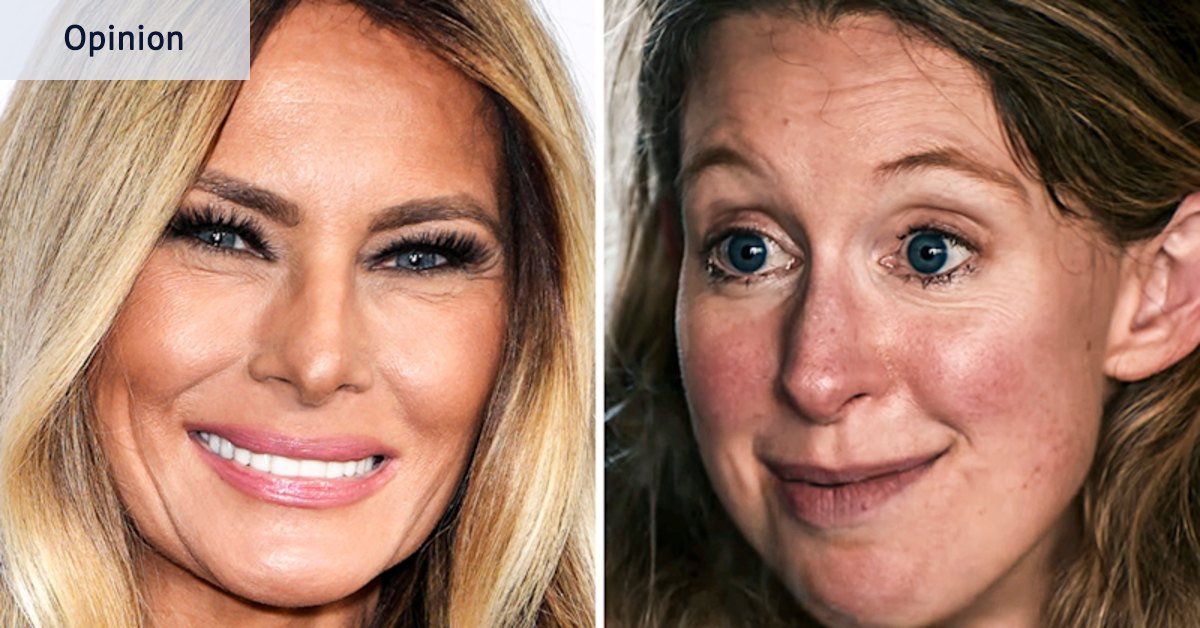
OpinionSenior Writer, CultureNovember 27, 2026 — 7:00pmNovember 27, 2026 — 7:00pmAt first glance, you might think there is zero connective tissue between You Can See Everything, one of the most acclaimed movies of the year, and Melania, one of the most derided (as both feature film, released in January, and a two-part series, released this week).But appearances can be deceptive. Which is precisely what joins them.Melania Trump arrives at the premiere of her not-so-revealing documentary series this month.APThese two documentaries are wildly divergent in style, tone and intent. But each ultimately leads us to the same place: in the age of perpetually performed selfhood, the truth of a person is almost impossible to grasp.In You Can See Everything, Nathan Fielder and his co-director, Lance Oppenheim, are invited into the home of disgraced Theranos founder Elizabeth Holmes and her partner, Billy Evans, and promised access to virtually every moment of the 34 days before she is due to begin an 11-year prison sentence for fraud.In Melania, one-time Hollywood hotshot (and mate of James Packer) Brett Ratner and his crew are granted unprecedented access to the former and once-again first lady as she prepares to begin a four-year sentence – sorry, term – at her husband Donald Trump’s side in the White House.In journalism, it is sometimes said, access is everything. But as both films gradually reveal, sometimes access is also nothing.Is Elizabeth Holmes a sociopathic liar, a master manipulator of gullible (and typically older) men, who turns those big blue eyes unflinchingly on them to ask “why would I lie”, or is she a hopelessly naive and overly optimistic entrepreneur who has rather been exploited by the men in her life, and by a system geared against young female business founders? That’s the question at the heart of You Can See Everything. But after almost three hours of fascinating, inventive and, yes, manipulative filmmaking, you are likely to emerge feeling that you can see almost everything (including, in one hilariously awkward scene filmed in a shower, Evans’ penis) but you can still emerge knowing almost nothing.Is that a failing on the part of the film and its makers, or is that its crowning glory? I’m leaning towards the latter view; as anyone who has seen Fielder’s work (especially on the HBO series The Rehearsal) will know, the ostensible aim of his filmmaking practice is often a long way from the outcome, or his true intent.I don’t think Ratner is doing anything so meta, so sophisticated, so shell-game-ish with his intimate yet icily distant portrait of Melania Trump. I simply think he doesn’t have the will, or perhaps the skill, to probe more deeply. His on-camera questions are Dorothy Dixers in the extreme, and his lens is utterly seduced by the shiny surface of things. At one point in the series, he asks her father what makes his daughter so wonderful, as she lurks in the background.I have watched the feature and the series (you’re welcome) and can honestly say that just about the only thing I learnt about Melania from Melania is that she likes nice things. Then again, she also likes her son Barron, and at least pretends to like her husband, so go figure.Nathan Fielder and Elizabeth Holmes in You Can See Everything.It’s perhaps no accident that both these films were initiated by their subjects. Holmes and Evans approached indie studio A24 with a pitch about a documentary on their lives; Oppenheim mentioned to Fielder that he’d heard a rumour about this; Fielder got in contact with the studio the following day, and, et voila, a week and a half later they were filming.That doesn’t mean, of course, that the subjects were in control of the narrative. But it does suggest that they thought they had something to gain by such a project. Holmes reportedly had never seen Fielder’s work; like everything else in and of this film, that may or may not be true. If it is, perhaps she regrets it. If it isn’t, perhaps this has played out exactly as she wanted it to.The idea of a Melania documentary was pitched by its subject (and executive producer) to Amazon founder Jeff Bezos in late 2024 or early 2025 (accounts differ). The company ended up paying about $US40 million to make the film (of which roughly 70 per cent went directly to the first lady), and another $US35 million to market it. That is an exorbitant amount of money for any documentary, let alone one as substance-free as this.The deal has been roundly criticised as a blatant attempt to curry favour with the president. And the content it produced has been almost universally dismissed as propaganda – and in the case of the series, propaganda that already seems hopelessly outdated in the wake of the midterm elections and Trump’s lame-duck presidency.Melania talks robotically about her compassion and her charity in aid of foster children and against online bullying (the irony of being married to one of the greatest online bullies appears to be entirely lost on her). She fleetingly mentions that she does not always agree with her husband, and that he is surrounded by too many yes people. But otherwise it is all baubles, frocks, pomp and circumstance. Heavy on gilt, light on guilt.What we’re seeing in these films is a performed self, attempts to control the narrative by giving seemingly unfettered access to the subject while actually revealing almost nothing of the true motivation, thoughts or character thereof. It’s a kind of seeing that leaves you not knowing what to believe.This is the documentary portrait in the post-truth world, an expanded take on the social media mode of self-revelation, heavily redacted and curated to present an “authorised” version.Much has been written about the dangers posed by AI and deep-fake technologies to our ability to trust in ostensible facts, and with good reason. But as You Can See Everything and Melania patently demonstrate, we ought to be on guard against human-driven fakery too.See everything? Sure. Believe it? Maybe not.You Can See Everything is in cinemas now. Melania (the feature and the series) is streaming on Prime Video. Must-see movies, interviews and all the latest from the world of film delivered to your inbox. Sign up for our Screening Room newsletter.More:CinemaOpinionReviewDocumentariesFilm & TV productionSee & DoFrom our partners
What do Melania and You Can See Everything have in common? More than you might think
Full Article
Original Source
Read the full article at Smh →KhanList aggregates and links to publicly available news content. We do not host full articles from third-party sources. Always verify important information with original sources.