
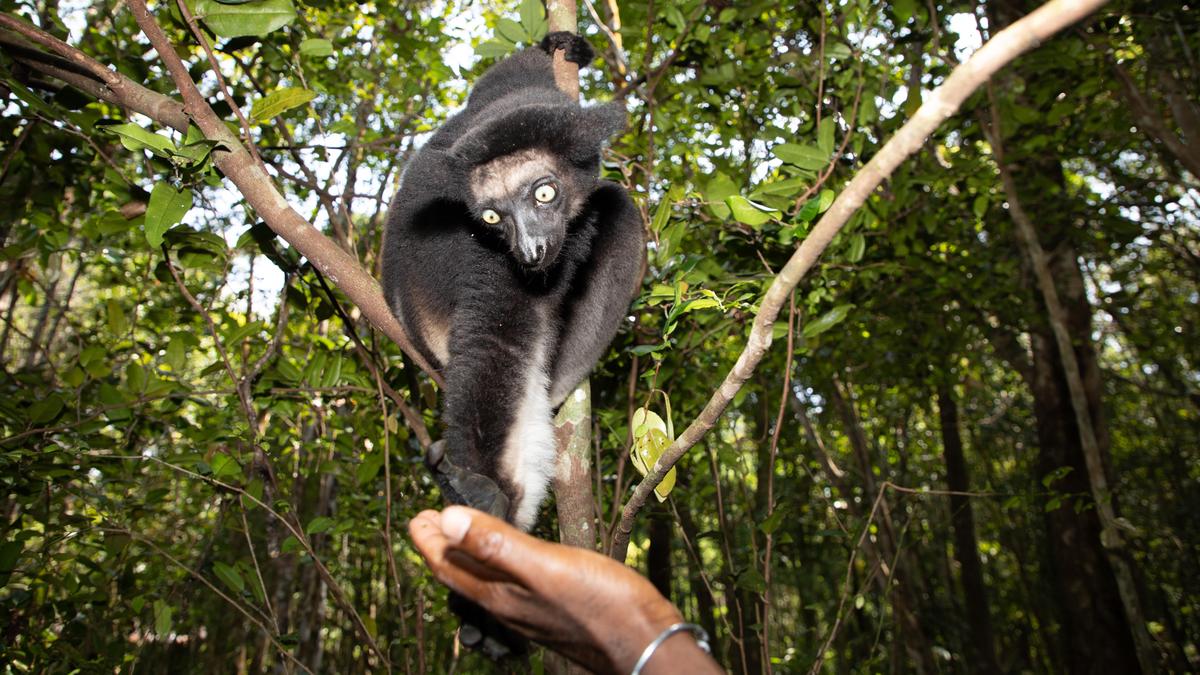
Have you seen opera performers sing? You might notice how their mouths move according to how high their pitch needs to be. Imagine finding out a primate in the rainforests of Madagascar has been doing the same, possibly even before opera began?Who are lemurs?With a pointy snout, large eyes and usually a long tail, you might have encountered this primate in one of your favourite movies, Madagascar. Remember King Julien, who loved to sing and dance? He was a type of lemur! So were Maurice and Mort, the two characters always around him. Endemic (naturally found only in) to the island of Madagascar, lemurs are primates with diverse activity patterns, and even though they share a resemblance with other primates, they evolved independently from monkeys, apes, etc. They are considered to be the world’s most endangered mammals by the International Union for Conservation of Nature (IUCN). This is mostly due to habitat loss, hunting and even unstable conservation efforts due to political and financial instabilities.While most lemurs might survive in captivity, there are specific species like the indri which can only survive in their natural habitat, making it extremely important for us to protect the forests and their home. Today, let’s talk about this very species — the indri or babakoto! One of the larger lemur species, the indri is the only singing lemur in the world. | Photo Credit: Special arrangement Who is indri?One of the larger lemur species, the indri is the only singing lemur in the world. These black-and-white-coated primates are known for their loud, often complex, and haunting territorial songs. They often sing as duets or group choruses and even use opera-like vocal techniques to reach higher pitches. This was, in fact, a quite recent discovery.Researchers from the University of Warwick and the University of Turin found that the world’s only singing lemur opens its mouth wider on higher notes, just like a trained soprano. The new study, published in PLOS Computational Biology, shows the first direct evidence that wild indris coordinate their mouth opening with the frequency of their songs. The research team analysed 83 video recordings of 19 wild indris, combining field audio with markerless motion-tracking technology. | Photo Credit: Special arrangement “The opera singers back in the day, before mics became a thing, used to tweak the shape of their mouth to sing louder and to reach farther to the audience sitting at the back. Imagine finding the same technique being used in the middle of a rainforest in Madagascar,” laughed Dr Chiara De Gregorio, corresponding author and Honorary Research Fellow at the University of Warwick.Human singers are trained to widen their mouths as pitch rises, aligning the resonant frequencies of the vocal tract with the harmonics of the voice and amplifying the sound. For an animal communicating through a thick forest, it could make the difference between a song that carries and one that doesn’t.“Every time the pitch of an indri’s song rose, we could see its mouth opening wider, frame by frame,” said Dr De Gregorio. “It’s the kind of fine-tuned coordination between voice and body that we usually associate with trained human singers, not with a lemur singing from the forest canopy.”This method is called vocal tract tuning (formant or resonance tuning), and it is the deliberate adjustment of the vocal tract’s shape via the jaw, tongue, lips, larynx, and pharynx to align its resonant frequencies with the sound harmonics produced by the vocal folds.“For example, if they say the letter A, like ‘ah’, and then E, you change the shape of your mouth to ‘ee’. I’m not doing anything different with my vocal cords, but I’m changing the shape of my mouth, resulting in a change in the sound. We put together these two things and found that as the pitch got higher, the mouth was wider,” she explained. “So what we found is that the Indris do, like humans, play around with the shape of the vocal tract while singing. It helps to make the resonance, the sound, more intense.” The researchThe research team analysed 83 video recordings of 19 wild indris, combining field audio with markerless motion-tracking technology. They tracked upper and lower lip positions frame by frame, comparing mouth-opening changes with vocal frequency changes, and found that indris opened their mouths wider to project higher-pitched vocalisation through the forest. Dr Chiara De Gregorio | Photo Credit: Special arrangement “You would see that if you have a male helping you and talking, the situation will resolve more quickly. And I think it’s a problem not only for women in STEM, but for women in general in the world.”Dr Chiara De Gregorio, when asked about her experience as a woman in STEM during groundwork.“Applying markerless pose estimation to footage recorded in the wild allowed us to look not just at the sounds indris make, but at the physical movements behind them,” said author Dr Filippo Carugati, University of Turin. “It let us study how the face and mouth move while an animal is singing, almost frame by frame, and connect those movements directly to changes in pitch. That’s something you simply can’t capture by listening to the audio alone.”Music and biology?Biomusicology is the study of music from a biological point of view. The term was coined by Nils L. Wallin in 1991 to encompass several branches of music psychology and musicology, including evolutionary musicology, neuromusicology, and comparative musicology.ch“In this field, we are interested in understanding what the biological roots of music-making are. In humans, music is considered a biological trait because all human cultures have some form of music. And we still like trying to understand where it comes from and how and why it evolved. Looking at singing species, and especially primates, is a great way to try to address this phenomenon,” Says Dr De Gregorio.“This paper, for example, showed that when lemurs and sopranos were faced with the same problem in an independent way, they found the same solution. The things we did today are the same trick that 70 million years ago, these lemurs were doing.”Humans and indris last shared a common ancestor approximately 74 million years ago, meaning the similarities in vocal production between the two species are likely the result of convergent evolution, the same solution arrived at independently across deep evolutionary time. “Groundwork during research is something that you really need to try at least once in your life. It’s always important to know if you go there, and if you don’t like it after a month or two and you want to go back, it’s okay. This is not a punishment. If you don’t like it, it’s fine. So people don’t have to be afraid to make, like, wrong choices. There are no wrong choices.”Dr Chiara De Gregorio“I think it’s interesting also because we always wish that when we find something as interesting happening to these lemurs, and that can reach a big part of the population, it’s also a way to raise awareness of the species because it’s a threatened species. The habitat is probably going to be destroyed, and these species do not survive in captivity. So there is no way to save them if we don’t preserve them. So get attention on the species and show how similar it is to humans.
What do lemurs and opera singers share?
Full Article
Original Source
Read the full article at Thehindu →KhanList aggregates and links to publicly available news content. We do not host full articles from third-party sources. Always verify important information with original sources.