
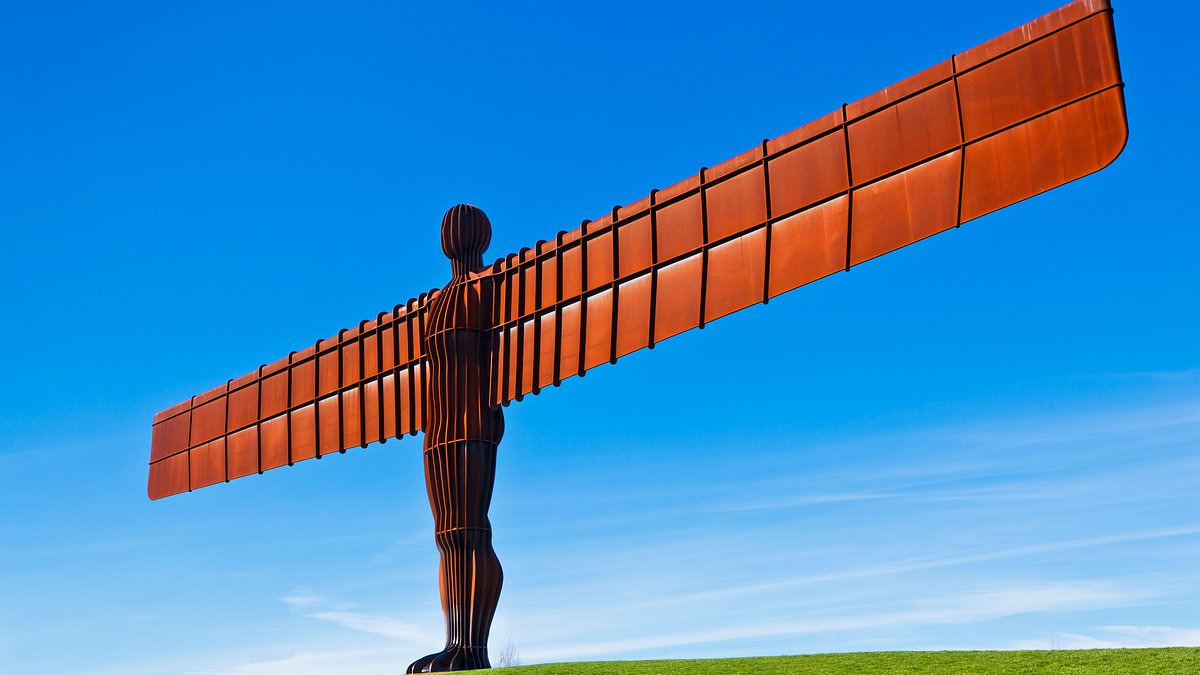
Pick up a pebble, large or small. Cradle it and weigh its smooth plainness, or notice its bands of colour. You probably don’t think of it as a mini work of art, and yet renowned 20th-century sculptors such as Barbara Hepworth and Henry Moore would have done. They found inspiration in the forms of the natural world – works of ‘art’ created by time.Standing on a beach, art historian Jo Baring thinks of the delight children have always found in pebbles. Right at the beginning of this beautifully written book, she identifies the magic at its heart: ‘The pebble… acts as a physical reminder of our connection to both material [substance] and what we make… For millennia, our ancestors have moulded, modelled and chiselled the materials they had to hand, creating objects with no immediate practical use.’ Art: Antony Gormley's Angel of the North is ‘a totem pole for the North East’So, not pots or combs or arrowheads, but things created – from stone or wood or metal – to convey a feeling or message. In other words, they have created sculpture.You may think of this art form in terms of the powerfully expressive bronze statue of Sir Winston Churchill in Parliament Square, London, created by the Welsh sculptor Ivor Roberts-Jones. Or perhaps Rodin’s work The Kiss? Or Antony Gormley’s hugely popular Angel Of The North. Jo Baring would describe the first of those – representing a historical figure – as just a ‘statue’. But Gormley’s Angel is, for her, undoubtedly a sculpture – described by the artist himself as ‘a totem pole for the North East’.As for the Rodin, interestingly – and it could be said rather strangely – she gives little time or space to the ‘greats’ of the three-dimensional art form, such as Rodin, or even Michelangelo. There are just eight lines on his magnificent and heartbreaking Pieta. But this is not a history. It is a very human story, in which the human at its heart is the author herself. Totem is a personal quest to ‘unearth the untold story of sculpture I felt dancing just ahead of me’.Once you stop seeing this book in terms of what you thought you knew and instead regard Baring as a guide into strange, symbolic realms of the imagination, then you are released into her wide-ranging storytelling. Thankfully moving on from some unnecessarily ‘woke’ reservations about the use of the word ‘Totem’ (annoyingly described as ‘problematic’ by ‘an art-history colleague’) Baring concludes that ‘this word is used across time and space to describe sculpture’.Left, Children have always loved playing with pebbles on the beach. Right, The Shigir Idol depicts an expression of dread that feels very modernShe discovers its origin in the language of the indigenous Ojibwe (or Chippewa) tribe of the American North-East. Their word ‘ototeman’ refers to a clan relation and signifies ‘to dwell together’. So a ‘totem’ is something shared. To explore the idea, looking at a complex totem pole in the Pitt Rivers Museum in Oxford and Gormley’s simple form of a towering angel, Baring guides the reader on an exhilarating global journey.From prehistoric artefacts such as the lion-man figure found in a German cave, to an ancient Mayan pyramid, and right up to the radical innovations of the 20th century, Baring reveals how sculpture expresses power, loss, identity, and the need to make meaning through form. She suggests that ‘we should begin to see sculpture not as an object, but a vessel, a holder of human knowledge, and imagination.’ Thinking of that first meaning of ‘totem’, she adds, ‘Sculpture is a repository of place, and human community, but it outlasts us.’So what you feel when you look at a picture of the earliest wooden carving to have survived might be related to your first impressions of a Henry Moore. Known as the Shigir Idol, this towering ‘totem’ is twice as old as the Pyramids – and yet isn’t its expression of dread absolutely modern? Its O-mouth stretches in a Munch-like scream – a ‘hole’ that makes my own mind leap forward to the work of Hepworth and Moore. Baring’s way of writing implicitly invites you to make such imaginative connections as she spans countries, cultures and times.She introduces us to the artists who have expanded sculpture’s possibilities – including Hepworth, Constantin Brancusi, Louise Bourgeois, Yayoi Kusama, and of course Antony Gormley – and revisits familiar works with fresh eyes. She considers the materials used – substances that were often at hand and reminds us that great artists, such as Moore, drew inspiration from collections of pebbles, feathers and bones kept in their studios. In her narrative we are never far from the natural world.Along this questing, puzzling – and sometimes puzzled – journey, visiting obscure works in barely-visited locations as well as those in major galleries, Baring’s intention might be summed up by the Indian contemporary artist Bharti Kher: ‘All of us artists, from way back, perhaps from when we first put our handprints on a cave wall, were trying to capture this thing called the human spirit…a hard thing to catch…I am constantly trying to create the manifestation of different things, to find this enigmatic stone I’ve been searching for.’Which takes us back to the pebble, and the mystery of how human beings define art and why it works so differently for each of us. The word ‘totem’ implies a mysterious object of worship, but also something shared. What do you feel when you whizz past the Angel Of The North on the A1? Admiration? Amusement? Awe? Does Michelangelo’s David elicit admiration – or possibly even amorousness?What matters is that you look, and the rest is up to you. Walk around the work, laugh at it if you wish (think of the ridiculous statue of Mary Wollstonecraft by Maggi Hambling) but be inspired by Jo Baring to flex your spirit – and respond.
What do Antony Gormley, Henry Moore and Rodin have in common? They were on a quest to capture the human spirit in material form... New book reveals how you can decode sculpture like an expert
Full Article
Original Source
Read the full article at Dailymail →KhanList aggregates and links to publicly available news content. We do not host full articles from third-party sources. Always verify important information with original sources.