
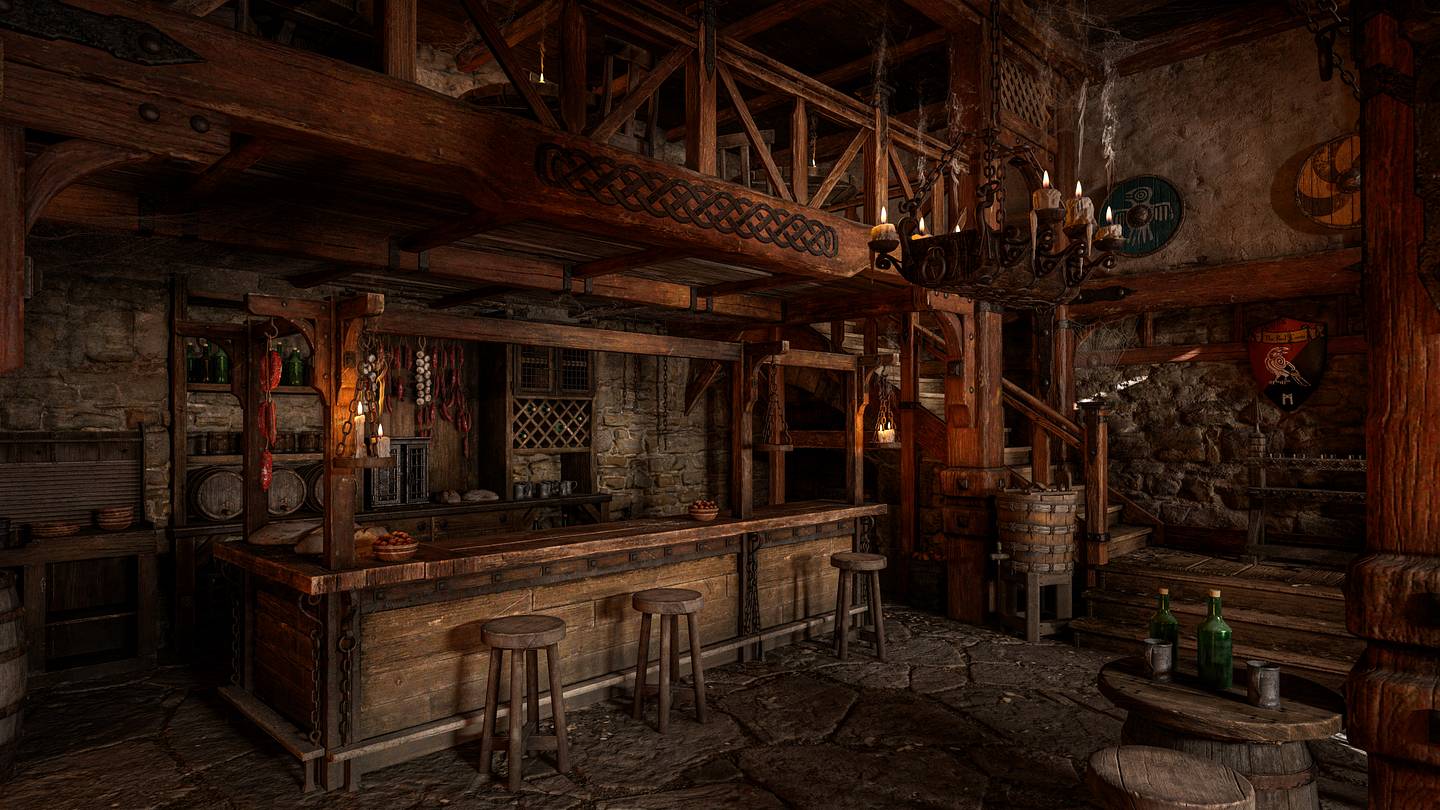
It’s safe to say what we eat every day has changed considerably over time. Where now we have an entire world of foods and cuisines to choose from—and an equally vast and convenient network of stores and restaurants in which to find them—go back in time a few centuries, and you’ll see a much different picture. Before foods could be easily imported from overseas, grown out of season, and in commercial or industrial quantities, the kinds of things you might find on offer in your local eatery would have been very different. And in medieval times, what was on offer would have depended far more on where you were and when, how much money you had in your pocket, and precisely what kind of establishment you’d chosen to eat in. WHAT EVEN IS A TAVERN ANYWAY? PHAS/GettyImagesAlthough we might think of them as interchangeable words, taverns, alehouses, and inns weren’t the same in medieval times, and so the food and drink on offer in each would have been somewhat different. As their name suggests, alehouses were essentially just that—someone’s private home (namely, that of an “alewife”) where a quantity of ale had been brewed and put on sale. (It is from these houses-cum-makeshift-bars that the term “public house,” and ultimately “pub,” eventually derived.) Taverns were far larger and more formal businesses, and as such were typically overseen by a wine merchant or guild vintner, who would offer wines, ciders, perries, meads, and other brewed drinks made of fruits and honey alongside the cheaper and more readily available ales. And inns were more specifically lodging houses, and as such were often located at cities’ gates or walls, crossroads, or partway along highways, where travelers could find a convenient place to stable their horse and bed down for the night. Alehouses, ultimately, tended not to offer food at all, as their purpose was merely to sell off a surplus of domestically brewed all. Inns, at the opposite end of the scale, were where a hungry traveler could typically enjoy more of a full meal, and fill their belly before continuing their journey. Taverns operated somewhere in between, offering lighter, cheaper, and quicker meals than inns—often at a fixed price and a set time each day—but a more substantial menu overall than alehouses.KEEPING IT SIMPLEfarluk/GettyImagesWith medieval taverns tending only to offer basic meals to their customers (especially in earlier times), smaller establishments might therefore only serve plates of bread and cheese, beans, cabbage and other greens, or bowls of thin soup or broth, with only larger taverns offering anything more substantial. A hearty medieval stew made of pulses and vegetables, known as a pottage, for instance, was especially popular as it was relatively cheap and easy to make, and could be kept warm over a fire for hours at a time with relatively little effort involved. As taverns were typically found in large towns and cities (there were 50 in London alone in the 1420s), whatever food was on offer there was limited by its size, location, and what was available locally. In cities in particular, food and ingredients would have to be sourced from nearby markets, which were in turn dependent on local farmers, harvest yields, seasonality, and geography. Coastal taverns, for instance, might offer more in the way of fish and seafood. Those in more rural locations might offer more in the way of game. Those in larger cities, meanwhile, would be limited to non-perishables that could be easily transported into town, as well as what was being grown, reared, or harvested on local farms. ON THE ROADHeritage Images/GettyImagesAs stop-off points on long journeys, inns often attracted a relatively wealthier clientele than alehouses and taverns, as these were often the kinds of people—monied merchants, court officials, military men, tradesmen, as well as anyone else who could afford the horses or transportation required for a long journey—who were most often on the road. As such, as well as simply wanting to fill their customers’ bellies as best they could, innkeepers would often put on a far more impressive spread than simpler taverns and alehouses, as their customer base could afford it. Roast meats were therefore a staple in many medieval inns (at a time when a basic laborer or peasant might only eat meat once a week, if that). Over time, however, inner-city taverns began to prove popular with the monied upper classes too, and became social hubs that gave people a place to meet, trade, gamble, play games, and exchange ideas. Astute tavernkeepers ultimately began to alter their menus to match their shifting clientele, becoming more inn-like in their offerings. Taverns proved ultimately to be the precursor to the modern-day restaurant. IF YOU’RE STILL HUNGRY, EAT YOUR DISH WAREOlga Mazyarkina/GettyImagesOut of everything you’d see on your table in a medieval tavern, though, perhaps the most bizarre was a large circle or rectangle of hard, stale bread. Known as a trencher, it worked as a base on which to cut meat or serve food, the juices and liquid from which would gradually soak into the bread, softening it. The diner could then eat the trencher themselves, if they were particularly hungry, or, more often than not, the used trenchers could be collected up and distributed to the poor. When this practice died out is unclear, but wooden (and later pewter) trenchers were already becoming more common by the 14th century. Read More:
What Did People Really Eat in Medieval Taverns?
Full Article
Original Source
Read the full article at Mentalfloss →KhanList aggregates and links to publicly available news content. We do not host full articles from third-party sources. Always verify important information with original sources.