
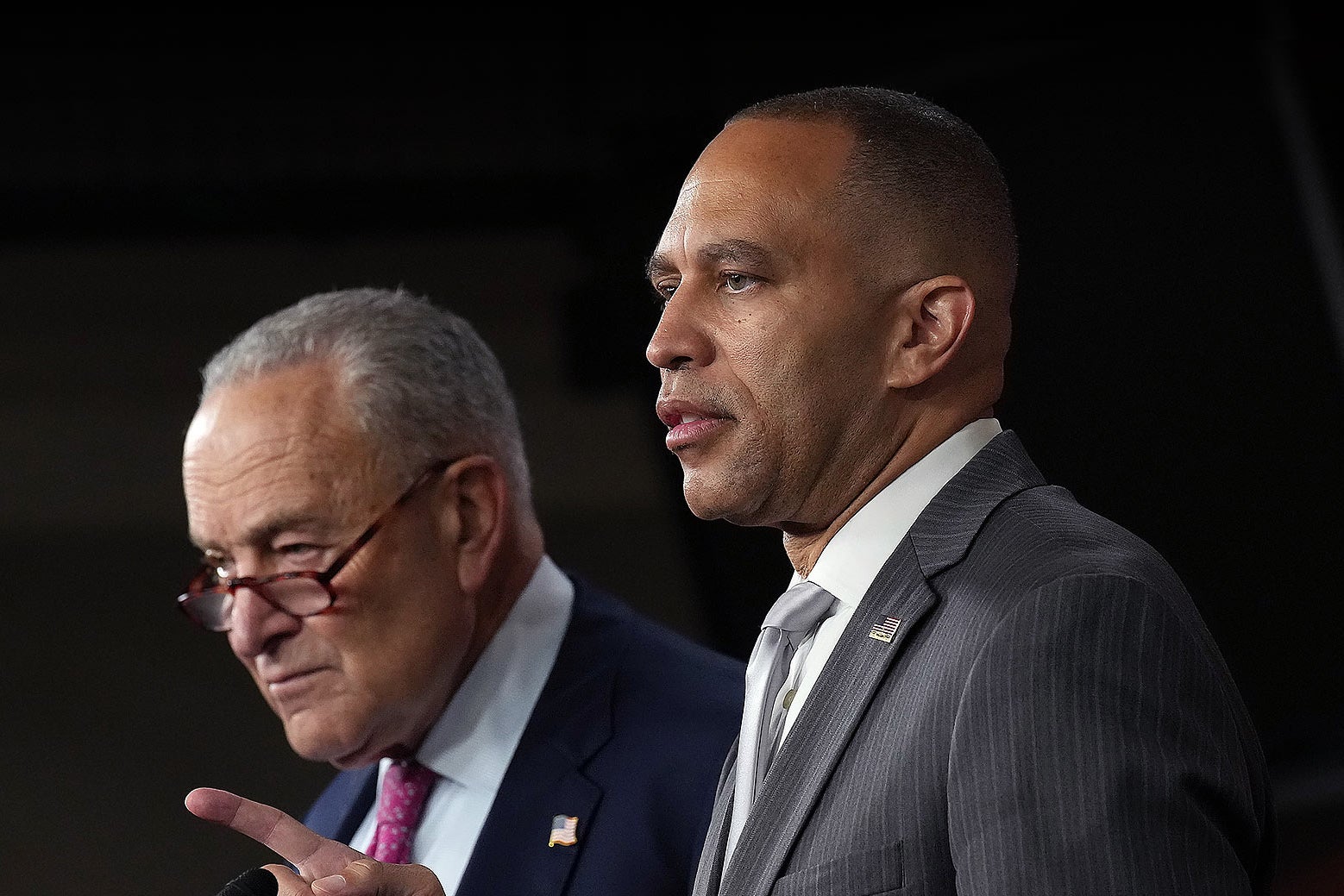
Jurisprudence By Enter your email to receive alerts for this author. Sign in or create an account to better manage your email preferences. Unsubscribe from email alerts Are you sure you want to unsubscribe from email alerts for Dahlia Lithwick? Nov 05, 202610:59 AM The majority party leaders. Kevin Dietsch/Getty Images Sign up for Executive Dysfunction, a weekly newsletter that highlights one under-the-radar story about how Trump is changing the law—or how the law is pushing back—and keeps you posted on the latest from Slate’s Jurisprudence team. In the end, it was the people. Not the courts, which did remarkably well. Or Big Business, which did remarkably limply. Or Big Law, which was not great, except where it was. Or Big Tech or Big A.I., which everyone rightfully hated. Or Big Messaging or Big MAGA, which crumpled like a sad leisure suit. Nope. It was the voters who were keenly able to recognize a mountain of Big Corruption, Big Graft, Big Ballroom, and Big Side Grifts for precisely what it was: antidemocratic and oligarchic. And if our joyful voyage through popular constitutionalism these past few months has taught us anything, it’s that civil society, voting rights groups, state and local election officials, journalists, and, in the end, voters fought and held the ephemeral line between an unaccountable monarchy and a replaceable, broken, and profoundly weakened party in the White House. While everyone kept mentioning the streets of Minneapolis as proof that the American public had become powerful, activated, and angry, many of us feared that this one inspiring, moving, and demonstrably fearless example might not be sufficient proof that a national movement for change had taken root. It had, though. It’s just that it happened in the million imperceptible ways that never quite grabbed enough headlines to seem like the fully organized, mobilized, nationwide movement it was. And whether it was the enraged post-Callais voters across the South, or the state election officials who war-gamed the hell out of these elections, or the coalitions of lawyers, or the postcard-writers, or the abortion rights activists, or furious parents of trans kids, or all of it together, the lesson wasn’t just that the MAGA coalition collapsed under the weight of its own fantasies and illusions, but that an extraordinary and lasting coalition of motivated voters rose up and roared. This was a transformational election that will be studied for years to come. But that the systems held, the large-scale election stealing never materialized, and the actual people showed up to fill the fragile vessel of democracy with hope is an extraordinary story and irrefutable proof that democratic systems can survive immense abuse and corrosion to still prevail. People voting for the abstraction that is democratic rule won out over Elon Musk’s many, many billions of dollars and the many, many failures of the corporate press. What must happen next? Everything everywhere, on your own terms. If you have a wish list, fight for it. It will be the fight of a generation, and it’s going to occupy your every day from now until a long time from now. But now it’s at least on the table. There will be an immediate call to address issues both of affordability and of accountability. As Sen. Raphael Warnock has already suggested, there is no reason to choose between the two. There is no one simple fix for what has been done to democracy in recent years. It is also worth recalling, however, that a malapportioned Senate, the Electoral College, and an unaccountable, monarchic Supreme Court all predated Donald Trump, and they must all be part of a massive systemic repair that will be the work of every single day for years to come. Perhaps the most important lesson of this week’s staggering victory is also the lesson of the days ahead. Democracy repair, clawing back the independence of once independent agencies, fixing extensive damage to education … and to science … and the military … and public health … and the list is near endless … this is not the stuff of a drive-through that we can revisit in 2028. As Sherrilyn Ifill wrote in advance of the midterms this past week: I believe we must treat this election as the beginning of our embrace of a new and more vigorous practice of citizenship. We can no longer afford to vote and walk away. We are required to maintain vigilance, to apply pressure, to stay “on call,” to support, monitor and stand at the ready should our presence, voices, our bodies, our dollars, our phone calls, and engagement become necessary. There will be fighting about where to start and what to prioritize, and there will be massive intracoalition differences of opinion about what major structural reform looks like. But hearings on structural Supreme Court reform should be immediate, and everything should be on the table. (Steve Vladeck runs down how to think about the court’s reaction to the tsunami elections here.) There must also be, as Stacey Abrams recently opined on Amicus, massive, systemwide reforms not just to the Supreme Court but to the appeals courts and the lower courts. As she urged in a recent panel, there will not be any one single magic bullet, but rather exactly the kind of broad, expert multipronged approach that sweeps in and focuses on state and local, as well as federal systems reform. This is absolutely the moment to capitalize on newly captured state trifectas and to think of newly flipped blue states as precisely the kinds of laboratories of democracy in the same way the GOP has long treated them. What will let all the air out of the midterm high will be a series of scoldings about priorities and goals. Americans have shown themselves to be able to day-drink straight democracy. Let them have at it. This will have to be a walk-and-chew-gum lame-duck period, but the American people have now shown beyond any shadow of a doubt that they expect a Congress to perform on the promises of accountability, oversight, and democracy reform. Investigations into absolutely everything that has been corroded and broken in the courts and the Justice Department will be of paramount importance. So will investigations into Department of Homeland Security abuses, rendition flights, extrajudicial assassinations, ICE raids, and every other atrocity professor Frank Bowman has already laid out as the many legal bases for impeachment. And whether or not you personally agree with Bowman that impeachment of Donald Trump himself is not necessarily a tactical priority, the American public is willing to be excited and educated about democracy and equality and the dangers of corruption. To squander that enthusiasm would be a sin. As we all embark on this project of reclaiming core constitutional values for the American public, we must remember that the distance between the original drafters of the Bill of Rights and the warriors for the 14th Amendment had little to do with fancy legal educations. What bound them was the conviction that the courts and the Congress could not make constitutional meaning without a robust public pushing and pulling the values of equality, dignity, and freedom around with their own bare hands. What those Framers recognized was that this country was established on a renunciation of the cynical view that only experts can be trusted with governance. What we have witnessed in the past few days is that impulse made corporeal. Turning that impulse from the ballot box to governance itself is what comes next. Department of Justice Donald Trump Jurisprudence Politics Supreme Court Judiciary 2026 Midterms
What Democrats Must Do Now
Full Article
Original Source
Read the full article at Slate →KhanList aggregates and links to publicly available news content. We do not host full articles from third-party sources. Always verify important information with original sources.