
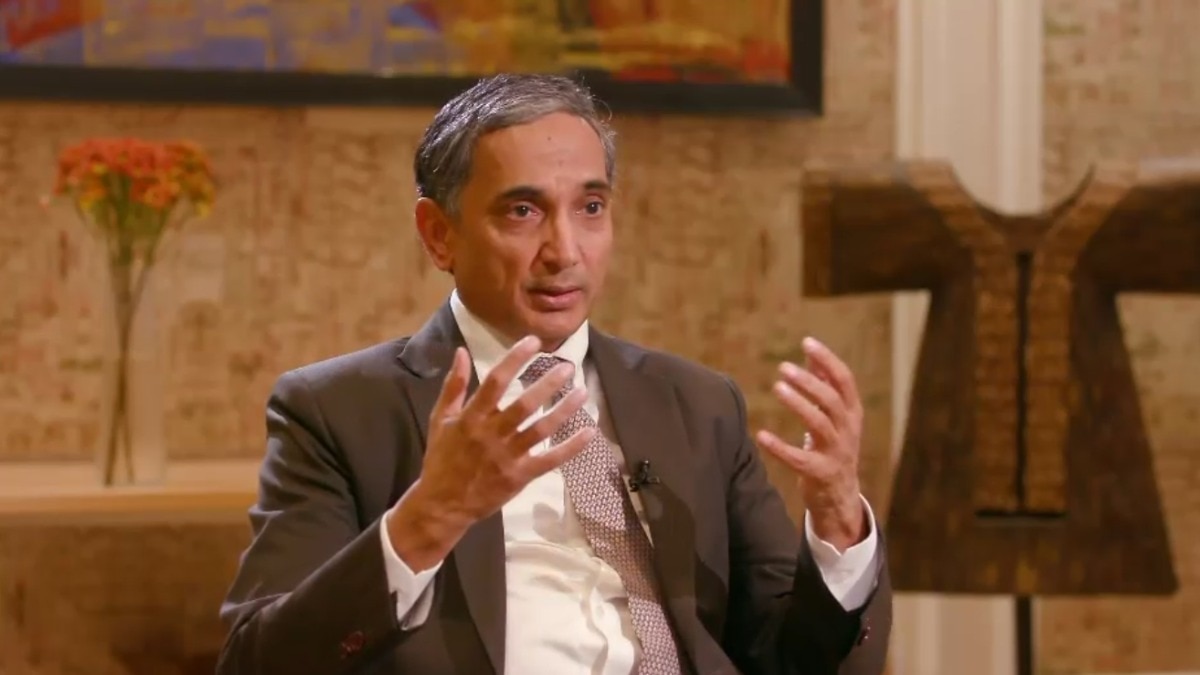
The IMF raised India's FY27 growth forecast to 7% from 6.4% after stronger-than-expected economic activity, but risks from the Middle East conflict, energy prices, tighter global financial conditions, AI-related uncertainty and adverse weather could threaten the outlook, said IMF's Krishna Srinivasan.Srinivasan said central banks must respond proactively to rising price pressures, with price stability remaining their primary objective.New Delhi,Oct 24, 2026 14:54 ISTThe International Monetary Fund (IMF) has raised India's FY27 growth forecast to 7% from 6.4%, offering reason for optimism, but the road ahead is far from free of risks.An energy crisis triggered by disruptions in the Strait of Hormuz that shows no signs of easing, a rupee under pressure, rising borrowing costs, uncertainty over the AI boom and the threat of El Nino could all complicate India's growth outlook. But, the real danger, IMF Asia chief Krishna Srinivasan said, is when these risks converge."The biggest worry is if all of these come together, the confluence of risks come together, that can have a significant bearing on prospects for India and for the region," Krishna Srinivasan, Director of the IMF's Asia and Pacific Department said in an exclusive interview with India Today.The IMF revised its forecast after India's economic performance in FY26-27 exceeded expectations, with the Fund projecting medium-term growth at around 6.9%. However, Srinivasan cautioned that sustaining this momentum would depend on how India navigates mounting global uncertainties, particularly the prolonged energy shock and its impact on inflation and growth."The energy shock is likely to get worse before it gets better," Srinivasan added. For India, which relies heavily on imported energy, a prolonged disruption could fuel domestic inflation, weaken external balances and weigh on growth. Higher energy costs can erode household purchasing power, raise production expenses for businesses and complicate the task of containing inflation.At the same time, allowing inflation to remain elevated can undermine growth over the longer term.Srinivasan said central banks must respond proactively to rising price pressures, with price stability remaining their primary objective."The overarching objective of central banks should be on price stability," he said, adding that policymakers must remain agile as inflationary pressures build.The IMF Asia chief also highlighted the pressure on Asia, which remains heavily dependent on imported oil and gas, with energy consumption accounting for around 4% of the region's GDP, roughly twice the share in the European Union.DIVERSIFICATION OF ENERGY NEEDS VERY IMPORTANT: IMF’S SRINIVASANIndia has already diversified its energy import sources, Srinivasan noted. But the room to absorb higher costs through fiscal measures is not unlimited."Fiscal buffers are thinning, not just in India, but across the region, because of the shocks we've had back to back," he said.The longer the disruption in the Hormuz continues, the harder it could become for the government to prevent international price increases from feeding into domestic fuel costs.The longer-term response, he argued, must go beyond managing the immediate crisis. India and other Asian economies need to diversify their sources of energy, reduce their dependence on fossil fuels and improve energy efficiency."This shock has clearly underscored the need for diversification of your, you know, where you import from, and also to reduce your energy intensity," he said.IMF ASIA CHIEF ON WEAKENING RUPEEWhile answering a question on the weakening rupee, Srinivasan said the energy shock, a stronger US dollar and capital outflows were adding to the pressure.He said the rupee should be allowed to adjust, with the central bank stepping in if its fall pushes up inflation or markets become unstable.“The rupee should be the first line of defence, allowing it to move to reflect the shock is important,” he said.“If the rupee depreciates, and it has passed through inflation, then monetary policy should respond accordingly,” Srinivasan added.He also stressed that the focus should be on protecting people rather than defending the currency at all costs.IMF’S SRINIVASAN ON INDIA’S RECENT TRADE DEALSWith global trade restrictions tripling between 2019 and 2025, Srinivasan welcomed India's trade agreements with the European Union and the UK as a way to diversify trade and investment.“I think it's a very important step. I think it's a much needed step,” he said. He also highlighted that the IMF estimates that deeper trade integration within Asia could raise the region's GDP by around 2%.Srinivasan said India’s trade deals could open up new avenues for trade and investment, but stressed that more reforms were needed to attract foreign capital.He pointed to the need for labour and land reforms, an easier business environment and steps to reverse the decline in net foreign direct investment.“A lot of reforms are needed, not just in the near term, but which will actually attract investment and so that it can boost growth over the medium term or medium to long term,” he said.‘AI BOOM CARRIES BOTH OPPORTUNITY AND RISKS’Responding to an IMF analysis of 19 Asian economies, which found that labour demand in AI-exposed sectors fell by around 10% relative to other sectors after ChatGPT's launch, Srinivasan said the decline had since stabilised, while demand for AI skills continued to rise.“In India, if you look at the services sector, the GCC and so on, there's actually been a rise in jobs,” he said.He stressed the need to reskill workers to help them adapt to changing job requirements.“The point is that, you know, skills, it's very important that, you know, the workers are well retooled. They are skilled to adapt to this change,” he said.EL NINO ADDS TO GROWTH RISKSEl Nino poses another risk to India's growth outlook, particularly if adverse weather hits agriculture and pushes up food prices.Srinivasan said its impact across Asia could vary, bringing drought, excessive rainfall or higher temperatures.“If El Nino significantly affects agriculture, it could weigh on growth, given India's continued dependence on the sector,” he said, adding that a severe impact on agriculture could add to inflationary pressures.- Ends
What could derail India's 7% growth outlook? IMF's Krishna Srinivasan explains
Full Article
Original Source
Read the full article at Indiatoday →KhanList aggregates and links to publicly available news content. We do not host full articles from third-party sources. Always verify important information with original sources.