
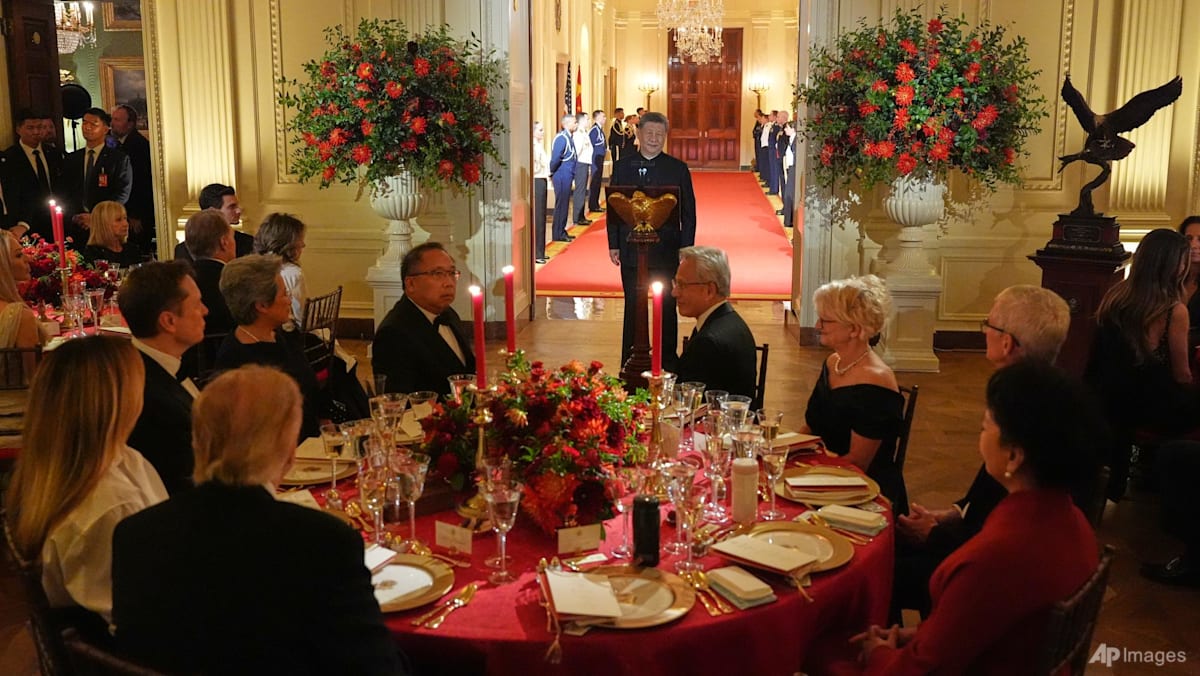
SHANGHAI: Chinese CEOs were conspicuously missing from United States President Donald Trump’s state dinner for Chinese counterpart Xi Jinping on Thursday (Sep 24), even as more than 30 American business leaders filled the room.Their absence changes little at the negotiating table, where Beijing’s senior economic officials - who were present - remain the key decision-makers, analysts say.But they add that the Chinese corporate vacuum still carries a cost - and also highlights the limited progress Washington and Beijing have made on trade and investment despite efforts to stabilise bilateral ties."The absence of PRC (People’s Republic of China) tech executives makes it harder for them to advocate with their own leaders to open China's markets and expand reciprocally beneficial trade, rather than the party-centric economic policies that now dominate," Drew Thompson, a senior fellow at the S Rajaratnam School of International Studies (RSIS), a Singapore think-tank, told CNA.A LOPSIDED BUSINESS PRESENCE Xi is on a reciprocal state visit to Washington, four months after Trump travelled to Beijing.Corporate America was represented in force at the White House state dinner on Thursday.At the head table with Trump, Xi and their wives sat Tesla and SpaceX chief Elon Musk, Nvidia CEO Jensen Huang, AMD CEO Lisa Su and Apple executive chairman Tim Cook. Advanced Micro Devices CEO Lisa Su, her husband Daniel Lin, Nvidia CEO Jensen Huang, his wife Lori Huang and Apple's Chairman of the Board Tim Cook attend the state dinner in Washington, DC, on Sep 24, 2026. (Photo: AFP/Brendan Smialowski) Elsewhere in the room were Amazon's Jeff Bezos, Meta's Mark Zuckerberg, OpenAI's Sam Altman, Microsoft's Satya Nadella and Google's Sundar Pichai, along with Wall Street chiefs including JPMorgan Chase's Jamie Dimon, BlackRock's Larry Fink and Goldman Sachs' David Solomon.China Inc had no equivalent presence in the room.Xi’s delegation instead comprised 16 officials, including Vice Premier He Lifeng, China's lead negotiator on trade with the US, National Development and Reform Commission (NDRC) chairman Zheng Shanjie, Commerce Minister Wang Wentao and Finance Minister Lan Fo'an.De facto chief of staff Cai Qi, Foreign Minister Wang Yi and Tang Fangyu, director of the Communist Party's Central Policy Research Office, were also among the attendees, according to the official White House guest list. US President Donald Trump, First Lady Melania Trump, Chinese President Xi Jinping and Politburo Standing Committee member Cai Qi and China's Foreign Minster Wang Yi look up during a flyover by a B2 stealth bomber and other aircraft, as they attend a ceremony near the colonnade in the White House on Sep 24, 2026. (Photo: Reuters/Jonathan Ernst) When Xi hosted Trump in Beijing in May, the state banquet brought business leaders from both countries together. Lenovo chief Yang Yuanqing, Xiaomi founder Lei Jun and ByteDance CEO Liang Rubo were among the Chinese executives who dined alongside Trump’s corporate delegation.There was no mirror image in Washington.The absence also contrasted with Xi’s previous US state visit in 2015 during the Barack Obama administration. Alibaba founder Jack Ma, Tencent chief Pony Ma and other Chinese executives took part in a bilateral CEO roundtable with Xi in Seattle before he travelled on to Washington. Alibaba co-founder Jack Ma (left) and other Chinese corporate leaders listen to Chinese President Xi Jinping at a US-China business roundtable, comprising US and Chinese CEOs, on Sep 23, 2015, in Seattle. (Photo: AFP/Pool/Elaine Thompson) Beijing had apparently sought to bring a business delegation, according to news reports.Executives from electric vehicle makers BYD and Xiaomi, battery giant CATL and Nvidia supplier Zhongji Innolight were among those in the running, the South China Morning Post (SCMP) reported on Sep 17.But the plans ended up falling through."It’s a bit of a metaphor for the lack of progress on trade and market access issues between the two sides," said RSIS' Thompson.He said there was “no common ground” between Washington's push for greater access to the Chinese market and Beijing's calls for looser US curbs on tech exports and greater access for Chinese exporters.Lin Han-Shen, China director at US strategic advisory firm The Asia Group, said the two capitals approached the guest list with different aims.For Beijing, a CEO delegation was meant to be a diplomatic deliverable - proof that improving ties could translate into commercial access for Chinese firms, he said. Chinese President Xi Jinping and US President Donald Trump speak during a state dinner at the White House in Washington, DC, US, on Sep 24, 2026. (Photo: Reuters/Evelyn Hockstein) For Beijing, a CEO delegation was meant to be a diplomatic deliverable - proof that improving ties could translate into commercial access for Chinese firms, he said.China had framed the delegation as a matter of reciprocity after US executives including Huang and Cook joined Trump on Air Force One for his visit to Beijing in May, the SCMP reported yesterday.During that visit, Trump introduced the US executives to Xi one by one, and Chinese Premier Li Qiang met them separately, according to Chinese state news agency Xinhua.Washington, Lin said, treated attendance as a matter of security clearance.In January 2025, the Pentagon added CATL, one of the firms reportedly under consideration for Xi’s business delegation, to its list of companies it says are linked to China's military - a designation the battery maker has disputed.Reuters reported on Wednesday, citing a source, that US officials did not want Chinese firms they believe have links to China's military to be represented. Another source said the White House had other priorities. WHAT IS XI TELLING WASHINGTON?A key message is that Beijing still sees major economic deals as something to be negotiated through the state first, with companies playing a secondary role, said analysts."The absence of CEOs reinforces that Chinese firms remain instruments of policy, not independent diplomatic actors in the way US companies are," said Lin.Thompson from RSIS said that the Communist Party retains a dominant role in China's economy."It's not Air China that's buying Boeings, it's the Communist Party," he said, referring to the country’s flag carrier.In May, China approved an initial purchase of 200 Boeing aircraft - its first commitment to buy American-made Boeing jets since 2017, according to the White House.The Asia Group’s Lin said that the business imbalance at Thursday's dinner “certainly reinforces Beijing's message that Washington needs commercial engagement with China more than China needs American corporate diplomacy". Chinese President Xi Jinping makes a toast during a state dinner held by US President Donald Trump at the White House in Washington, DC, US, on Sep 24, 2026. (Photo: Reuters/Evelyn Hockstein) At the same time, corporate China’s absence from the state dinner should not be over-interpreted, analysts cautioned."The absence of a CEO entourage may change the optics, but it does not alter the substance of the summit," George Chen, a partner and co-chair of digital practice at The Asia Group, told CNA.RSIS’ Thompson also cautioned against assuming the American executives were there simply to court Beijing.“I think those CEOs are as much courting US Cabinet members responsible for the economy, like (Treasury Secretary) Scott Bessent, as well as President Trump and his family,” he said.Had Chinese executives attended, he added, they would similarly have valued proximity to Xi as much as access to their American counterparts.“The message is clear - that China is ambivalent about improving the trade relationship and making it more reciprocal and beneficial to American companies,” Thompson said. PERSISTENT HURDLES, LIMITED GAINSThe missing corporate presence also highlights how difficult it remains for Washington and Beijing to make meaningful progress on trade and investment, even as the two governments seek to stabilise the broader relationship, said analysts.Both sides agreed to set up a Board of Trade and Board of Investment in May, as part of the outcomes from the Trump-Xi summit in Beijing.The Board of Trade will allow both sides to manage bilateral trade across non-sensitive goods, while the Board of Investment will provide a government-to-government forum for discussing investment-related issues, a White House fact sheet said.Neither was mentioned by name in China's official readout of Thursday's talks, and the US has yet to issue its own.According to the readout, Xi said the two sides' economic and trade teams "had a new round of consultations, and reached a new joint arrangement". He did not specify what the arrangement covered or whether it involved either of the two boards. China's de facto chief of staff Cai Qi, China's Foreign Minister Wang Yi, China's Vice Premier He Lifeng, US Vice President JD Vance, Secretary of State Marco Rubio and Treasury Secretary Scott Bessent attend a meeting between US President Donald Trump and Chinese President Xi Jinping in the Oval Office at the White House in Washington, D.C., US, September 24, 2026. (Photo: REUTERS/Evan Vucci) The clearest movement on the economic front came just before the summit.After talks with Chinese Vice Premier He, Bessent said the two sides had agreed to extend their trade truce by two months to Jan 10. China has not publicly confirmed the new expiry date.“It gives Trump and Xi some additional runway to negotiate the broader economic relationship rather than facing a Nov 10 cliff," said The Asia Group’s Lin.Thompson said the summit produced no major economic breakthroughs, and that neither side was willing to make concessions for now.In China, every industry has a security dimension, making it difficult for Beijing to open its market to American products, he said.In the US, meanwhile, Chinese goods can run into national security concerns of their own, from data management to sensors and networks that could create vulnerabilities."There isn't any agreement on the two sides about what industries should be considered national security," he said.Additional reporting by Lakeisha Leo
What corporate China’s absence from Trump-Xi state banquet says about US-China business ties
Full Article
Original Source
Read the full article at Channelnewsasia →KhanList aggregates and links to publicly available news content. We do not host full articles from third-party sources. Always verify important information with original sources.