
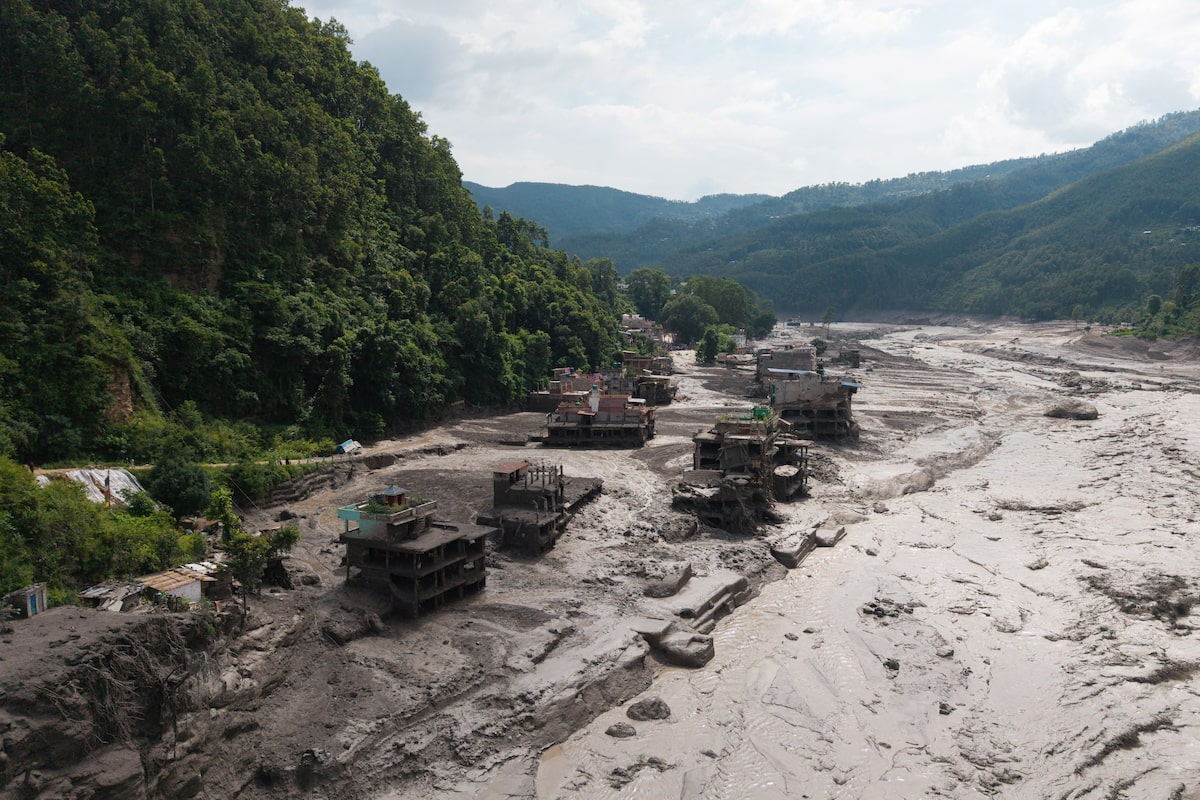
Open this photo in gallery:A drone view shows mud covering properties following a flash flood at Trishuli in Nuwakot district, Nepal, on Wednesday.Stringer/ReutersAt least 95 people have been killed in massive floods that struck the Himalayan border region of Nepal and China’s Tibet on Wednesday. Authorities on both sides fear the final number of casualties will be far higher amid massive destruction.Here is a look at what caused the calamity, and where things stand now.What happened?Torrential floods swallowed roads, bridges, houses, and power projects in the border areas of Nepal, and triggered a mudslide that hit Gyirong Port, a major land crossing with neighbouring Tibet, cutting roads, communications, and power links to the area.What caused the calamity?Open this photo in gallery:A boy looks at the devastation caused by flash flooding along the Trishuli River.Niranjan Shrestha/The Associated PressIt is suspected that an earthquake struck the region and triggered the lower part of a glacier to collapse on the Lhende Khola river in Nepal, causing the floods.The river runs through both Nepal and Tibet.Are any foreigners missing?At least 484 travellers, including 105 Indians, 93 Nepalis, three U.S. citizens, and 12 British citizens have been reported missing. Eight South Koreans working on a hydropower plant were also unaccounted for.The other missing included 17 Malaysian nationals, four South Africans, and one person each from Australia and the Netherlands.Has the danger passed?Authorities have warned that a second flood may occur since a blockage is still lodged upstream on the Lhende Khola river.Flood alerts have also been issued in the Indian states of Bihar and Uttar Pradesh, which border Nepal, since several rivers flow down the Himalayas into their plains.What is the situation now?Open this photo in gallery:A flooded road following a flash flood in Galchhi in the Dhading district, Nepal.Stringer/ReutersPolice and military personnel were engaged in rescue efforts, although officials have said rescue helicopters would not be able to land in some of the affected areas until the waters receded.People living in low-lying regions were being moved to safer places, and those along the river have been advised to remain alert.How is the rescue effort progressing?China has deployed at least 574 rescuers to the land crossing but the flood sediment is posing a challenge.Other countries have also offered to help.Giant neighbour India said it was co-ordinating closely with Kathmandu on rescue and relief efforts. South Korea plans to send a rapid-response team comprising government officials and fire and police personnel.Is this the first time it happens?Climate experts at the Kathmandu-based International Centre for Integrated Mountain Development said an avalanche from a glacier likely caused Wednesday’s flash flood.The Lhende Khola River, a tributary of the Bhotekoshi, had maximum flooding, they said.“The Lhende Khola has flooded twice in 14 months, this time triggered by an ice rock avalanche from a glacier on the Nepal side that blocked the river and released a sudden surge downstream,” said Saswata Sanyal, a disaster risk reduction specialist at the climate research group.The region saw similar flash floods in August last year, when a glacial lake in Tibet overflowed because of high temperatures. Nine people were killed, and critical infrastructure, including a bridge connecting Nepal and China, was damaged.The Himalayan region, which spans several countries including India, is especially vulnerable to heavy rains, floods and landslides because of warming due to human-caused climate change. Research shows that extreme weather events, including heat waves, rains and melting glaciers, have become more frequent.Researchers in Kathmandu found earlier this year that glaciers across the Hindu Kush Himalaya region are melting at an accelerating rate, with ice loss rates doubling since 2000, primarily due to rising global temperatures and climate change.- With a file from the Associated Press
What caused the catastrophic flooding on the Nepal-Tibet border?
Full Article
Original Source
Read the full article at Theglobeandmail →KhanList aggregates and links to publicly available news content. We do not host full articles from third-party sources. Always verify important information with original sources.