
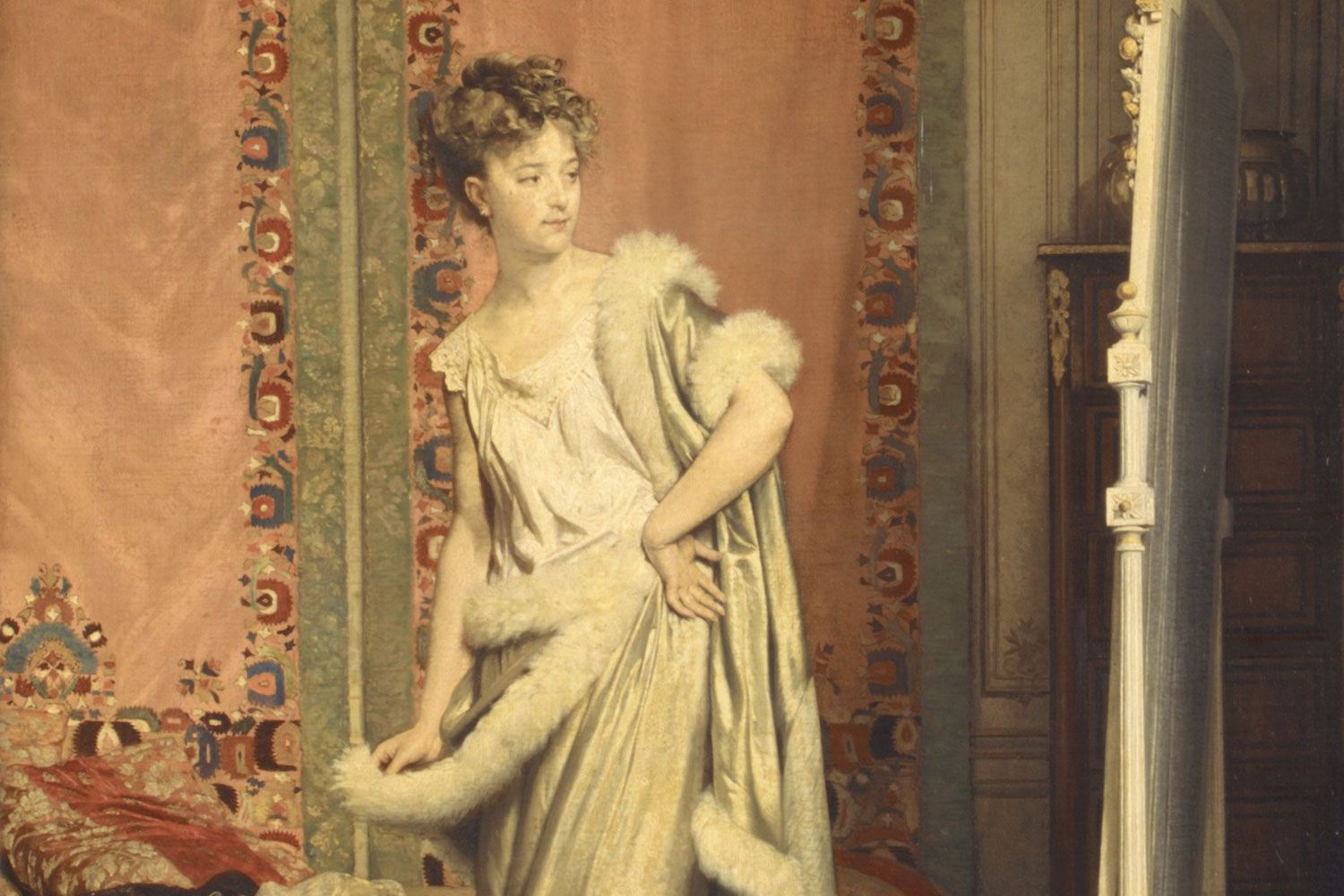
A new analysis of 486 portraits suggests that the ideal waist-to-hip ratio increased between 1650 and 1950 November 23, 2026 2:30 p.m. Before the Mirror, Pierre-Paul-Léon Glaize, 1873 Public domain via Wikimedia Commons Long before the invention of photography, wealthy Europeans commissioned portraits to preserve their likenesses for posterity. But portraits aren’t necessarily faithful reproductions of reality. Like photos, they can be manipulated to accentuate flattering features, portraying subjects as they wish to be seen. As it happens, those choices can tell us a great deal about how ideal beauty standards have evolved over time. According to a study published last week in the journal Proceedings of the Royal Society B, historic portraits serve as “cognitive fossils” that shed new light on “historical shifts in psychological preferences and reproductive strategies.”“They cover a much longer timespan than photographs, which allows us to observe changes across several centuries,” lead author Jeanne Bovet, a behavioral scientist at England’s Northumbria University, tells El País’ Miguel Ángel Criado. “They were created to be seen by others—suitors, relatives, society—and therefore reflect the messages people wanted to convey.” The researchers analyzed 606 women in 486 European portraits created between 1650 and 1950. They then recruited roughly 1,500 participants to assess various aspects of the subjects’ appearances. One group received cropped images of subjects’ faces and guessed their ages, while another group rated their attractiveness. A third group estimated each woman’s waist-to-hip ratio by examining full portraits with blurred-out faces. Waist-to-hip ratio is calculated by dividing someone’s waist circumference by their hip circumference. Women with lower ratios have more of an hourglass shape, with larger hips and smaller waists, while those with higher ratios have a straighter silhouette. Quick facts: The contrapposto pose In 2019, a study published in the journal Archives of Sexual Behavior found that the contrapposto pose—standing with weight shifted onto one leg—can lower perceived waist-to-hip ratio. This pose appears in many famous artworks, from Sandro Botticelli’s Birth of Venus (circa 1485) to Michelangelo’s David (1504). The researchers found that subjects’ perceived waist-to-hip ratios have increased over time. “We confirmed an upward trend across those three centuries, although there were fluctuations,” Bovet tells El País. Ratios bottomed out in the mid-18th century, which produced works like The Souvenir (circa 1776-78) by Jean-Honoré Fragonard, a French Rococo painter. The painting depicts a woman in a light pink dress, cinched tightly around the waist. Her perceived waist-to-hip ratio was 0.51. A century later, the French artist Pierre-Paul-Léon Glaize created Before the Mirror (1873), which depicts a woman in a looser gown that isn’t fitted to accentuate her curves. Raters estimated this subject’s waist-to-hip ratio at 0.72. What drove this evolution? The study’s authors explain that lower waist-to-hip ratios are traditionally linked to youth and fertility. “Evolutionary psychologists have proposed that a preference for a low [waist-to-hip ratio], or a more hourglass-shaped silhouette, might reflect a preference for more fertile partners,” Bovet tells Science magazine’s Jack Tamisiea. A 1765 portrait of Maria Luisa of Parma by the French artist Laurent Pêcheux Public domain via Wikimedia Commons The researchers think that the upward trend may be connected to other societal shifts during this 300-year period. Women began having children at older ages—and having fewer children overall. Infant mortality declined, and women spent more time pursuing education. According to the raters, subjects in later portraits also appeared to be older. While women’s waist-to-hip ratios do increase with age, the upward trend in ratios persisted even when researchers controlled for perceived facial age. Perceived body weight, meanwhile, remained relatively stable. Louis Boucherie, a computational social scientist at the University of Copenhagen who wasn’t involved in the research, thinks that connecting beauty standards to social change can be challenging. Earlier this year, he co-authored a study on the body types that appear on runways, magazine covers and advertisements. Over the past 25 years, models’ waist and hip ratios didn’t change much. “Women’s education kept rising during that time, but models’ proportions barely changed,” he tells Science. “To me, that suggests the fashion industry itself shapes its body ideals at least as much as social change does.” You Might Also Like Get the latest stories in your inbox every weekday. More about: Art Arts European History Health History New Research Painting Portraiture Women's History
What Can 300 Years of European Portraits Reveal About Evolving Beauty Standards?
Full Article
Original Source
Read the full article at Smithsonianmag →KhanList aggregates and links to publicly available news content. We do not host full articles from third-party sources. Always verify important information with original sources.