
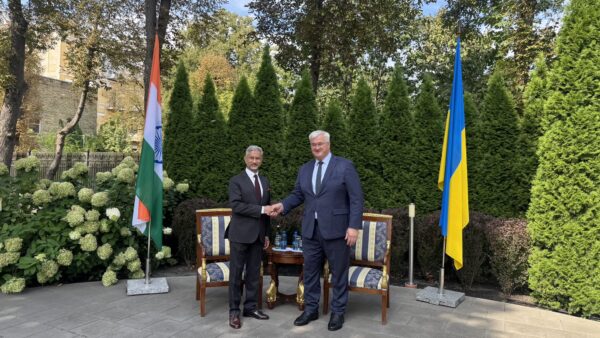
Speaking at the Munich Leaders Meeting earlier this week, India’s Minister for External Affairs S. Jaishankar said that India’s consistent position that the Russia-Ukraine conflict should end through “dialogue and diplomacy” between the concerned parties remains unchanged. In the same breath, he acknowledged that New Delhi in “recent months” has been a “little more involved beyond advocacy” in negotiating an end to the conflict. Without providing details, the Indian foreign minister said India was engaged in discussions with both sides on specific arrangements involving Black Sea shipping, grain and energy exports, and possible “non-attack” understandings. During the latest press briefing, the Indian Ministry of External Affairs confirmed that New Delhi was having “ongoing conversations with both Russia and Ukraine” on these matters. Earlier, in his address at the United Nations General Assembly, Jaishankar said that New Delhi was “prepared to do everything possible” to ameliorate the conflict in Ukraine, “especially with regard to food and energy security.” As part of this activism to broker peace and operational agreements, New Delhi, along with the United States, Egypt, and Turkiye, reportedly submitted a proposal for a ceasefire between Russia and Ukraine, which Ukrainian Foreign Minister Andrii Sybiha described as the “most extensive.” That proposal followed Jaishankar’s visit to Kyiv on September 3, the first-ever standalone bilateral visit by an Indian foreign minister to Ukraine. According to a press release from the Embassy of Ukraine in India, the discussions between Jaishankar and Sybiha focused on the situation in the Black Sea and freedom of navigation, global food security, nuclear threats posed by Russia, and the development of India-Ukraine relations. Indian media reports cited unnamed government sources to confirm that a truce plan was discussed during Jaishankar’s visit to Kyiv. Despite moving beyond rhetorical calls for dialogue toward concrete proposal-based diplomacy, New Delhi has not formally described its role as a mediator. Its reticence probably stems from its own antipathy toward mediation when it comes to its disputes with Pakistan on the Kashmir issue. Referring to Pakistan’s mediation efforts in the ongoing war in West Asia, Jaishankar commented that India would not be a “dalal (broker)” nation like Islamabad. New Delhi has strong relations with Russia. It would, therefore, not want to jeopardize ties with its trusted partner by taking any position that could go against President Vladimir Putin’s domestic interests, especially. This is why, despite repeated criticism from the West for its perceived “pro-Russia” position, New Delhi has refrained from publicly censuring Russian actions in Ukraine and voted against or abstained on most Ukraine-related resolutions at the United Nations. So far, Moscow has responded positively to New Delhi’s peace efforts, with Putin publicly praising Prime Minister Narendra Modi for his “ideas and persistent efforts” for peace in the ongoing war in Ukraine. During his talks with Putin on the sidelines of the SCO summit in Bishkek earlier this year, Modi urged the Russian leader to move from “endless war” to the “end of war” for the sake of humanity. Nevertheless, the shift in New Delhi’s tone, small as it is at present, is an important development. It reflects domestic concerns over the war’s economic costs on India. Both Russia and Ukraine are major suppliers of several essential commodities to India, including agricultural products. Supply chain disruptions caused by the conflict have already had a major impact on the Indian economy. A notable example is the extraordinary surge in the price of sunflower oil, which Russia and Ukraine supply to India. Due to supply chain disruptions caused by attacks on cargo ships in the Black Sea, New Delhi’s sunflower oil imports fell to their lowest level in more than four years in September. Consequently, between October 2025 and October 2026, retail prices increased by 18.7 percent. Beyond economic motives, humanitarian concerns also drive New Delhi’s position. Targeted strikes on commercial shipping in the Black Sea continue to claim the lives of Indian seafarers, who account for the second largest share of the global maritime workforce. Additionally, Indian businesses have faced severe financial losses due to the recent escalation in the conflict. In August, a Russian airstrike targeted a site at ArcelorMittal Kryvyi Rih, owned by Indian businessman Lakshmi Mittal, forcing a partial shutdown of the plant. More recently, on October 4, Russian attacks heavily damaged the Indian-owned Kusum Healthcare pharmaceutical plant, resulting in estimated losses of $50 million. New Delhi’s more robust approach toward negotiating an end to the Russia-Ukraine conflict is also being appreciated by its European partners. Previously, India’s “cautious” position on the Ukraine crisis has caused some friction in the EU-India relationship. As New Delhi’s traditional partnership with Washington encounters friction, strengthening alignments with partners in Europe is increasingly becoming a strategic necessity. Going forward, New Delhi is unlikely to mediate directly between Russia and Ukraine, given the complexity and historical baggage of the conflict. More likely, it will play a more important, visible political and diplomatic role, acting as a facilitator of dialogue. This role will be determined by India’s own economic interests, likely to focus on issue-based negotiations, rather than to increase its political heft on the global stage by acting as direct mediator.
What ‘Beyond Advocacy’ Means for India’s Role in the Russia-Ukraine Conflict
Full Article
Original Source
Read the full article at Thediplomat →KhanList aggregates and links to publicly available news content. We do not host full articles from third-party sources. Always verify important information with original sources.