
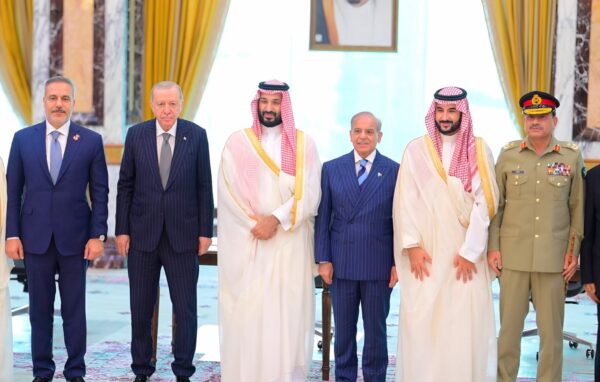
The Mecca Joint Defence Agreement between Saudi Arabia, Pakistan, and Turkiye, signed on August 7, evoked both disconcertion and skepticism in New Delhi’s strategic circles. The official reaction, delivered by the spokesperson of India’s External Affairs Ministry, to the sudden unveiling of what is being increasingly referred to as an “Islamic NATO” was one of quiet concern. The spokesperson observed that the Indian government – in a typical diplomatic aphorism that gives little away – is “examining its implications” from the perspective of “our national security” and “regional peace and stability.” He said that India would “safeguard its national interests.” Still, most of the country’s strategic community was more openly alarmed. Although many have dismissed the agreement as more optics than substance, the pact is seen by some as a master stroke by Pakistan, India’s arch-rival. It may be time for New Delhi to recalibrate its approach to the Gulf, a region of immense economic and strategic importance. Approximately 8.8 million Indian nationals reside in the region. The Gulf Cooperation Council (GCC) is India’s largest regional-bloc trading partner, comprising 15.4 percent of India’s total trade. India and the GCC signed a free trade agreement in February this year. While the fine print of the Mecca agreement has yet to surface and its practical implications not yet worked out, the pact envisages bringing together three countries – a GCC member, a NATO member, and a South Asian country that happens to be the only Islamic nuclear power – under a collective deterrence mechanism. The aggregate matrix of all three countries, according to the Global Firepower Index (GFI) 2026 that evaluates 145 modern military entities, could produce a significant fielding of military might, consisting of 1.4 million active personnel, more than 6,000 tanks, 3,415 military aircraft, 844 naval assets, and defense spending of more than $124 billion. India ranked fourth in the GFI – behind the U.S., Russia, and China – and has 1.4 million active personnel, a defense budget of $86 billion, 343 naval assets, 3,913 tanks, and 2,183 military aircraft. However unlikely, a crisis invoking the Mecca pact against India could test New Delhi ’s capabilities. The Mecca pact isn’t targeted against a single adversarial nation. Barring Israel, at least hypothetically, there is no common enemy that all three pact countries could foresee defending themselves against. The pact seems, instead, to be more about hedging and signaling. It could be the Saudi way of signaling that it no longer trusts the U.S. security umbrella. Contrary to U.S. President Donald Trump‘s expectation (however far-fetched) that the Saudis would join the Abraham Accord and forge relations with Israel, Riyadh is probably closing the door on any such possibility. Similarly, Turkiye, which has severed all its ties with Israel, could be doing the same with regard to its position within NATO. And Islamabad, euphoric about being in the Trump administration’s good graces, gained at least in part through its role as a mediator in the ongoing war in Iran, could be conveying the message that its economic vulnerability does not limit its military outreach. The Mecca pact has been welcomed by Trump for seemingly myopic strategic reasons – possibly as a manifestation of his desire for security burden-sharing by countries overtly dependent on the U.S. This makes little sense in the larger geostrategic scheme of things, however, as the pact is bound to attract more members from the Islamic World in the coming years. This will not bring stability but unease, especially where India is concerned. It is not just that the rise of an “Islamic NATO” will affect India’s ability to carry out cross-border counterterrorism strikes. India’s proximity to Israel could potentially sound the death knell on ambitious projects such as the India-Middle East-Europe Economic Corridor (IMEC). An emboldened and still hostile Pakistan, enjoying close ties with Ankara and Riyadh, could impact India’s search for a zero-terrorism future. A wait-and-see attitude can thus hardly serve New Delhi’s long term interests. It is in such complexities that the bankruptcy of Trump’s strategic miscue is on full display. New Delhi needs to accept that its approach to the Gulf, upon which its economic dependence has grown immensely, needs an overhaul. So far, India’s West Asia policy has been anchored to its strategic ties with the UAE and Israel, often functioning through minilateral frameworks such as the I2U2 group (India, Israel, UAE, and the United States). The Mecca pact potentially exposes the limitations of such a lash-up, especially as the commitment of the U.S. to a credible strategic posture in Asia is on the wane. Indian military diplomacy centered on defense and intelligence cooperation needs to find more partners among the Gulf countries. New Delhi’s role as a major diplomatic and economic player in the region could be buttressed by an equally affirmative security presence to actualize its “Link and Act West” policy. Its strategic partnerships with a handful of the Gulf countries such as Oman, Kuwait, and Qatar mean little unless its military reach in the region gains greater depth. In short, India needs to upgrade its existing relationship with individual countries of the region by security and defense relationships, which would be in sync with India’s main regional defense and security aim of ensuring the open and free sea lines of communication through the Gulf of Aden, the Red Sea and the Gulf of Oman. More importantly, the Mecca pact, whatever its practical weight turns out to be, marks a structural shift in Gulf security architecture that New Delhi cannot afford to view through the narrow lens of India-Pakistan rivalry alone. India’s stakes in the Gulf are too vast and too vital to its energy security, diaspora, trade, and connectivity ambitions. The Mecca pact should serve as a stark reminder that in a region being reshaped by shifting alliances, India needs to scale up from being a valued economic partner to becoming an indispensable security stakeholder.
What Are the Implications of the Mecca Pact for India?
Full Article
Original Source
Read the full article at Thediplomat →KhanList aggregates and links to publicly available news content. We do not host full articles from third-party sources. Always verify important information with original sources.