
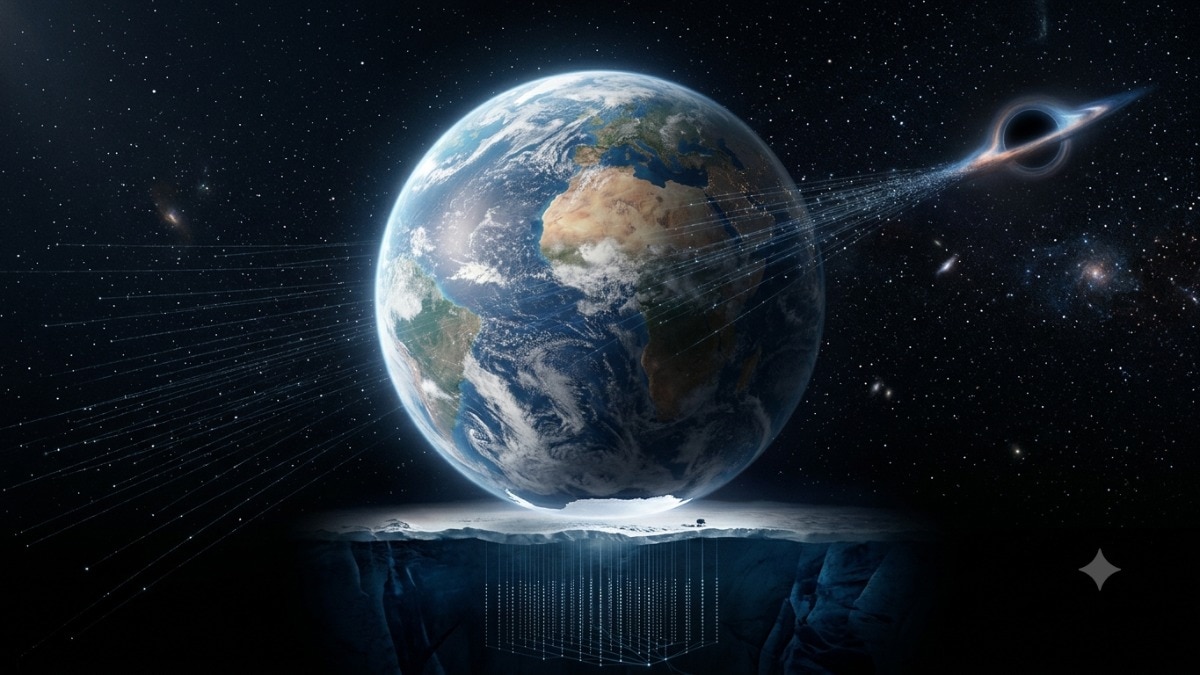
Neutrinos are tiny, nearly massless particles that pass through matter almost undetected. Nicknamed "ghost particles", they are at the heart of Francis Halzen's 2026 Physics Nobel-winning work with IceCube. Here is what neutrinos are, why they are so difficult to detect and how they help scientists explore the universe.Neutrinos are tiny, nearly massless particles that pass through matter almost undetected. Nicknamed “ghost particles”, they are at the heart of Francis Halzen’s 2026 Physics Nobel-winning work with IceCube. (AI-generated image)New Delhi,Oct 7, 2026 15:15 ISTThe universe is full of particles that we cannot see, and some of them are passing through your body right now.They are called neutrinos, and they are so difficult to detect that physicists have nicknamed them “ghost particles”. The elusive particles are at the centre of the 2026 Nobel Prize in Physics, awarded to Belgian-American physicist Francis Halzen for his decisive contributions to the IceCube Neutrino Observatory and the discovery of high-energy neutrinos from cosmic sources.But what exactly makes a neutrino so ghost-like?WHAT ARE NEUTRINOS?Neutrinos are extremely tiny subatomic particles. They have no electric charge and an incredibly small mass. They are produced in huge numbers during nuclear reactions, including those taking place inside stars such as our Sun. They can also emerge from violent cosmic events involving supernovae, black holes and other extreme environments.The strange part is that neutrinos barely interact with ordinary matter. That means a neutrino can travel through enormous amounts of material without being stopped. Trillions of neutrinos can pass through Earth every second, while most leave no detectable trace.That is why “ghost particles” is such a fitting nickname.WHY ARE THEY SO HARD TO CATCH?Imagine trying to detect something that can pass through an entire planet without hitting anything.That is essentially the problem scientists face.Very occasionally, a neutrino does collide with an atomic nucleus. When that happens, the collision can produce a charged particle that travels through the surrounding material and creates a tiny flash of blue light.This is where IceCube comes in.The observatory uses thousands of light sensors called Digital Optical Modules, or DOMs, buried deep inside the Antarctic ice. These sensors are designed to detect the faint flashes of light produced when a neutrino interaction occurs. Artistic rendering of the IceCube Lab at the South Pole, based on a real image. Neutrinos from a distant cosmic source travel towards Earth and are detected by IceCube’s sensors, known as Digital Optical Modules (DOMs), buried beneath the Antarctic ice. (Photo: IceCube/NSF) Think of the ice as a giant detector. The neutrino itself cannot be seen. Scientists instead look for the tiny burst of light it can create when it finally interacts with matter.Halzen's idea was to use the enormous, exceptionally clear ice beneath the South Pole for this purpose. IceCube now instruments roughly one cubic kilometre of Antarctic ice, turning a huge chunk of the continent into a neutrino detector.SO WHY DO SCIENTISTS CARE ABOUT NEUTRINOS?Neutrinos are not just interesting because they are difficult to detect. They can tell scientists things that ordinary light cannot.Some of the most violent events in the universe, including exploding stars and material falling into supermassive black holes, produce enormous numbers of neutrinos.These particles can then travel across space with very little interference.Light from a distant cosmic object can be absorbed, scattered or blocked by gas and dust before reaching us. Neutrinos can pass through much of that material almost untouched. That means they can carry information from places that may be difficult to study using light alone.This gives scientists a new way of investigating the universe.For example, detecting a high-energy neutrino can help researchers identify where an extreme cosmic event happened and what kind of process produced it. Combined with observations of light, gravitational waves and other signals, neutrinos can provide another piece of the cosmic puzzle. Artistic rendering of the IceCube Neutrino Observatory showing a neutrino interacting with an ice molecule and the resulting light detected by IceCube sensors. Each coloured circle represents detected light, while the colour sequence indicates the timing of the signals. (Photo: IceCube Collaboration/NSF) And there is another reason they matter. Neutrinos are produced in enormous numbers inside the Sun and during nuclear reactions, so studying them also helps physicists understand how stars work and how fundamental particles behave.So the goal is not to somehow “use” neutrinos like electricity or radiation in everyday technology. Their value is as messengers and probes. By catching the tiny number that interact with detectors, scientists can learn about both the universe's most extreme environments and the fundamental laws of physics.WHAT DID THE NOBEL-WINNING WORK REVEAL?IceCube began operations in 2011 and detected extremely high-energy neutrinos coming from beyond our solar system.In 2018, researchers traced a high-energy neutrino to a distant active galaxy powered by a supermassive black hole. In 2023, IceCube produced the first neutrino-based image of the Milky Way.This is why the “ghost particles” are so valuable. They are not merely particles passing through us. They are messengers carrying clues from places we may otherwise struggle to see.The 2026 Nobel recognised the technology and scientific work that made it possible to detect these elusive cosmic messengers.So these “ghost particles” are becoming something else too: messengers from some of the most violent places in the universe.The 2026 Nobel recognised the technology and scientific vision that finally gave scientists a way to listen to them.- Ends
What are neutrinos, the 'ghost particles' behind the 2026 Physics Nobel?
Full Article
Original Source
Read the full article at Indiatoday →KhanList aggregates and links to publicly available news content. We do not host full articles from third-party sources. Always verify important information with original sources.